Home
Class 11
PHYSICS
If the coefficient of friction between A...

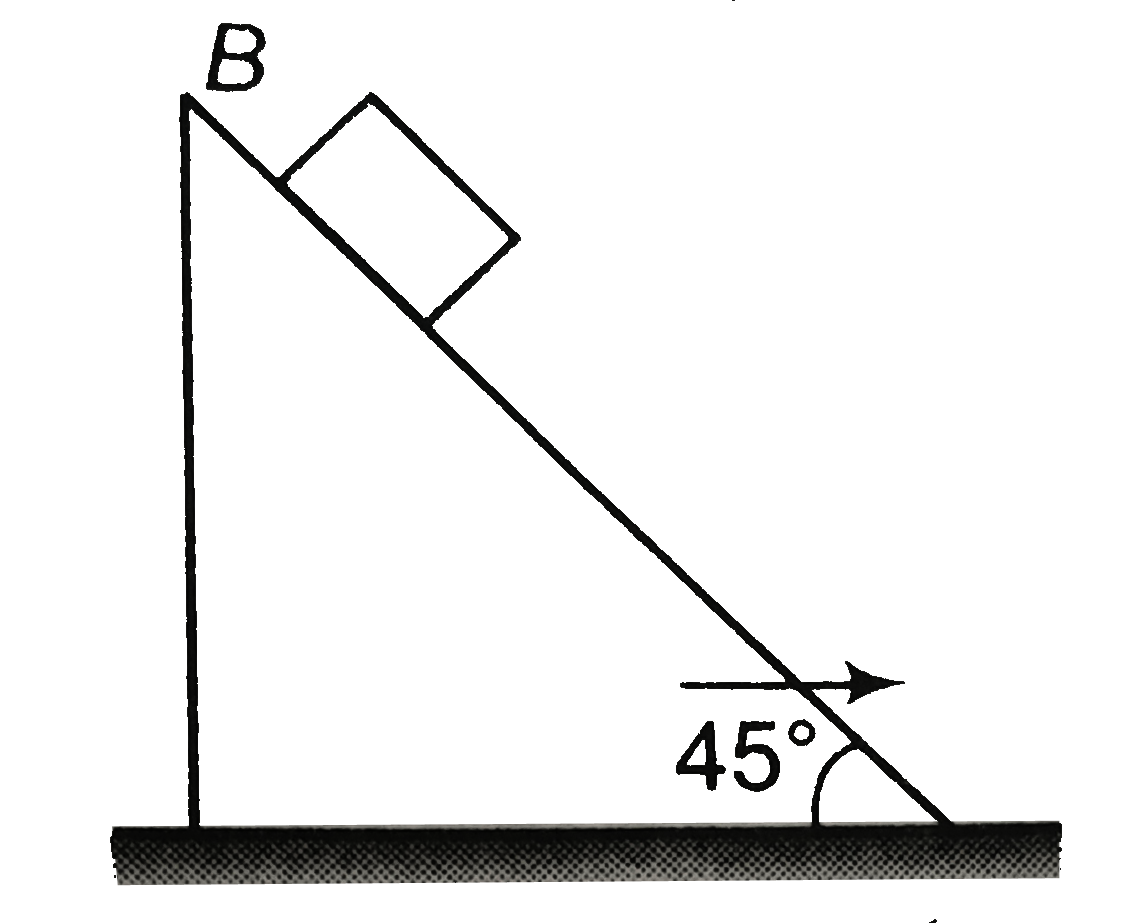
If the coefficient of friction between `A` and `B` is `mu`, the maximum acceleration of the wedge `A` for which `B` will remain at rest with respect to the wedge is

A

`mug`

B

`g((1+mu)/(1-mu))`

C

`(g)/(mu)`

D

`g((1-mu)/(1+mu))`

Text Solution

Verified by Experts

The correct Answer is:
B

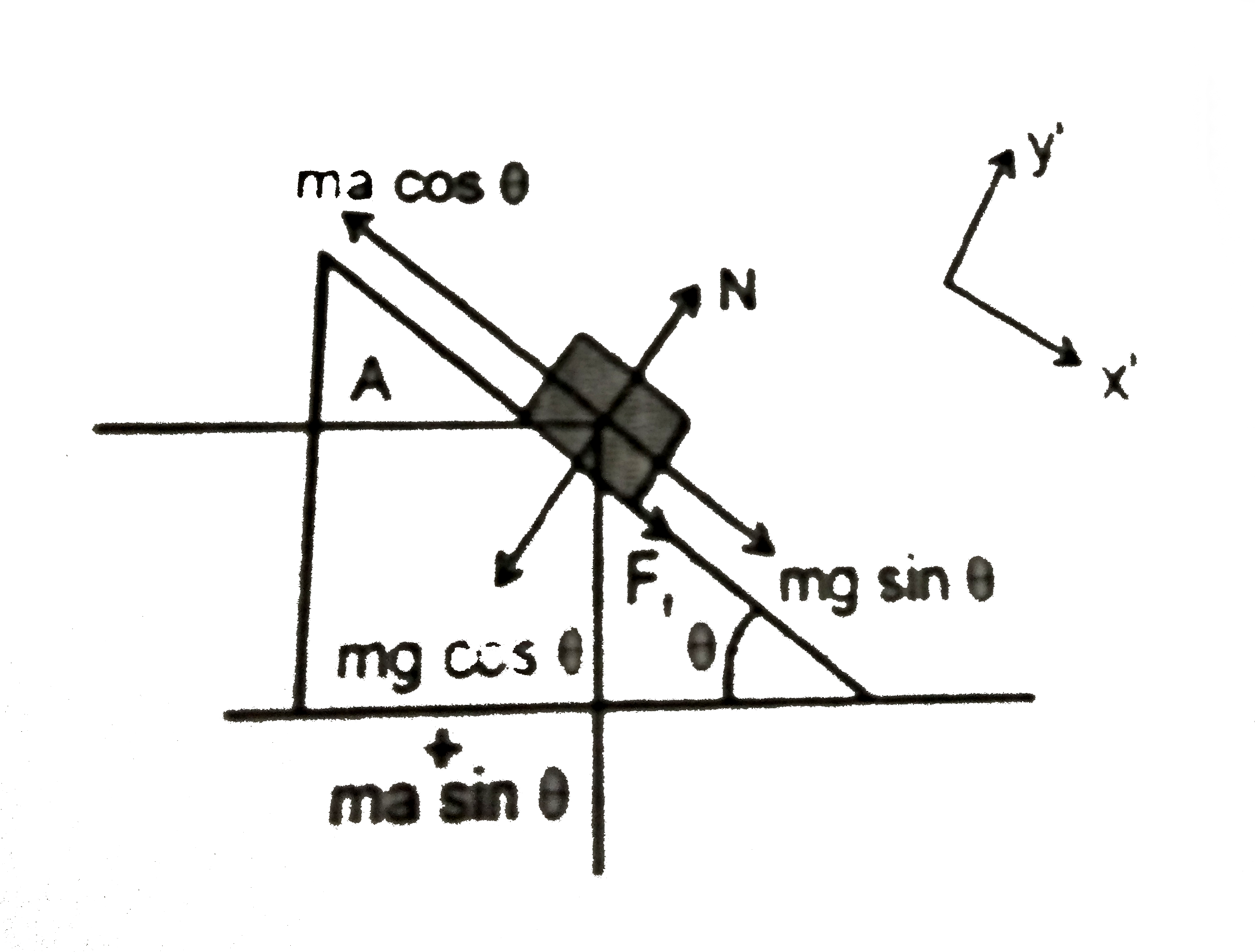
FBD of block `B w.r.t.` wedge `A`,for maximum `'a':`
Perpendicular to wedge `:`
`Sigmaf_(y)=(mg cos theta+ma sin theta-N)=0`
and `Sigmaf_(x)=mgsintheta+muN-macos theta=0(` for maximum `a)`

`rArr mgsin theta+mu(mg cos theta +ma sin theta)-ma cos theta =0`
`rArr a=((g sin theta+mu g cos theta))/(cos theta-musintheta)`
for `theta=45^(@)`
`a=g((tan 45^(@)+mu)/(cot 45^(@)-mu)),a=g((1+mu)/(1-mu))Ans.`
Promotional Banner

Topper's Solved these Questions

  • DAILY PRACTICE PROBLEMS

    RESONANCE|Exercise dpp 30|4 Videos
  • DAILY PRACTICE PROBLEMS

    RESONANCE|Exercise Comprehension|127 Videos
  • DAILY PRACTICE PROBLEMS

    RESONANCE|Exercise dpp 28|7 Videos
  • CURRENT ELECTRICITY

    RESONANCE|Exercise Exercise|54 Videos
  • ELASTICITY AND VISCOCITY

    RESONANCE|Exercise Advanced Level Problems|9 Videos

Similar Questions

Explore conceptually related problems

The minimum value of acceleration of wedge for which the block start sliding on the wedge, is:

If the coefficient of friction between the wedge A and block B shown in the figure is mu , then the maximum possible horizontal acceleration of A for which B doesn’t slip is [ angle of inclination of wedge = 45^@ ]

A wedge B of mass 2 m is placed on a rough horizontal suface. The coefficient of friction between wedge and the horizontal surface is mu_(1) . A block of mass m is placed on wedge as shown in the figure. The coefficient of friction between block and wedge is mu_(2) . The block and wedge are released from rest. Q. Suppose the inclined surface of the wedge is at theta=37^(@) from angle from horizontal and mu_(2)=0 are wedge will remain in equilibrium if

Figure shows an irregular wedge of mass m placed on a smooth horizontal surface. Part BC is rough. If the coefficient of friction between the block and wedge is mu , and the block comes to rest with respect to wedge at a point E on the rough surface then BE will be

Wedge is fixed on horizontal surface. Block A is pulled upward by applying a force F as shown in figure and there is no friction between the wedge and the block A while coefficient of friction between A and B is mu . If there is no relative motion between the block A and B then frictional force developed between A and B is

A block of mass 2 kg is kept on a smooth wedge of mass 3 kg and wedge is kept on a rough horizontal surface. A vertical force of 60 N is applied on the minimum coefficient of friction between the wedge and horizontal surface, so that wedge remains at rest during the motion of block on the wedge ?

