Home
Class 11
PHYSICS
In the figure shown, a person pulls a li...

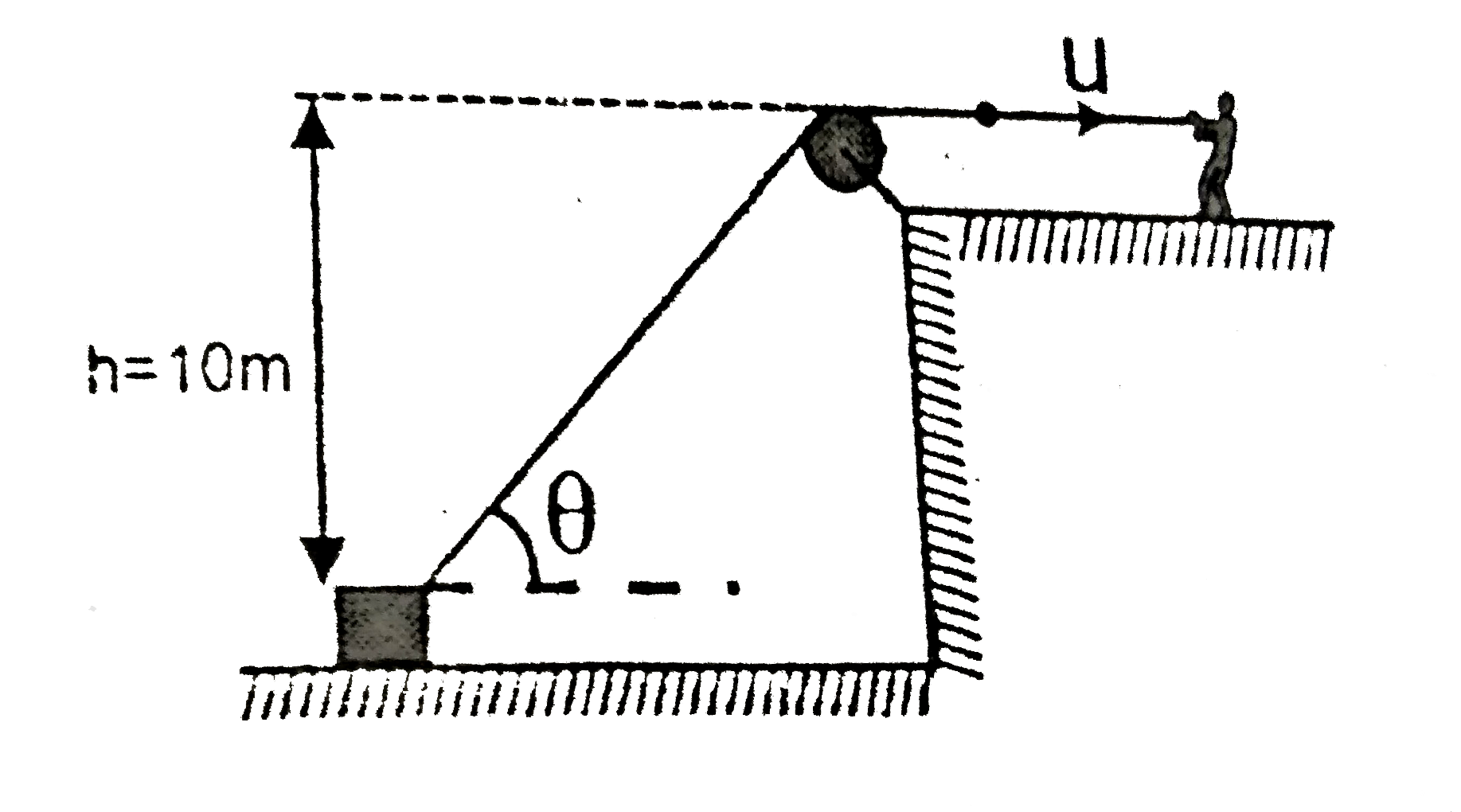
In the figure shown, a person pulls a light string with a constant speed `u=10m//s`. The other end of the string is tied to a very small block which moves on a smooth horizontal surface. Find the angle `'theta'`when the block 3 leaves the surface . Take `g=10m//s^(2).`

Text Solution

Verified by Experts

The correct Answer is:
`theta=(pi)/(4)`

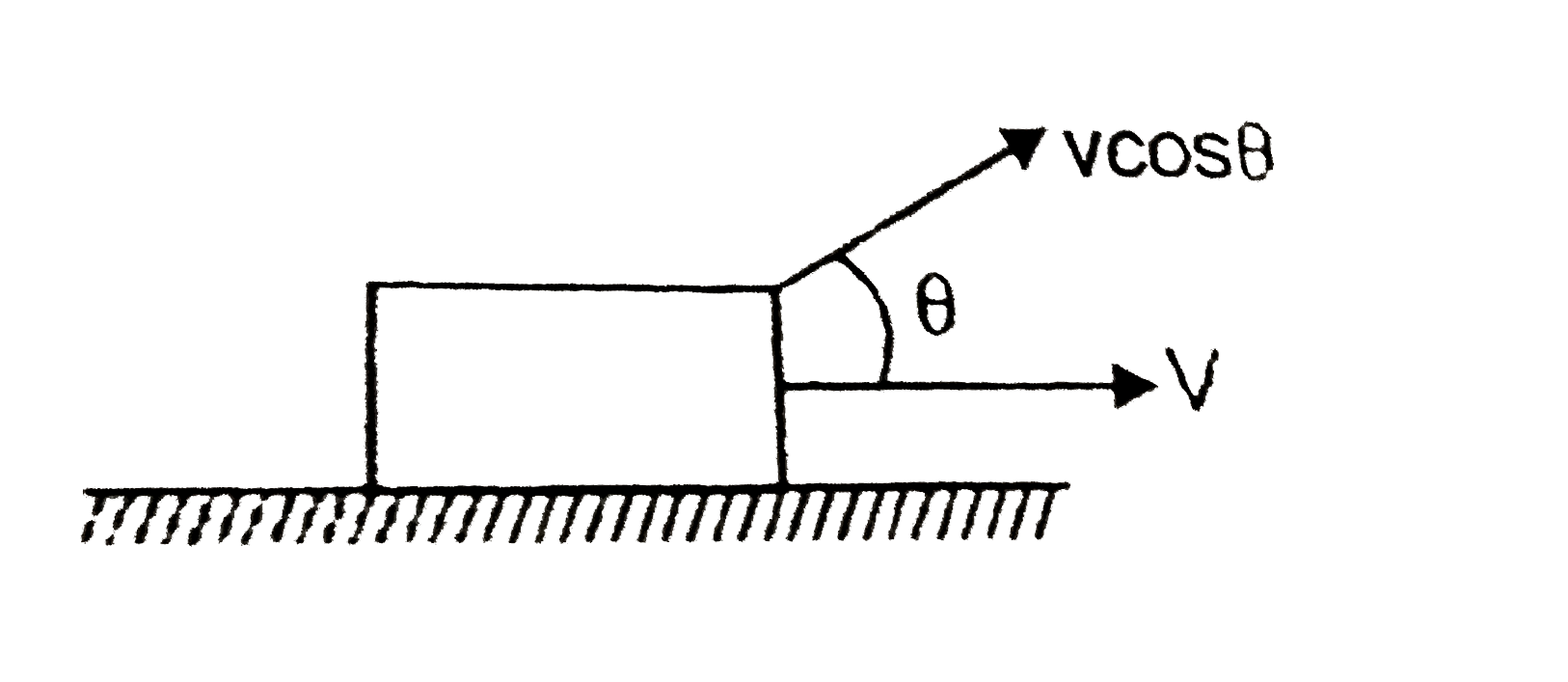
By constraint velocity component of block along the string should be `u`.
`rArrv cos theta u or v=u sec theta ….(1)`

from `(1)a=(dv)/(dt)=u sec theta tan theta (d theta)/(dt) ….(2)`

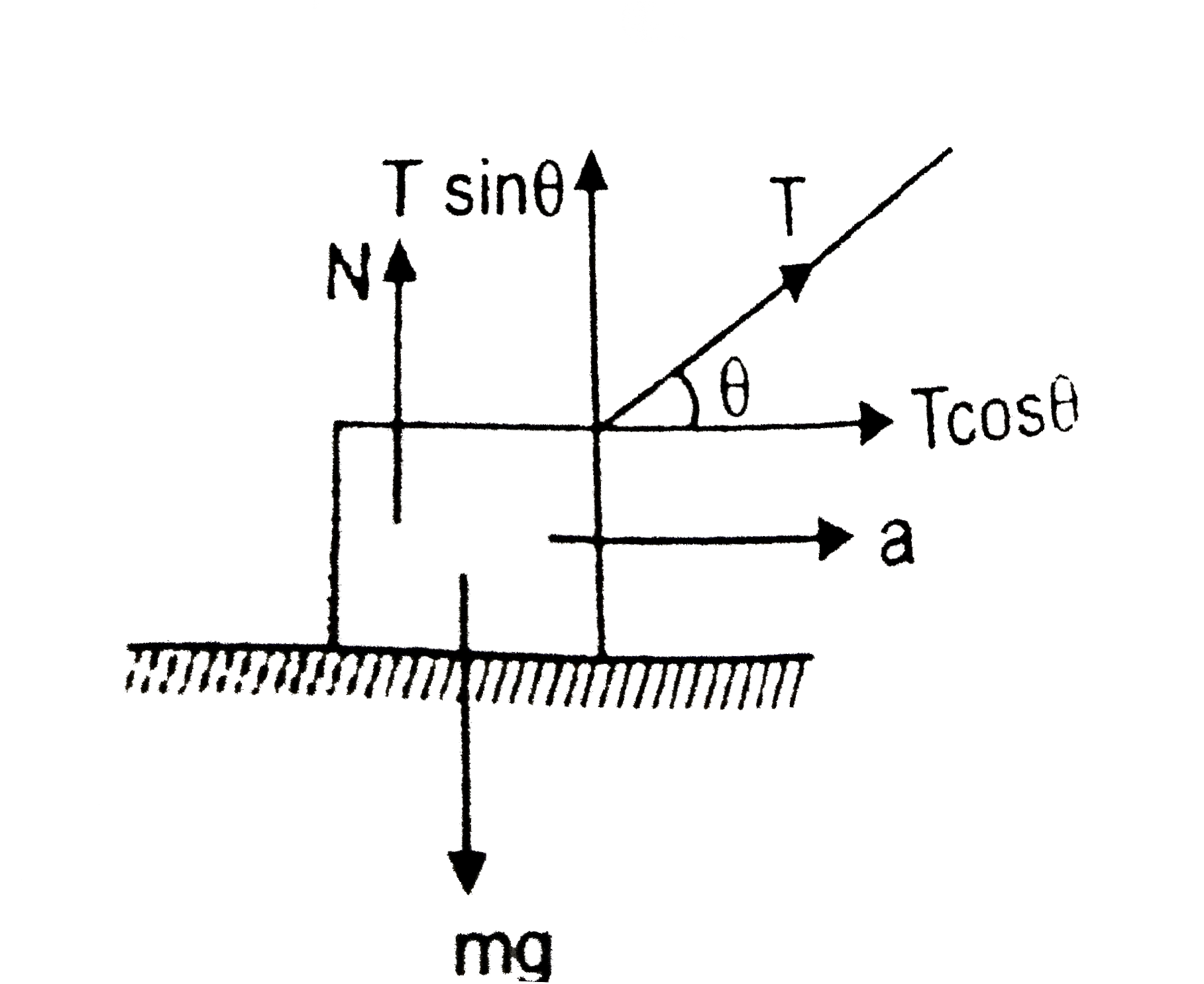
Initially when block is at a large distance `theta ` is a small component of `T` in vertical direction is very small. As block comes nearer and nearer. `T sin theta` increases and `N` decreases.
When `T sin theta =mg` then block just loses contact with the ground .
so `T sin theta = mg ...............(3)`
`T cos theta =ma ...................(4)`
`(3) & (4) rArr`
`a tan theta =g ..........(5)`

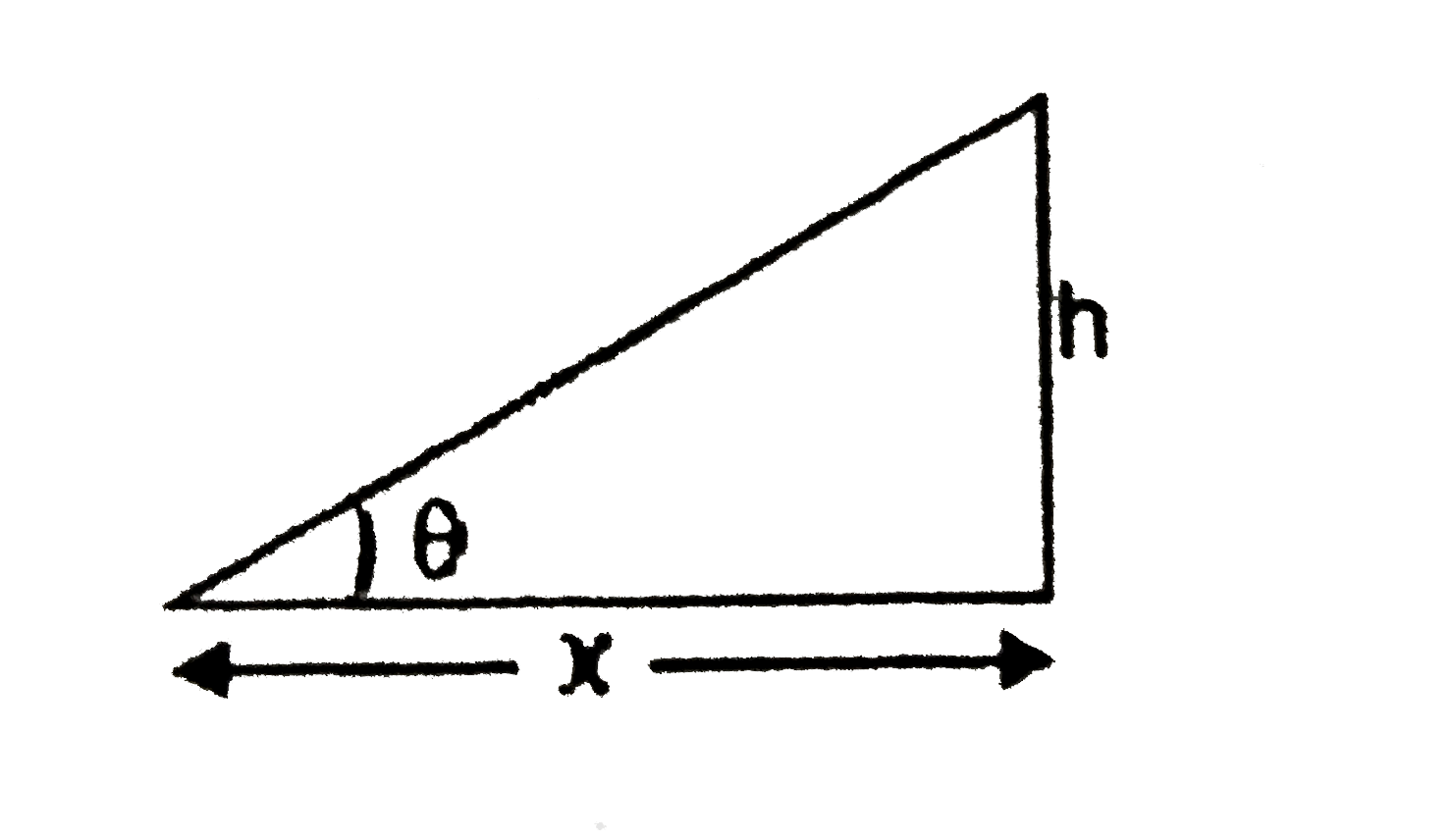
also, `x=h cot theta`
`(dx)/(dt)=-h c o s ec^(2) theta (d theta)/(dt)["as x is decreasing" (dx)/(dt)=-v]`
or `(use theta)/(h cosec^(2)theta)=( d theta)/(dt)...` using (1) .......(6)
usint `(2),(5)` and `(6)` we get
`u sec theta tan theta ((u sec theta)/(h cosec^(2)theta))tan theta =g`
putting values of `u,h & g` we get.
`tan^(4)tehta=1rArrtheta=(pi)/(4)`
Ans. `theta=(pi)/(4)`
Promotional Banner

Topper's Solved these Questions

  • DAILY PRACTICE PROBLEMS

    RESONANCE|Exercise dpp 30|4 Videos
  • DAILY PRACTICE PROBLEMS

    RESONANCE|Exercise Comprehension|127 Videos
  • DAILY PRACTICE PROBLEMS

    RESONANCE|Exercise dpp 28|7 Videos
  • CURRENT ELECTRICITY

    RESONANCE|Exercise Exercise|54 Videos
  • ELASTICITY AND VISCOCITY

    RESONANCE|Exercise Advanced Level Problems|9 Videos

Similar Questions

Explore conceptually related problems

A block of mass 1kg is tied to a string of length 1m the other end of which is fixed The block is moved on a smooth horizontal table with constant speed 10ms^(-1) . Find the tension in the string

Find the tension in the horizontal string PQ and the string QR in the given figure. [Take g=10m//s^(2) ]

In the figure shown, the blocks A and B are connected with an inextensible string. If the block B is pulled with a velocity of 5 m/s then it is observed that block A moves with 10 m/s. Find the angle theta in (degree) shown in the diagram:

Four blocks each of mass M connected by a massless strings are pulled by a force F on a smooth horizontal surface, as shown in figure.

A ball of mass 0.01 kg is suspended from a fixed point O by means of a light and inextensible string of length 10m. The ball is first taken aside such that string becomes horizontal and then released from reast. At the lowermost point of its path, it hits a stationary small block of mass 1.205kg lying on a rough horizontal surface. After striking the block, the ball rebounds and comes to rest when the string makes an angle of 30^@) with the horizontal . Due to the impact the block moves through a distance of 0.5m on the horizontal surface. Find the coefficient of friction between the block and the surface.

In the figure shown, all surfaces are smooth and force constant of spring is 10N//m . Block of mass (2 kg) is attaced with the spring. The spring is compressed by (2m) and then released. Find the maximum distance d travelled by the block over the inclined plane. Take g=10m//s^(2) . .

In the arrangement shown in the fig, end A of the string is being pulled with a constant horizontal velocity of 6 m//s . The block is free to slide on the horizontal surface and all string segments are horizontal. Find the velocity of point P on the thread.

A block of mass 10 kg is hanging over a smooth and light pulley through a light string and the other end of the string is pulled down by a constant force F. The kinetic energy of the block increases by 20 J in 1 s

A block of mass M is placed on a rough horizontal surface. It is connected by means of a light inextensible string passing over a smooth pulley . The other end of string passing over a smooth pulley. The other end of string is connected to a block of mass m. There is no friction between vertical surface and block m If the whole system ( horizontal surface + blocks ) accelerates towards right the value of maximum on the horizontal surface is