Home
Class 11
PHYSICS
A 1 kg block is being pushed against a w...

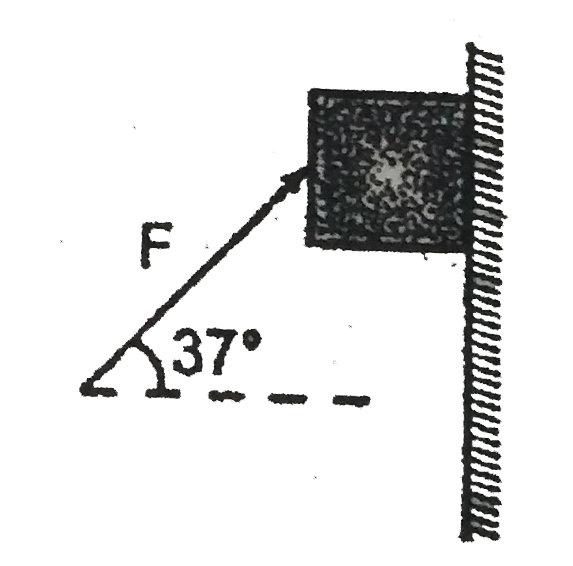
A 1 kg block is being pushed against a wall by a force F=75N as shown in the figure. The coefficient of friction is 0.25. The magnitude of acceleration of the block is:

A

`10m//s^(2)`

B

`20m//s^(2)`

C

`5m//s^(2)`

D

none

Text Solution

Verified by Experts

The correct Answer is:
B


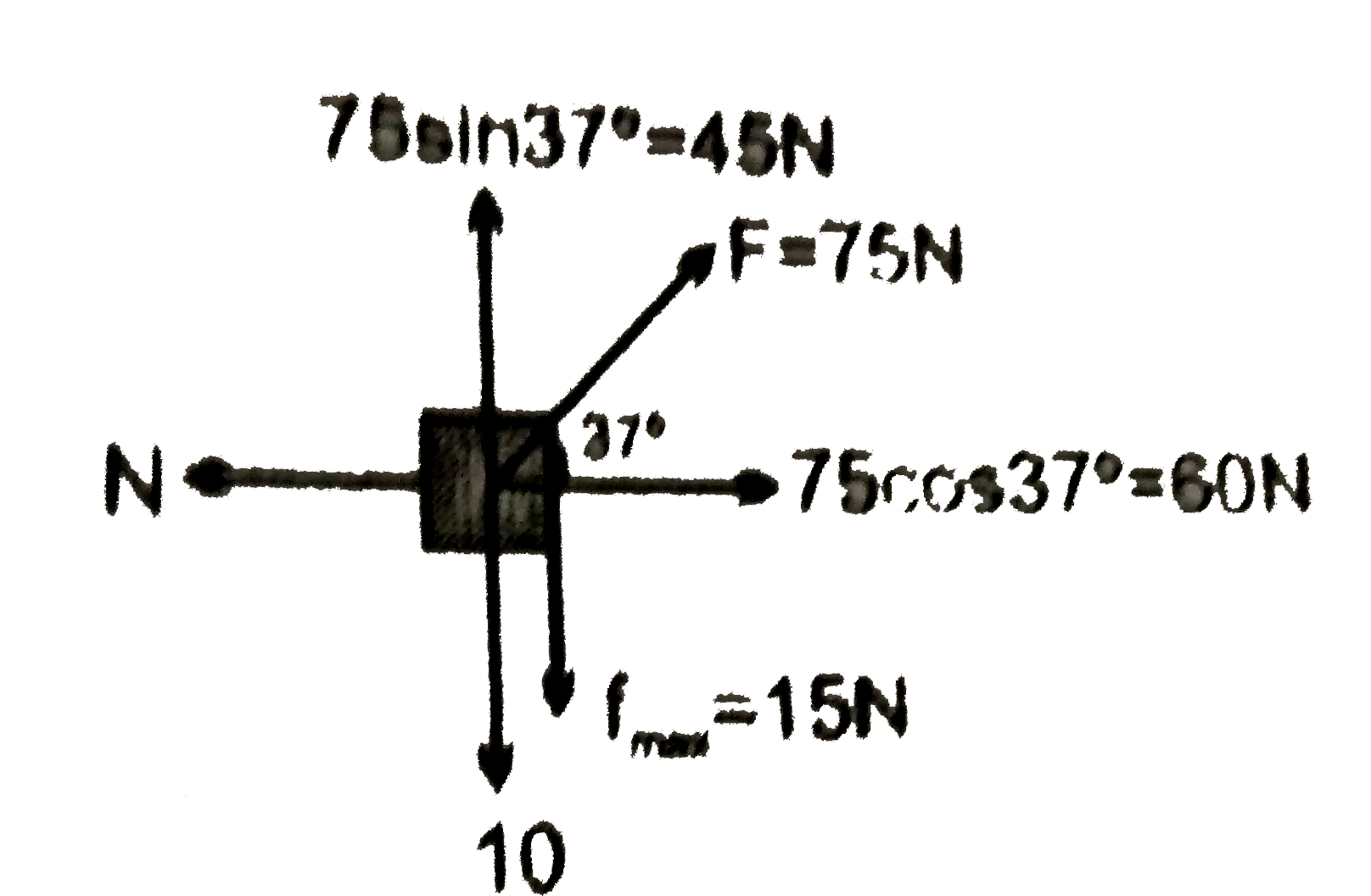
As the upward force `(45N)` is greater than total downward force `(25N)` hence, it has an upward acceleration.
`SigmaF_(x)=0 rArrN=60N`
`SigmaF_(y)=ma_(y)`
`rArr 45-25=(1)a`
`a=20m//s^(2)`
Promotional Banner

Topper's Solved these Questions

  • DAILY PRACTICE PROBLEMS

    RESONANCE|Exercise Comprehension|127 Videos
  • DAILY PRACTICE PROBLEMS

    RESONANCE|Exercise dpp 31|7 Videos
  • DAILY PRACTICE PROBLEMS

    RESONANCE|Exercise dpp29|5 Videos
  • CURRENT ELECTRICITY

    RESONANCE|Exercise Exercise|54 Videos
  • ELASTICITY AND VISCOCITY

    RESONANCE|Exercise Advanced Level Problems|9 Videos

Similar Questions

Explore conceptually related problems

A block of weight 5 N is pushed against a vertical wall by a force 12 N . The coefficient of friction between the wall and block is 0.6 . Find the magnitude of the force exerted by the wall on the block :

A block of weight 5N is pushed against a vertical wall by a force 12 N. The coefficient of friction between the wall and block is 0.6. The magnitude of the force exerted by the wall on the block is

Given in figure are two blocks A and B of weight 20N and 100N, respectively. These are being pressed against a wall by a force F as shown. If the coefficient of friction between the blocks is 0.1 and between block B and the wall is 0.15, the frictional force applied by the wall on block B is:

A block of mass 4 kg is pressed againest the wall by a force of 80N as shown in figure Determine the value of the friction force and block's acceleration (Take mu_(s) = 0.2 , mu_(s) = 0.15)

A block of mass 5 kg is (i) pushed in case (A) and (ii) pulled in case (B), by a force F = 20 N, making an angle of 30^(@) with the horizontal, as shown in the figures. The coefficient of friction between the block and floor is mu=0.2 . The difference between the accelerations of the block, in case (B) and case (A) will be: (g=10ms^(-2))

A block of mass m slides along a floor while a force of magnitude F is applied to it at an angle theta as shown in figure. The coefficient of kinetic friction is mur . Then, the block's acceleration 'a' is given by: (g is acceleration due to gravity)

A force of 100N is applied on a block of mass 3 kg as shown in the figure-2.164. The coefficient of friction between the surface and the block is 0.25.The frictional force acting on the block is: (Take g=10m/s^(2) )

A 2 kg block is present against a rough wall by a force F = 20 N as shown in figure .Find acceleration of the block and force of friction acting on it . (Take g = 10 m//s^(2))

A block of mass m kg is pushed up against a wall by a force P that makes an angle ' theta ' with the horizontal as shown in figure . The coefficient of static friction between the block and the wall is mu . Find the minimum value of P that allows the block to remain stationary .

A block of mass 0.1 kg is held against a wall by applying a horizontal force of 5 N on the block. If the coefficient of friction between the block and the wall is 0.5, then the magnitude of the frictional force acting on the block is

