Home
Class 11
PHYSICS
An arrangement of the masses and pulleys...

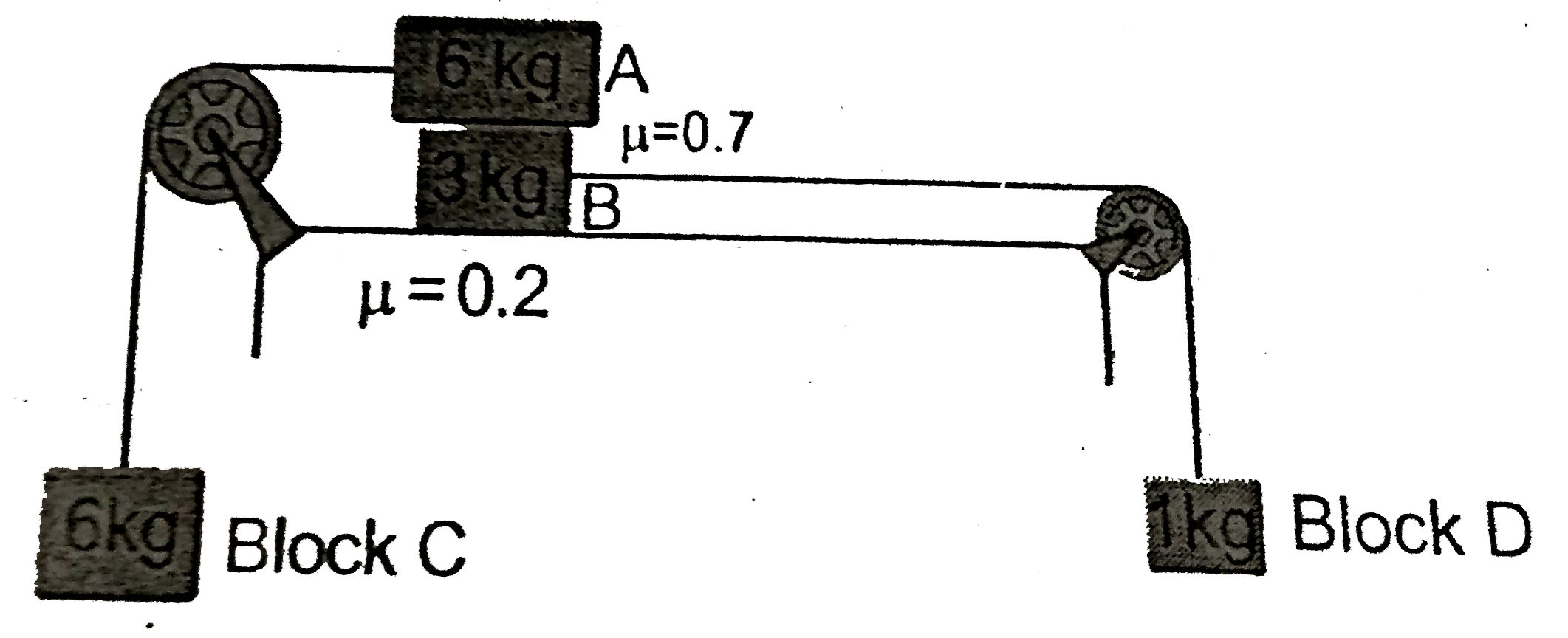
An arrangement of the masses and pulleys is shown in the figure. Strings connecting masses `A` and `B` with pulley are horizontal and all pulleys and strings are light. Friction coefficient between the surface and the block `B` is `0.2` and between block `A` and `B` is `0.7`. The system is released from rest. (use `g=10m//s^(2))`

A

The magnitude of acceleration of the system is `2m//s^(2)` and there is no slipping between block `A` and block `B`.

B

The magnitude of friction force between block `A` and block` B` is `42N`

C

Acceleration of block `C` is `1m//s^(2)` downwards.

D

Tension in the string connecting block `B` and block `D` is `12N`.

Text Solution

Verified by Experts

The correct Answer is:

A, D

Suppose block `A` and `B` move together. Applying `NLM` on `C,A+B,` and `D`
`60-18-T'=9a`
`T'-10=1a`
Solving `a=2m//s^(2)`
To check slipping between `A` and `B` , we have to find friction force in this case. If it is less than limiting static friction, then there will be no slipping between `A` and `B`. ltbr. Applying `NLM` on `A`.
`T-g=6(2)`
as `T=48N`
`f=36N`
and `f_(s)=42N` hence `A` and `B` move together.
and `T'=12N`.
Promotional Banner

Topper's Solved these Questions

  • DAILY PRACTICE PROBLEMS

    RESONANCE|Exercise dpp 32|8 Videos
  • DAILY PRACTICE PROBLEMS

    RESONANCE|Exercise dpp 33|8 Videos
  • DAILY PRACTICE PROBLEMS

    RESONANCE|Exercise Comprehension|127 Videos
  • CURRENT ELECTRICITY

    RESONANCE|Exercise Exercise|54 Videos
  • ELASTICITY AND VISCOCITY

    RESONANCE|Exercise Advanced Level Problems|9 Videos

Similar Questions

Explore conceptually related problems

find the acceleration of the block of mass M in the situation shown in figure. All the surfaces are frictionless and the pulleys and the string are light.

In the system shown all the surfaces are frictionless while pulley and string are massless. The mass of block A is 2m and that of block B is m. The acceleration of block B immediately after system is released from rest is

Block A of mass m and block B of mass 2m are placed on a fixed triangular wedge by means of a light and inextensible string and a frictionless pulley as shown in fig . The wedge is inclined at 45^(@) to the horizontal on both sides . The coefficient of friction between the block A and the wedge is 2//3 and that between the block B and the wedge is 1//3 .If the system of A and B is released from rest then find . a. the acceleration of A b. tension in the string c.the magnitude and direction of the frictional force acting on A

In the given figure, Find mass of the block A, if it remains at rest, when the system is released from rest. Pulleys and strings are massless. [g=10m//s^(2)]

In the arrangement shown, the pulleys and the strings are ideal.The acceleration of the block B is

Friction coefficient between any two surface in contact is 0.5 pulleys and string aare frictioness .Find the friction between blocks A and B ( in newton)

In the arrangement shown, the pulleys and strings are massless. The acceleration of block B is :

In the arrangement shown, the pulleys and the string are ideal. The acceleration of block B is.

In the arrangement shown in figure, pulley and string are light. Friction coefficient between the two blocks is mu whereas the incline is smooth. Block A has mass m and difference in mass of the two blocks is deltam . Find minimum value of m for which the system will not accelerate when released from rest.

In the arrangement shown in fig neglect the masses of pulleys and string and also friction Calculate acceleration of blocks A and B
