Home
Class 11
PHYSICS
In the arrangement shown, W(1) = 200N, W...

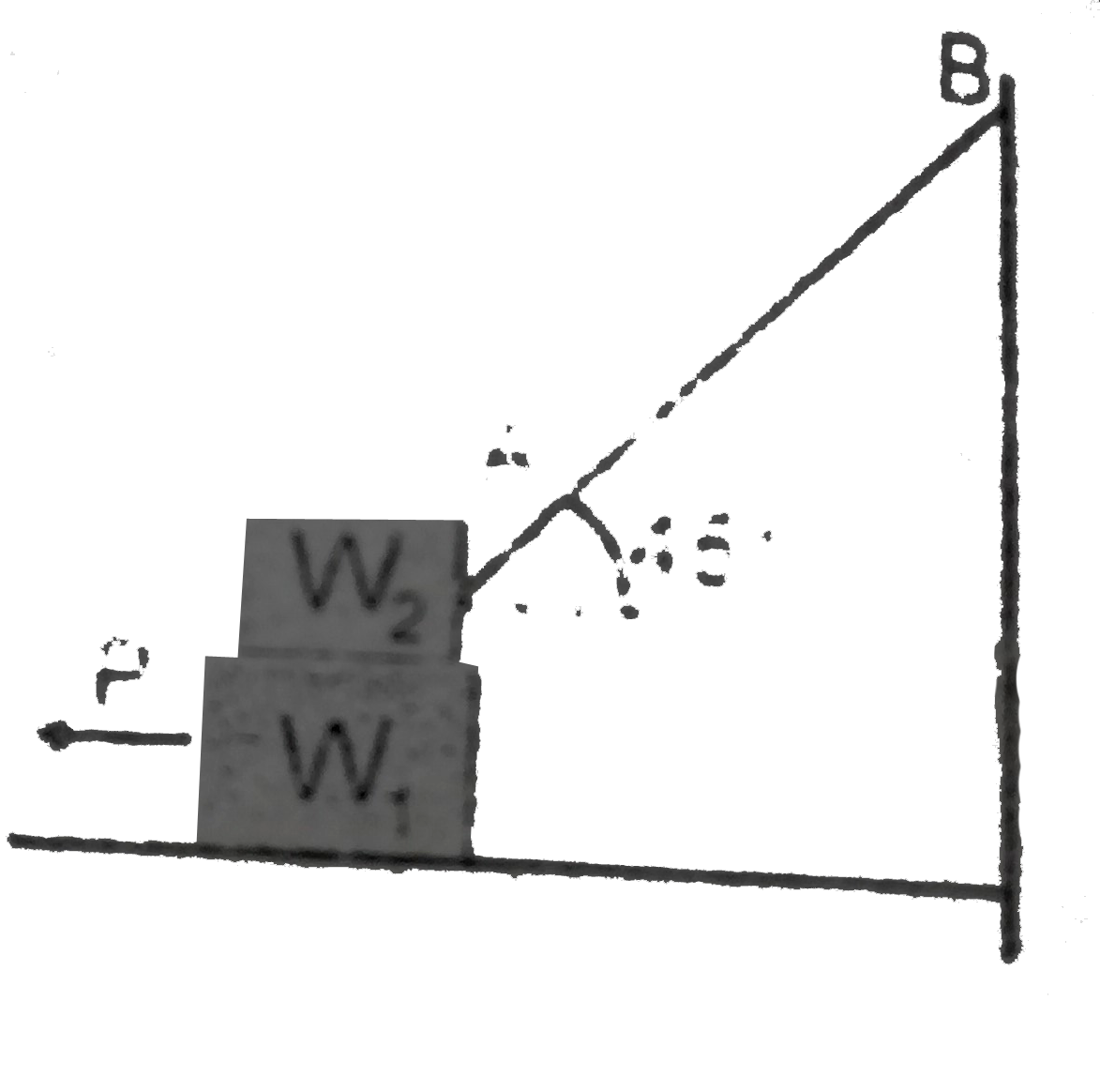
In the arrangement shown, `W_(1) = 200N, W_(2) = 100 N,mu = 0.25` for all surfaces in contact. The block `W_(1)` just slides under the block `W_(2)`

A

A pull of `50N` is to be applied on `W_(1)`

B

A pull of `90N` is to be applied on `W_(1)`

C

Tension in the string `AB` is `10sqrt(2)N`

D

Tension in the string `AB` is `20sqrt(2)N`

Text Solution

Verified by Experts

The correct Answer is:
B, D

`B,D`

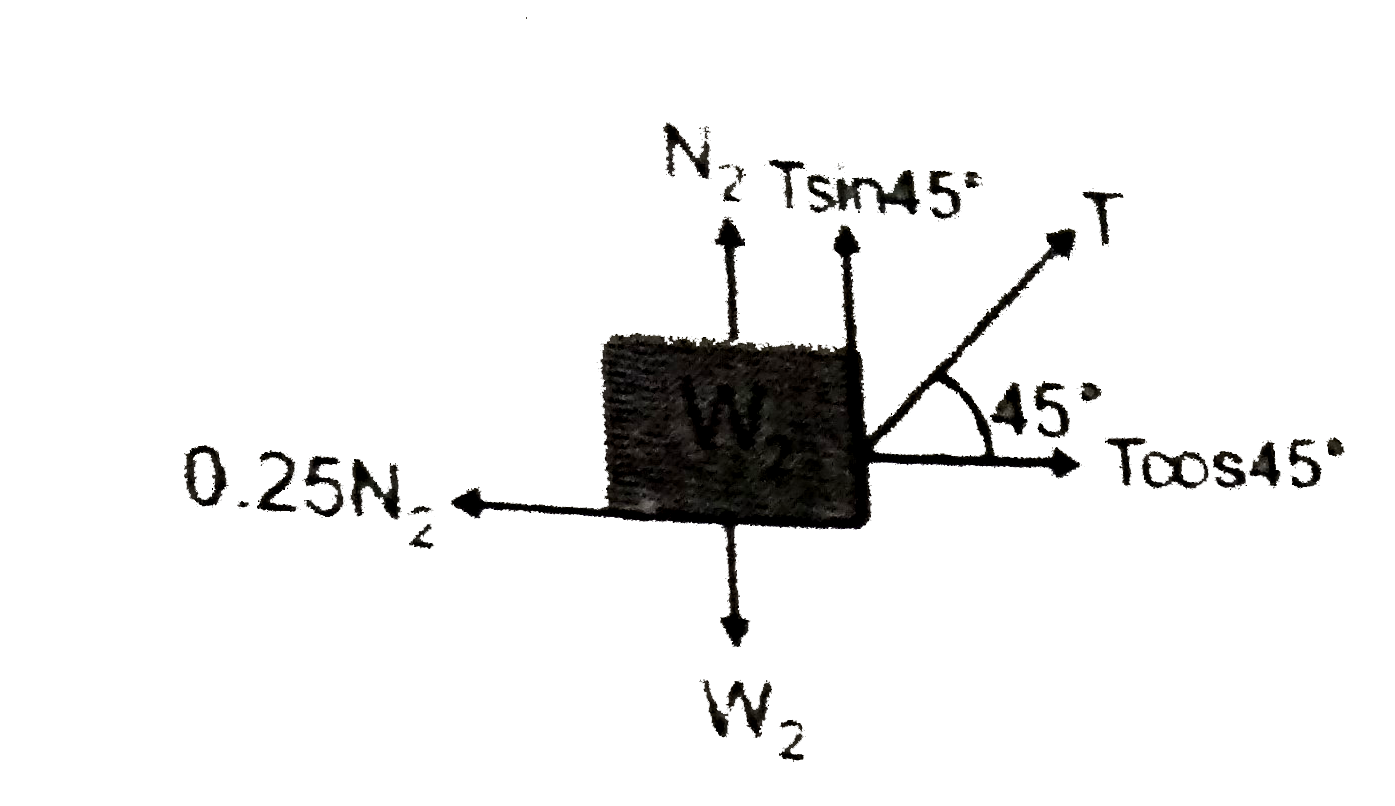
For `W_(2):`
`N_(2)+T sin 45^(@)=W_(2)=100 ….(1)`
`Tcos 45^(@)=0.25N_(2) ….(2)`
`rArr T=20sqrt(2)N,N_(2)=80N`

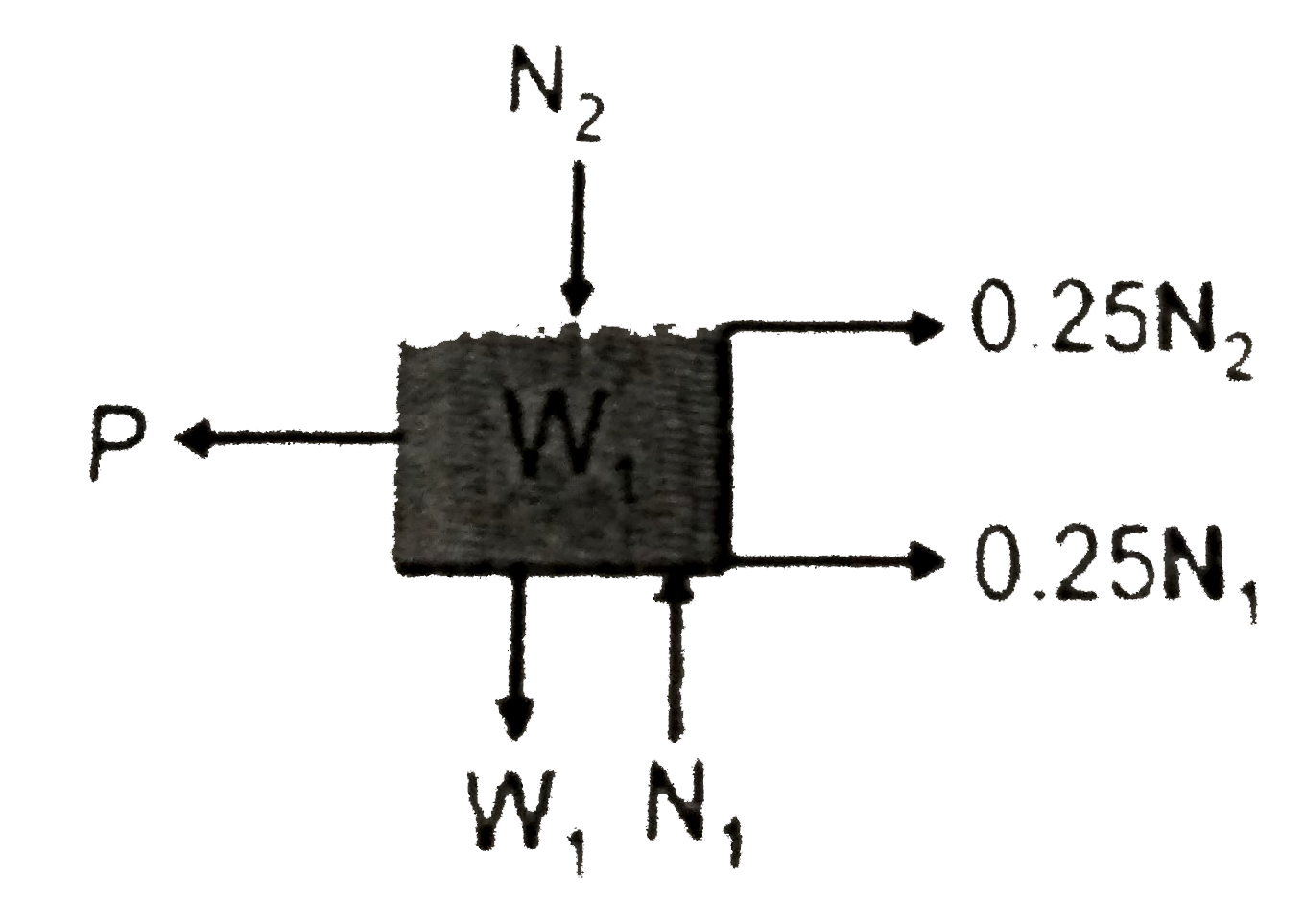
For `W_(1):`
`P=0.25(N_(1)+N_(2)) ...(3)`
`N_(1)+W_(1)=N_(1) ....(4)`
`=N_(1)=280N`
Promotional Banner

Topper's Solved these Questions

  • DAILY PRACTICE PROBLEMS

    RESONANCE|Exercise dpp 34|5 Videos
  • DAILY PRACTICE PROBLEMS

    RESONANCE|Exercise DPP 35|5 Videos
  • DAILY PRACTICE PROBLEMS

    RESONANCE|Exercise dpp 32|8 Videos
  • CURRENT ELECTRICITY

    RESONANCE|Exercise Exercise|54 Videos
  • ELASTICITY AND VISCOCITY

    RESONANCE|Exercise Advanced Level Problems|9 Videos

Similar Questions

Explore conceptually related problems

Calculate the Force (F) required to cause the block of mass m_(1) = 20 kg just to slide under the block of mass m_(2) = 10 kg [ coefficient of friction mu = 0*25 for all surfaces ]

Calculate the force P required to cause the block of weight W_(2)=200N just to slide under the block of weight W_(1)=100N shown in figure-2.43. What is the tension in the string AB and the normal forces acting between the blocks and that applied by ground on W_(2) ? Surfaces of the blocks in contact are rough and the frictional force between the two blocks is 25 N and that between lower block and ground is 75 N Take g = 10 m//s^(2) .

Calculate the force P required to cause the block of weight W_(2)=200N just to slide under the block of weight W_(1)=100N shown in figure-2.83. What is the tension in the string AB ? Coefficient of friction mu = 0.25 for all surfaces in contact. [90 N, 20sqrt(2)N]

Block A of weight 500 N and block B of weight 700 N are connected by rope pulley system as shown. The largest weight C that can be suspended without moving block A and B is W . The coefficient of friction for all plane surfaces of contact is 0.3 . The pulleys are ideal. Find (W)/(90) .

The relative density of a material of a body is found by weighing it first in air and then in water. If the weight of he body in air is W_(1) = 8.00 +- N and the weight in water is W_(2) = 6.00 +- 0.05 N , then the relative density rho_(r ) = W_(1)//( W_(1) - W_(2)) with the maximum permissible eror is

Two weights W_(1) and W_(2) in equilibrium and at rest, are suspended as shown in figure. Then the ratio (W_(1))/(W_(2)) is :

In the system shown, the blocks A,B and C are of weight 4W, W and W respectively. The system set free. The tension in the string connecting the blocks B and C is

Let the minimum external work done in shifted a particle form centre of earth to earth's surface be W_(1) and that form surface of earth to infinity be W_(2) . Then (W_(1))/(W_(2)) is equl to

In a given figure system is in equlibrium, If W_(1) = 300 N. Then W_(2) is approximately equal to

A man is standing on a weighing machine with a block in his hand. The machine records w. When he takes the block upwards with some acceleration the machine records w_(1). When he takes the block down with some acceleration, the machine records w_(2). Then choose correct option