Home
Class 11
PHYSICS
A small block of mass m is released from...

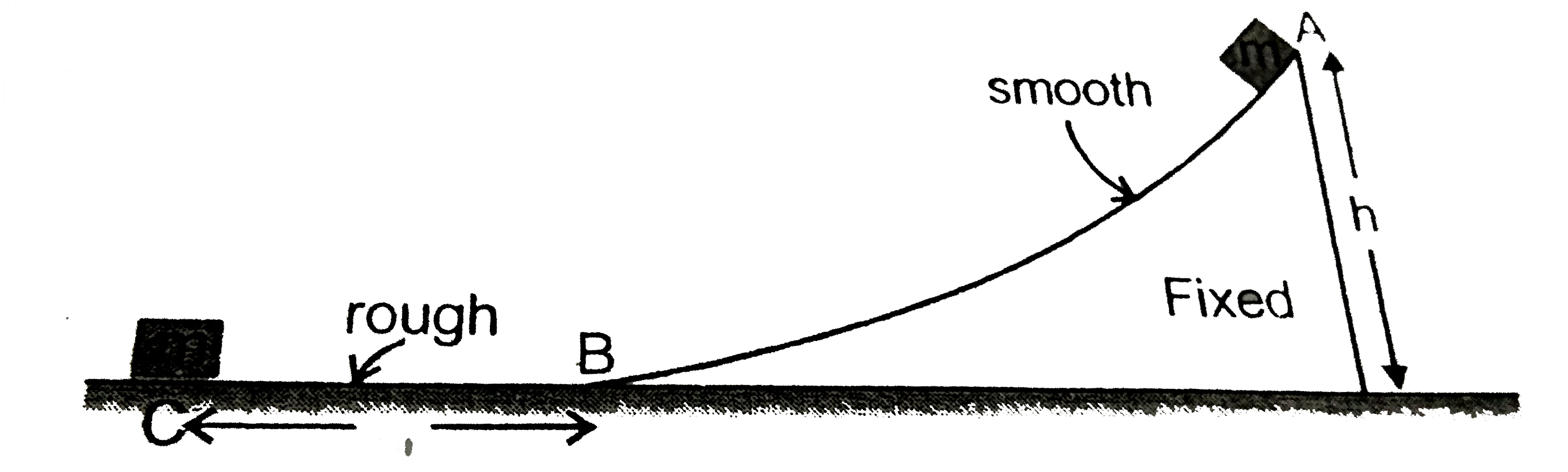
A small block of mass `m` is released from a fixed smooth wedge in figure. Initial point is marked as `A`. Bottom of wedge is marked as `B` and at a point `C` the block stops because the straight part of floor is rough.

The friction coefficient of the block with the floor is `:`

A

`(h)/(x_(0)`

B

`(x_(0))/(h)`

C

zero

D

1

Text Solution

Verified by Experts

The correct Answer is:

A

Totol work doen by gravity`=` work done against friction ltbr. `mgh=mu mg. x_(0)`
`=mu=(h)/(x_(0))`
Promotional Banner

Similar Questions

Explore conceptually related problems

A small block of mass m is released from a fixed smooth wedge in figure. Initial point is marked as A . Bottom of wedge is marked as B and at a point C the block stops because the straight part of floor is rough. The velocity of the block at the midpoint between B to C will be :

A small block of mass m is released from a fixed smooth wedge in figure. Initial point is marked as A . Bottom of wedge is marked as B and at a point C the block stops because the straight part of floor is rough. Work donw by normal reaction is zero during the motion of the block

A ball of mass m is released from A inside a smooth wedge of mass m as shown in figure. What is the speed of the wedge when the ball reaches point B?

A block of mass m is at rest over the rough surface of the fixed wedge.

A block of mass m is released from a wedge of mass m as shown in figure . Find the time taken by the block to reach the end of the wedge.

A block of mass m is released from the top of a wedge of mass M as shown in figure. Find the displacement of wedges on the horizontal ground when the block reaches the bottom of the wedges. Neglect friction everywhere.

A block of mass m is placed at rest on a smooth wedge of mass M placed at rest on a smooth horizontal surface. As the system is released

A block of mass 1 kg is placed on a wedge shown in figure. Find out minimum coefficient of friction between wedge and block to stop the block on it.

For the figure shown, block of mass m is released from the rest. Find the distance of the wedge from initial position, when block m arrives at the bottom of the wedge. All surfaces are frictionless.
