

Home
Class 11
PHYSICS
A ball is projected on a very long floor...

A ball is projected on a very long floor. There may be two conditions `(i)` floor is smooth `& (ii)` the collision is elastic
If both the considered then the path of ball is as follows.

Now if collision is inelastic and surface is rough then the path is as follows.

Successive range is decreasing .
Roughness of surface decreases the horizontal component of ball during collision and inelastic nature of collision decreases the vertical component of velocity of ball. In first case both components remain unchanged in magnitude and in second case both the components of the velocity will change.
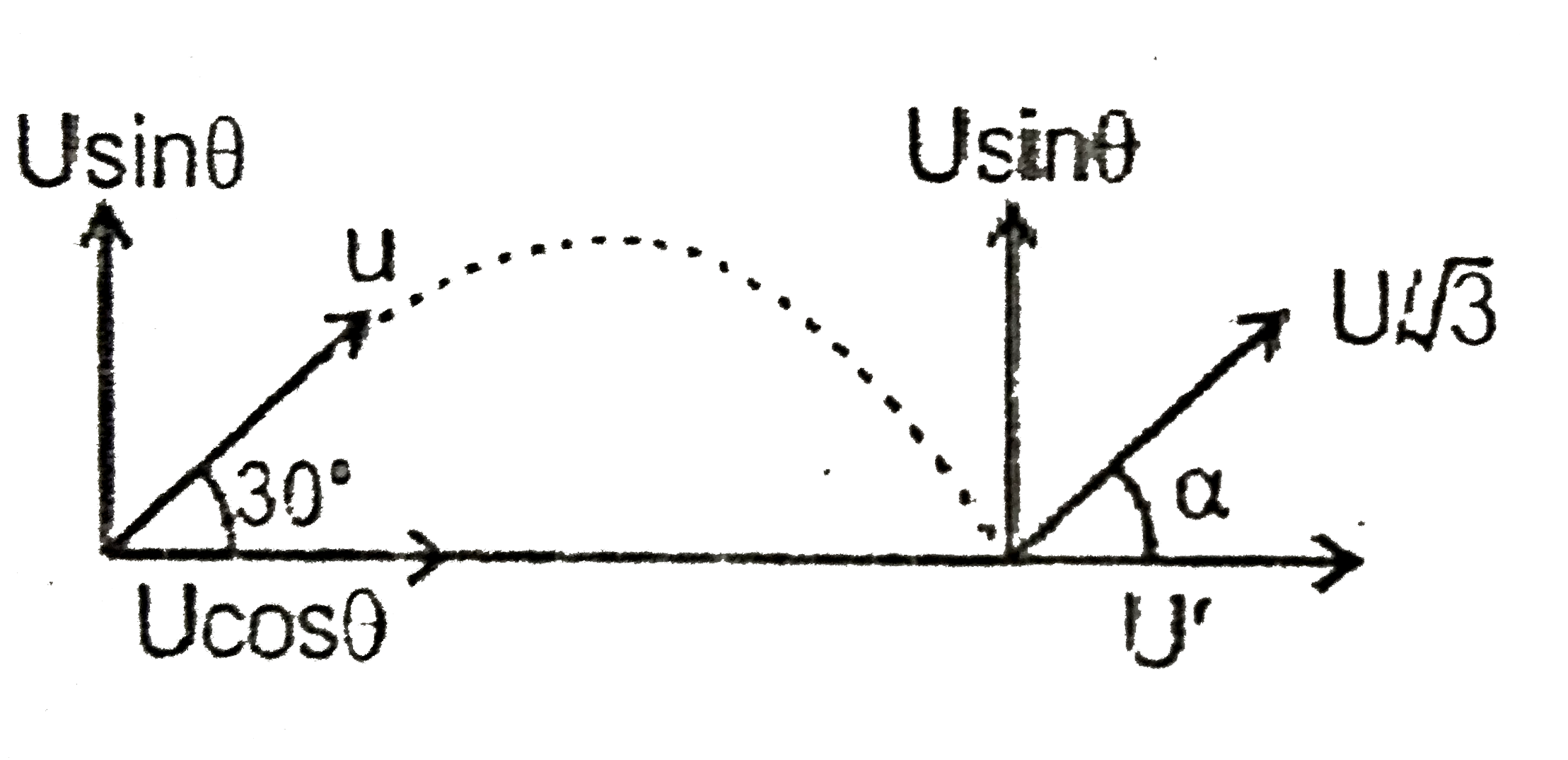
Let us consider a third case here surface is rough but the collision of ball with floor is elastic. A ball is projected withe speed `u` at an angle `30^(@)` with horizontal and it is known that after collision with the floor its speed becomes `(u)/(sqrt(3))` . Then answer the following questions.
The ratio of maximum height reached by ball in first loop and second loop `((H_(1))/(H_(2)))` is `:`

A

`(1)/(4)`

B

`(1)/(2)`

C

1

D

`(1)/(sqrt(3))`

Text Solution

Verified by Experts

The correct Answer is:
C

As the collision is elastic vertical component remains unchanged but the rough floor changes the horizontal component.
`:. U^('2)=((U)/(sqrt(3)))^(2)-(U sin 30^(@))^(2):. U'=(U)/(2sqrt(3))`

Now `tan alpha=((U')/(U sin theta ))^(-1)=sqrt(3) :. alpha=60^(@)`.
As the verticla components remain unchanged therefore the vertical height achieved will remain same.
`:. (H_(1))/(H_(2))=1`
Promotional Banner

Similar Questions

Explore conceptually related problems

A ball is projected on a very long floor. There may be two conditions (i) floor is smooth & (ii) the collision is elastic If both the considered then the path of ball is as follows. Now if collision is inelastic and surface is rough then the path is as follows. Successive range is decreasing . Roughness of surface decreases the horizontal component of ball during collision and inelastic nature of collision decreases the vertical component of velocity of ball. In first case both components remain unchanged in magnitude and in second case both the components of the velocity will change. Let us consider a third case here surface is rough but the collision of ball with floor is elastic. A ball is projected withe speed u at an angle 30^(@) with horizontal and it is known that after collision with the floor its speed becomes (u)/(sqrt(3)) . Then answer the following questions. The angle made by the resultant velocity vector of the ball with horizontal after first collision with floor is :

A ball is projected on a very long floor. There may be two conditions (i) floor is smooth & (ii) the collision is elastic If both the considered then the path of ball is as follows. Now if collision is inelastic and surface is rough then the path is as follows. Successive range is decreasing . Roughness of surface decreases the horizontal component of ball during collision and inelastic nature of collision decreases the vertical component of velocity of ball. In first case both components remain unchanged in magnitude and in second case both the components of the velocity will change. Let us consider a third case here surface is rough but the collision of ball with floor is elastic. A ball is projected withe speed u at an angle 30^(@) with horizontal and it is known that after collision with the floor its speed becomes (u)/(sqrt(3)) . Then answer the following questions. If the ball after first collision with the floor has rebounded vertically then the speed of the ball just after the collision with the floor would have been :

Distinguish between elastic collision and an inelastic collision .

A ball strikes a smooth horizontal floor obliquely and rebounds inelastically.

If two bodies stick together after collision. Will the collision be elastic or inelastic?

A ball is projected from a point on a smooth horizontal floor at an angle theta with the horizontal . Speed of projection is u . Ball collides with the floor several times . Find the total time and horizontal distance covered by the ball .

A ball rebounds after colliding with the floor, then in case of inelastic collision-

A ball is dropped from a height h on a floor. The coefficient of restitution for the collision between the ball and the floor is e. The total distance covered by the ball before it comes to the rest.

The ball is released when the string is horizontal. The collision between the ball and the block is head - on elastic. The velocities of the ball and the block immediately after collision

A ball strikes a horizontal floor at 45^(@) . 25% of its kinetic energy is lost in collision. Find the cofficient of resultation

