Home
Class 11
PHYSICS
A smooth ball 'A' moving with velocity '...

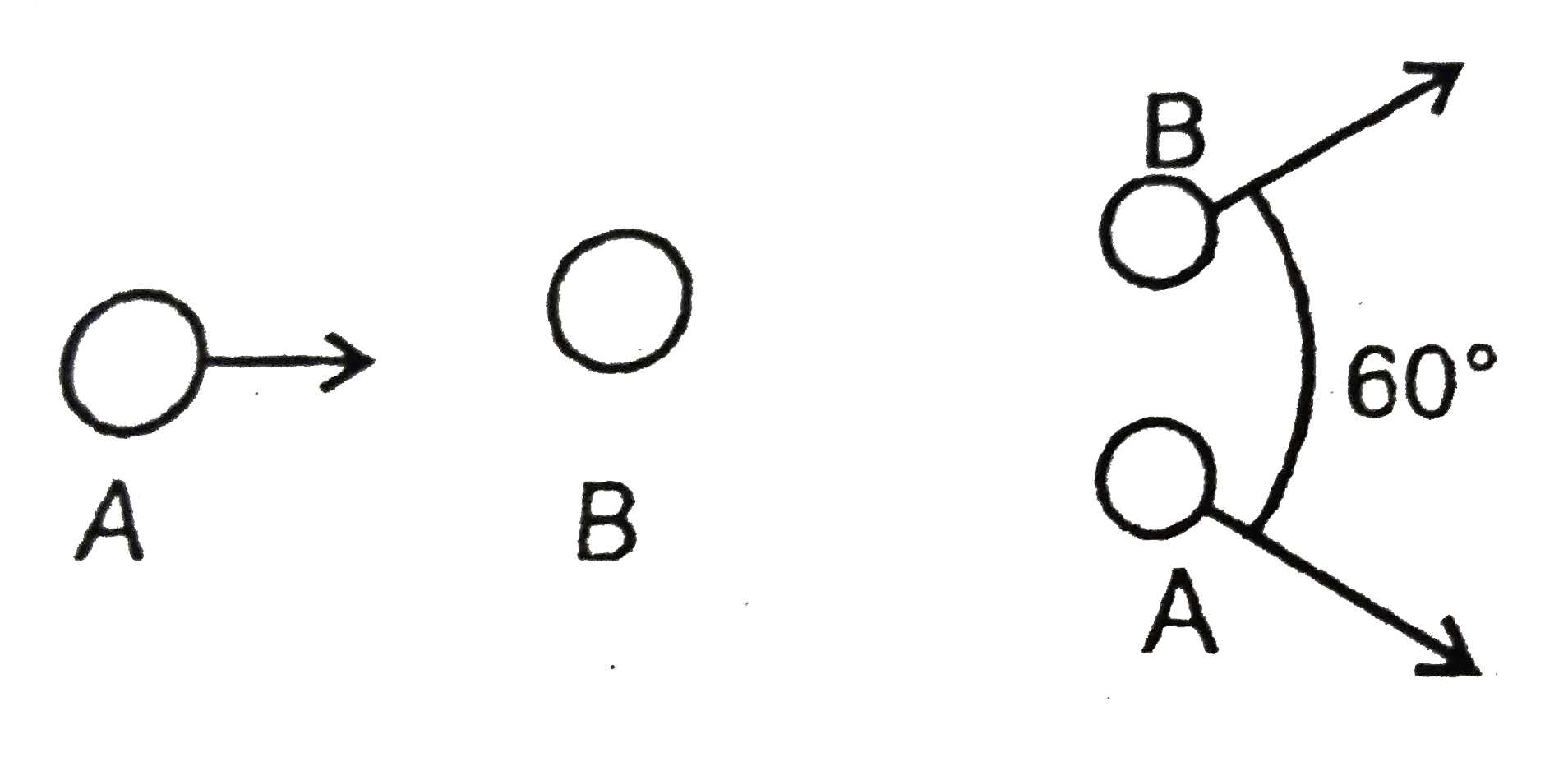
A smooth ball `'A'` moving with velocity `'V'` collides with another smooth identical ball at rest. After collision both the balls move with same speed with angle between their velocities `60^(@)`. No external force acts on the system of balls.

If the kinetic energy lost is fully converted to heat then heat produced is

A

`(1)/(3) mV^(2)`

B

`(2)/(3) mV^(2)`

C

0

D

`(1)/(6)mV^(2)`

Text Solution

Verified by Experts

The correct Answer is:

D

From conservation of momentum
`mv=mv' cos 30^(@)+mv' cos 30^(@)`
`:. V' =(v)/(2 cos 30^(@))=(v)/(sqrt(3))`
Loss in kinetic energy
`=(1)/(2)mv^(2)-2xx(1)/(2)m((v)/(sqrt(3)))^(2)=(1)/(6)mv^(2)`
Promotional Banner

Similar Questions

Explore conceptually related problems

A smooth ball 'A' moving with velocity 'V' collides with another smooth identical ball at rest. After collision both the balls move with same speed with angle between their velocities 60^(@) . No external force acts on the system of balls. The value of coefficient of resititution is

A smooth ball 'A' moving with velocity 'V' collides with another smooth identical ball at rest. After collision both the balls move with same speed with angle between their velocities 60^(@) . No external force acts on the system of balls. The speed of each ball after the collision is

A ball of mass m moving with velocity v collides head on elastically with another identical ball moving with velocity - V. After collision

A ball moving with velocity 9ms^(-1) collides with another smiliar stationary ball. If after the collision, both the balls move in the directions making an angle of 30^(@) with the initial direction, then their speeds, after collision will be

A ball of mass m moving with a velocity v undergoes an oblique elastic collision with another ball of the same mass m but at rest. After the collision if the two balls move with the same speeds , the angle between their directions of motion will be:

A ball moving with a velocity 12m/s strikes an identical ball at rest.After collision both balls move in directions making 30^(0) with original direction of motion.speeds of the balls after collision are (in ms^(-1) ) ?

A ball of mass m is moving with velocity u and collides head on with another identical body at rest . What is the maximum possible loss of kinetic energy due to collision ?

A ball of mass 100g moving at a speed of 12 m s^(-1) strikes another ball of mass 200 g at rest. After the collision both the balls move with a common velocity. Find the common velocity.

A ball of mass m moving with velocity v collides elastically with another ball of identical mass coming from the opposite direction with velocity 2v. Their velocities after collisions are-
