Home
Class 11
PHYSICS
A rod AC of length l and mass m is kept ...

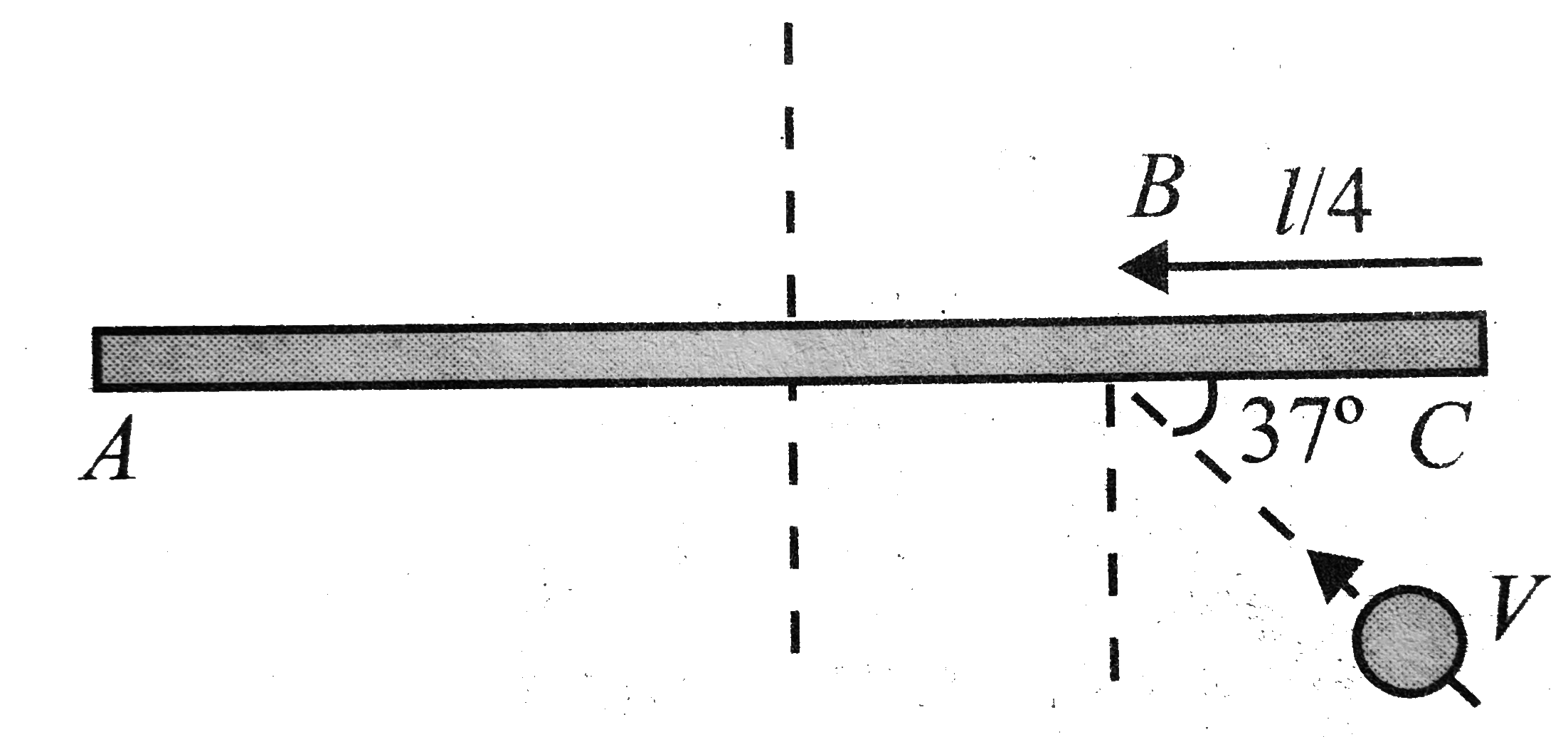
A rod `AC` of length `l` and mass `m` is kept on a horizontal smooth plane. It is free to rotate and move. A particle of same mass `m` moving on the plane with velocity `v` strikes the rod at point `B` making angle `37^@` with the rod. The collision is elastic. After collision,

A

The angular velocity of the rod will be `(72v)/(55l)`

B

The centre of the rod will travel a distance `(pi l)/(3)` in the time in which it makes half rotation

C

Impulse of the impact force is `(24mV)/(55)`

D

none of these

Text Solution

Verified by Experts

The correct Answer is:
A, B, C

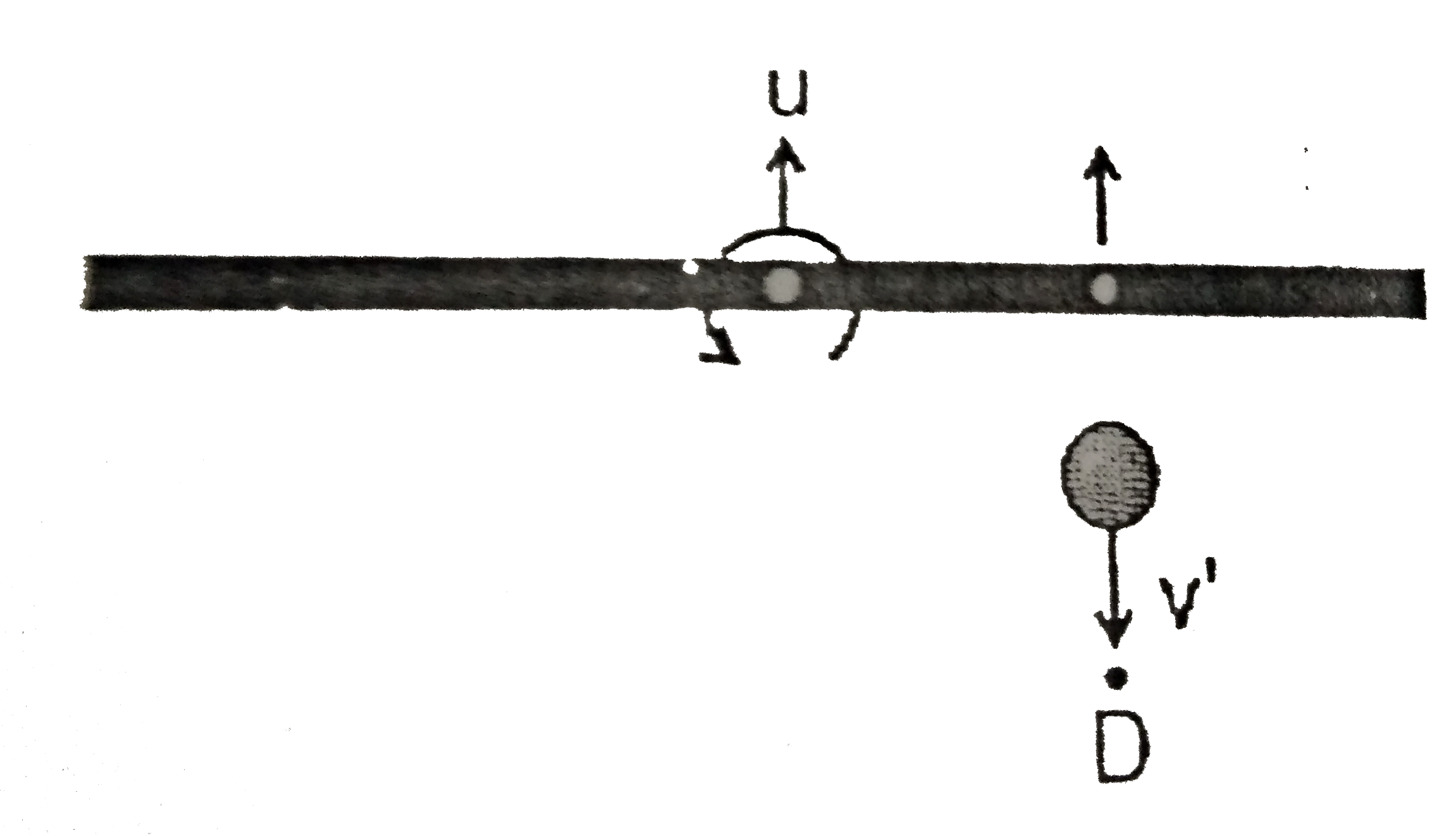
The ball has `V'`, component of its velocity perpendicular to the length of rod immediately after the collision. `u` is velocity of `COM` of the rod and `omega ` is angular velocity of the rod, just after collision. The ball strikes the rod with speed `v cos 53^(@)` in perpendicular direction and its component along the length of the rod after the collision is unchanged.
Using for the point of collision.
Velocity of separation `=` Velocity of approcah

`rArr (3V)/(5)=((omegal)/(4)+u)+V' .....(1)`
Conserving linear momentum `(` of rod `+` particle `)`, in the direction `_|_` to the rod.
`mV.(3)/(5)=m u =mV' ....(2)`
Conserving angular moment about point `'D'` as shown in the figure
`0=0+[m u(l)/(4)-(ml^(2))/(12)omega]rArr u=(omegal)/(3) ....(3)`
By solving
`u=(24V)/(55), w=(72V)/(55l)`
Time taken to rotate by `pi` angle `t=(pi)/(omega)`

In the same time, distance travelled `=u_(2).t=(pil)/(3)`
Using angular impulse`-` angular momentum equation
`int N.dt(l)/(4)=(ml^(2))/(4).(72V)/(55l)rArrintN.dt=(25mV)/(55) }`
or `{("usingimpu lse-momentum equation on Rod"),(intNdt=m u=(24mv)/(55)):}`
Promotional Banner

Topper's Solved these Questions

  • DAILY PRACTICE PROBLEMS

    RESONANCE|Exercise dpp 69|5 Videos
  • DAILY PRACTICE PROBLEMS

    RESONANCE|Exercise dpp 70|7 Videos
  • DAILY PRACTICE PROBLEMS

    RESONANCE|Exercise dpp 67|2 Videos
  • CURRENT ELECTRICITY

    RESONANCE|Exercise Exercise|54 Videos
  • ELASTICITY AND VISCOCITY

    RESONANCE|Exercise Advanced Level Problems|9 Videos

Similar Questions

Explore conceptually related problems

A rod AB of mass M and length L is lying on a horizontal frictionless surface. A particle of mass m traveling along the surface hits the end A of the rod with a velocity v_(0) in a direction perpendicular to AB . The collision is completely elastic. After the collision the particle comes to rest. Find the ration m//M .

A uniform rod of length l and mass 2m rests on a smooth horizontal table. A point of mass m moving horizontally at right angle to the rod with velocity v collides with one end of the rod and sticks to it, then:

A rod AB of mass M and length L is lying on a horizontal frictionless surface. A particle of mass m travelling along the surface hits the end A of the rod with a velocity v_(0) in a direction perpendicular to AB. The collision in elastic. After the collision the particle comes to rest (a). Find the ratio m//M (b). A point P on the rod is at rest immediately after collision find the distance AP. (c). Fid the linear speed of the point P a time piL//3v_(0) after the collision.

A uniform bar of length 6a and mass 8 m lies on a smooth horizontal table. Two point-masses m and 2m moving in the same horizontal plane with speeds 2v and v respectively strike the bar as shown in Fig, and stick to the bar after collision.

A uniform rod of length l and mass 2 m rests on a smooth horizontal table. A point mass m moving horizontally at right angles to the rod with velocity v collides with one end of the rod and sticks it. Then

A rod of mass 4m and length L is hinged at the mid point. A ball of mass 'm' moving with speed V in the plane of rod, strikes at the end at an angle of 45^@ and sticks to it. The angular velocity of system after collision is-

A uniform rod of length L lies on a smooth horizontal table. The rod has a mass M . A particle of mass m moving with speed v strikes the rod perpendicularly at one of the ends of the rod sticks to it after collision. Find the velocity of the rod with respect to C before the collision

A uniform rod of length L lies on a smooth horizontal table. The rod has a mass M . A particle of mass m moving with speed v strikes the rod perpendicularly at one of the ends of the rod sticks to it after collision. Find the velocity of the particle with respect to C before the collision

