Home
Class 11
PHYSICS
A particle moves with a simple harmonic ...

A particle moves with a simple harmonic motion in a straight line, in the first second starting from rest it travels a distance a and in the next second it travels a distance b in the same direction. The amplitude of the motion is

A

`(2a^(2))/(3a-b)`

B

`a-b`

C

`2a-b`

D

`a//b`

Text Solution

Verified by Experts

The correct Answer is:
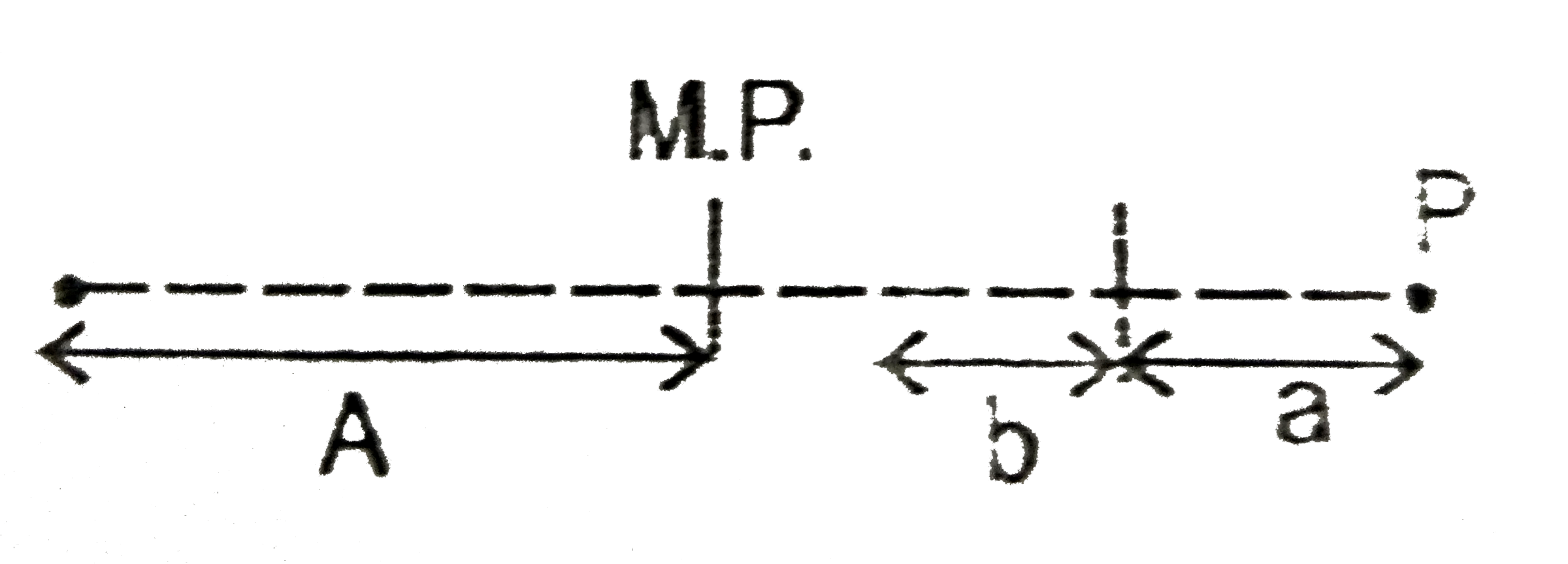
A

`x=A cos wt (` as it starts from rest at `t=0)`

`A-a=A cos w ……(1)`
`A-(a+b)=A cos 2w ….(2)`
Solving `(1)` and `(2)` for `A` we get `A =(2a^(2))/(3a-b)`
Promotional Banner

Topper's Solved these Questions

  • DAILY PRACTICE PROBLEMS

    RESONANCE|Exercise dpp 71|8 Videos
  • DAILY PRACTICE PROBLEMS

    RESONANCE|Exercise dpp 72|4 Videos
  • DAILY PRACTICE PROBLEMS

    RESONANCE|Exercise dpp 69|5 Videos
  • CURRENT ELECTRICITY

    RESONANCE|Exercise Exercise|54 Videos
  • ELASTICITY AND VISCOCITY

    RESONANCE|Exercise Advanced Level Problems|9 Videos

Similar Questions

Explore conceptually related problems

A particle performs SHM in a straight line. In the first second, starting from rest, it travels a distance a and in the next second it travels a distance b in the same direction. The amplitude of the SHM is

A particle moves with simple harmonic motion in a straight line. In first taus , after starting form rest it travels a destance a, and in next tau s it travels 2a, in same direction, then:

A particle moves with SHM in a straight liine. In the first second afer starting from rest, it travels a distance x_(1) cm and in the next second it travels a distance x_(2) cm in the same direction. Prove that the amplitude of oscillation is 2x_(1)^(2)//(3x_(1)-x_(2)) .

A particle executes SHM in a straight line. In the first second starting from rest it travels distance a and in the next second it travels distance a and in the next second it travels distance d in the same direction. The amplitude of SHM is :

A particle moves simple harmonically in a straight line starting from rest. In first 't' sec it travels a distance 'a' and in next 't'sec it travels '2a' in same direction. Then its time period is ?

A particle starting from rest travels a distance x in first 2 seconds and a distance y in next two seconds, then

A particle moves with constant acceleration for 6 seconds after starting from rest. The distance travelled during the consecutive 2 seconds interval are in the ratio?

