Home
Class 11
PHYSICS
A mass m(1) lies on fixed, smooth cylind...

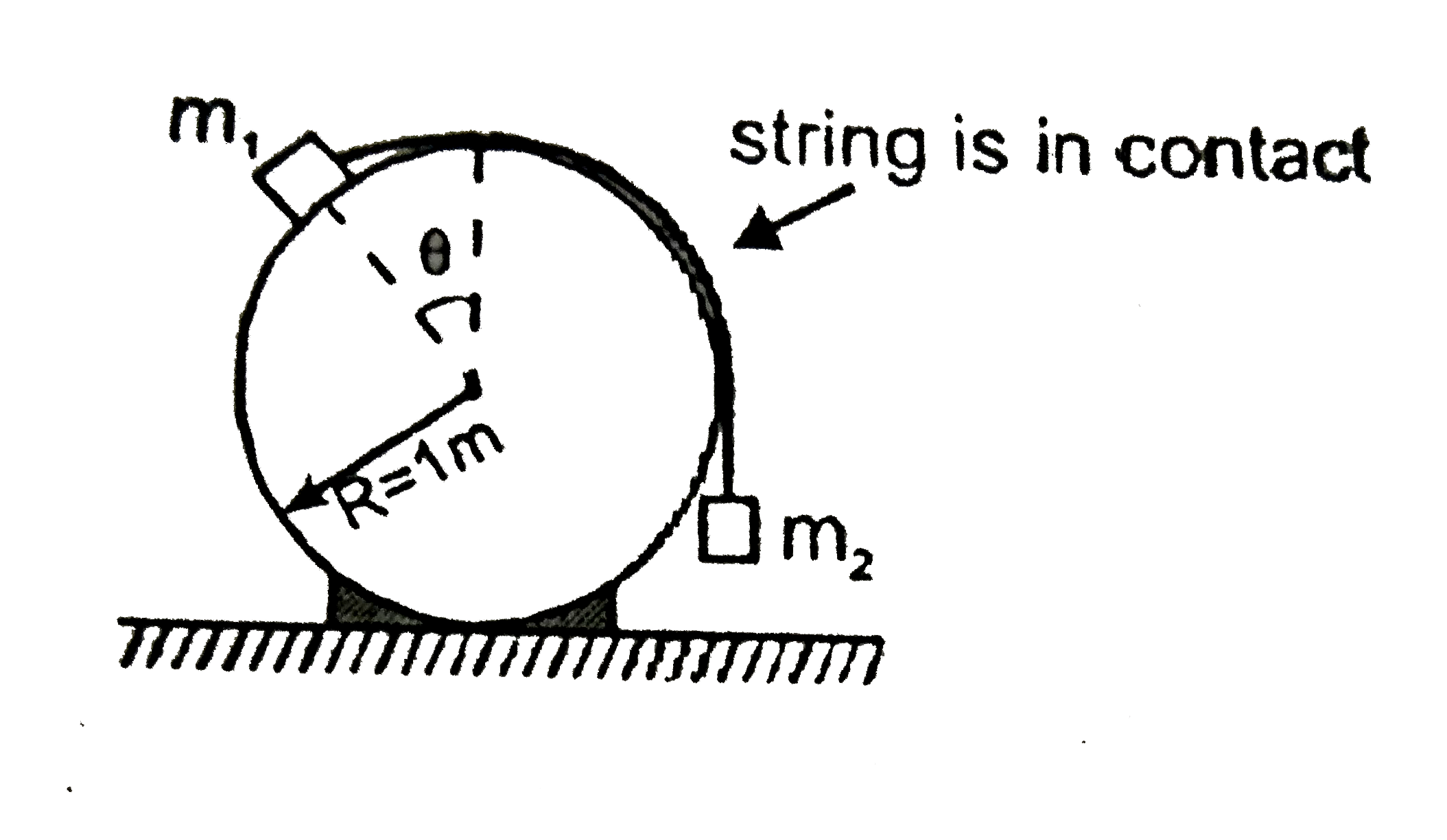
A mass `m_(1)` lies on fixed, smooth cylinder . An ideal cord attached to `m_(1)` passes over the cylinder and is connected to mass `m_(2)` as shown in the figure.
`(a)` Find the value of `theta (` shown in diagram `)` for which the system is in equilibrium.
`(b)` Given `m_(1)=5 kg, m_(2)=4kg` . The system is released from rest when `theta =30^(@)` . Find the magnitude of acceleration of mass `m_(1)` just after the system is released.

Text Solution

Verified by Experts

The correct Answer is:

`sin theta=(m_(2))/(m_(1))`
`(b) (15)/(9)m//s^(2)`

`(a)` The system is in equilibrium when `m_(1)g sin theta =m_(1)g`
or `sin theta =(m_(2))/(m_(1))`
`(b)` Let the tangential acceleration of `m_(1)` be `a`.
`:. m_(2)g-m_(1)g sin theta=(m_(1)+m_(2))a`
`a=(40-25)/(9)=(15)/(9)m//s^(2)`
the normal acceleration of `m_(1)` is zero.
`:'` speed of `m_(1)` is zero.
`:. ` The magnitude of acceleration of `m_(1)=(5)/(3)m//s^(2)`
Promotional Banner

Topper's Solved these Questions

  • DAILY PRACTICE PROBLEMS

    RESONANCE|Exercise dpp 83|6 Videos
  • DAILY PRACTICE PROBLEMS

    RESONANCE|Exercise dpp 84|5 Videos
  • DAILY PRACTICE PROBLEMS

    RESONANCE|Exercise dpp 81|4 Videos
  • CURRENT ELECTRICITY

    RESONANCE|Exercise Exercise|54 Videos
  • ELASTICITY AND VISCOCITY

    RESONANCE|Exercise Advanced Level Problems|9 Videos

Similar Questions

Explore conceptually related problems

A mass m_(1) lies on a fixed smooth cylinder. An ideal chord attached to m_(1) passes over the cylinder and is conneced to m_(2) . The system is released at theta = 30^(@) . Acceleration of m_(1) just after releasing the system is (5)/(n)m//s^(2) . Find the value of n .

Two masses m and M are attached to the strings as shown in the figure. If the system is in equilibrium, then

In the figure shown , all surface are smooth . Acceleration of mass '4m' , when the system Is released from rest will be

A block of mass m_(1) on asmooth, horizontal surface is connected to a second mass m_(2) by a light string over a height, frictionless pulley. A force of magnitude F_(0) is applied to mass m_(1) . Find the value of force F_(0) for which the system will be is equilibrium.

Two masses m_(1) and m_(2) are attached with light strings as shown. If the system is in equilibrium, find the value of theta

Consider the system of masses and pulleys shown in fig. with massless string and fricitionless pulleys. (a) Give the necessary relation between masses m_(1) and m_(2) such that system is in equilibrium and does not move. (b) If m_(1)=6kg and m_(2)=8kg , calculate the magnitude and direction of the acceleration of m_(1) .

Blocks of mass M_(1) and M_(2) are connected by a cord which passes over the pulleys P_(1) and P_(2) as shown in the figure. If there is no friction, the acceleration of the block of mass M_(2) will be

In figure shown, pulleys are ideal m_(1)gt 2m_(2) . Initially the system is in equilibrium and string connecting m_(2) to rigid support below is cut. Find the initial acceleration of m_(2) ?

Figure-2.54 shows a block of mass m is placed on an inclined wedge of mass M If the system is released from rest find the acceleration of m and M.
