Home
Class 11
PHYSICS
A ball of mass 'm' drops from a height w...

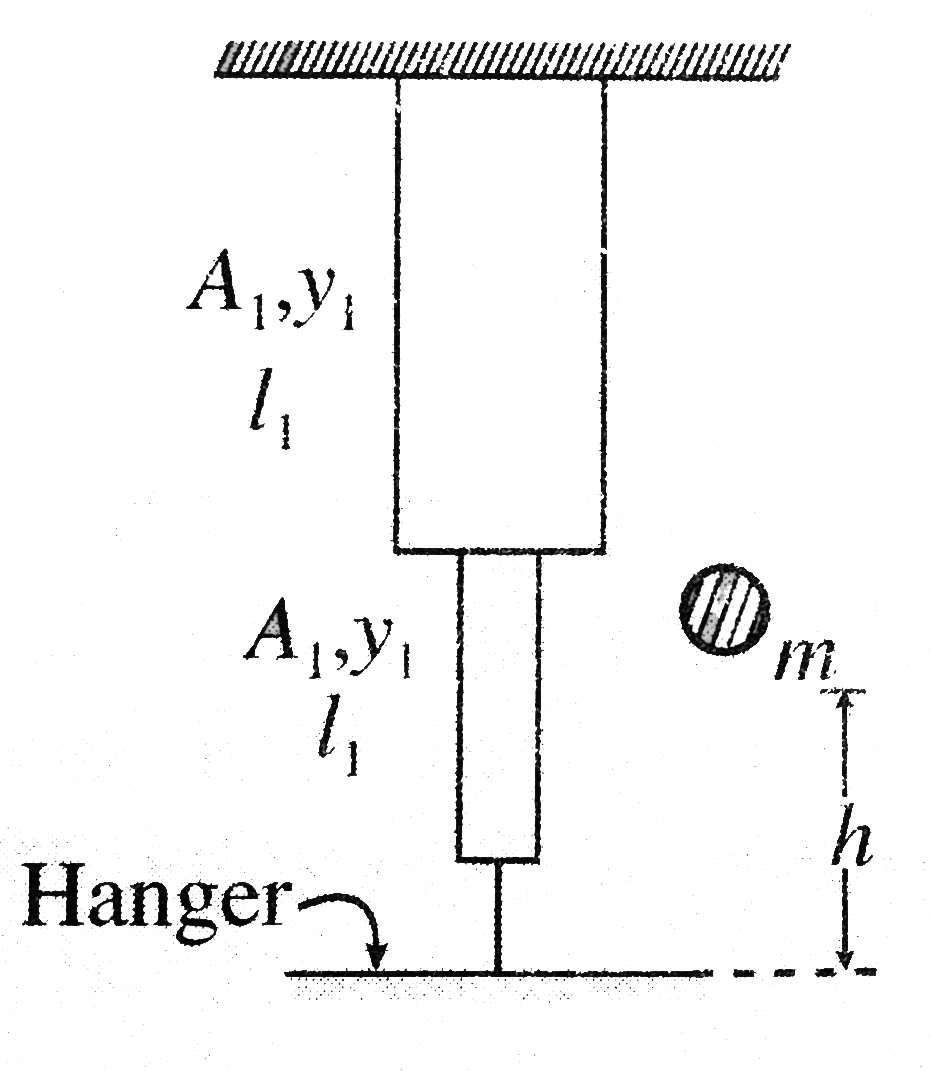
A ball of mass `'m'` drops from a height which sticks to a mass-less hanger after striking it. Neglecting overturning, Find out the maximum extension in rod, assuming that the rod is mass-less.

Text Solution

Verified by Experts
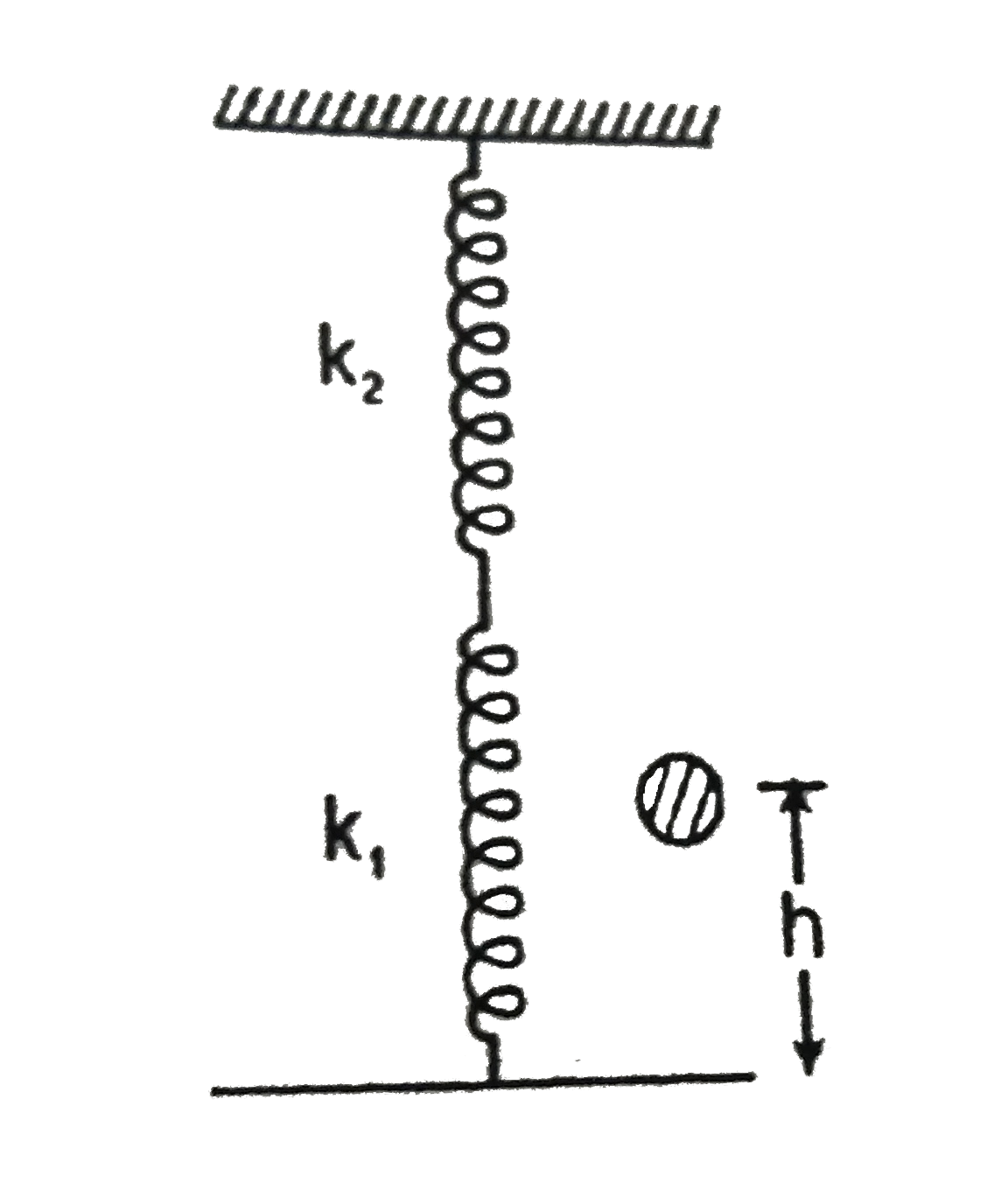
Applying energy conservation
`mg(h+x)=(1)/(2)(k_(1)k_(2))/(k_(1)+k_(2))x^(2)`
where `k_(1)=(A_(1)y_(1))/(l_(1)) k_(2)=(A_(2)y_(2))/(l_(2))`
`& K_(eq)=(A_(1)A_(2)y_(1)y_(2))/(A_(1)y_(1)l_(2)+A_(2)y_(1)l_(1))`
`k_(eq)x^(2)-2mgx-2mgh=0`
`x=(2mg+-sqrt(4m^(2)g^(2)+8mghk_(eq)))/(2k_(eq)) x_(max)=(mg)/(k_(eq))+sqrt((m^(2)g^(2))/(k_(eq)^(2))+(2mgh)/(k_(eq)))`
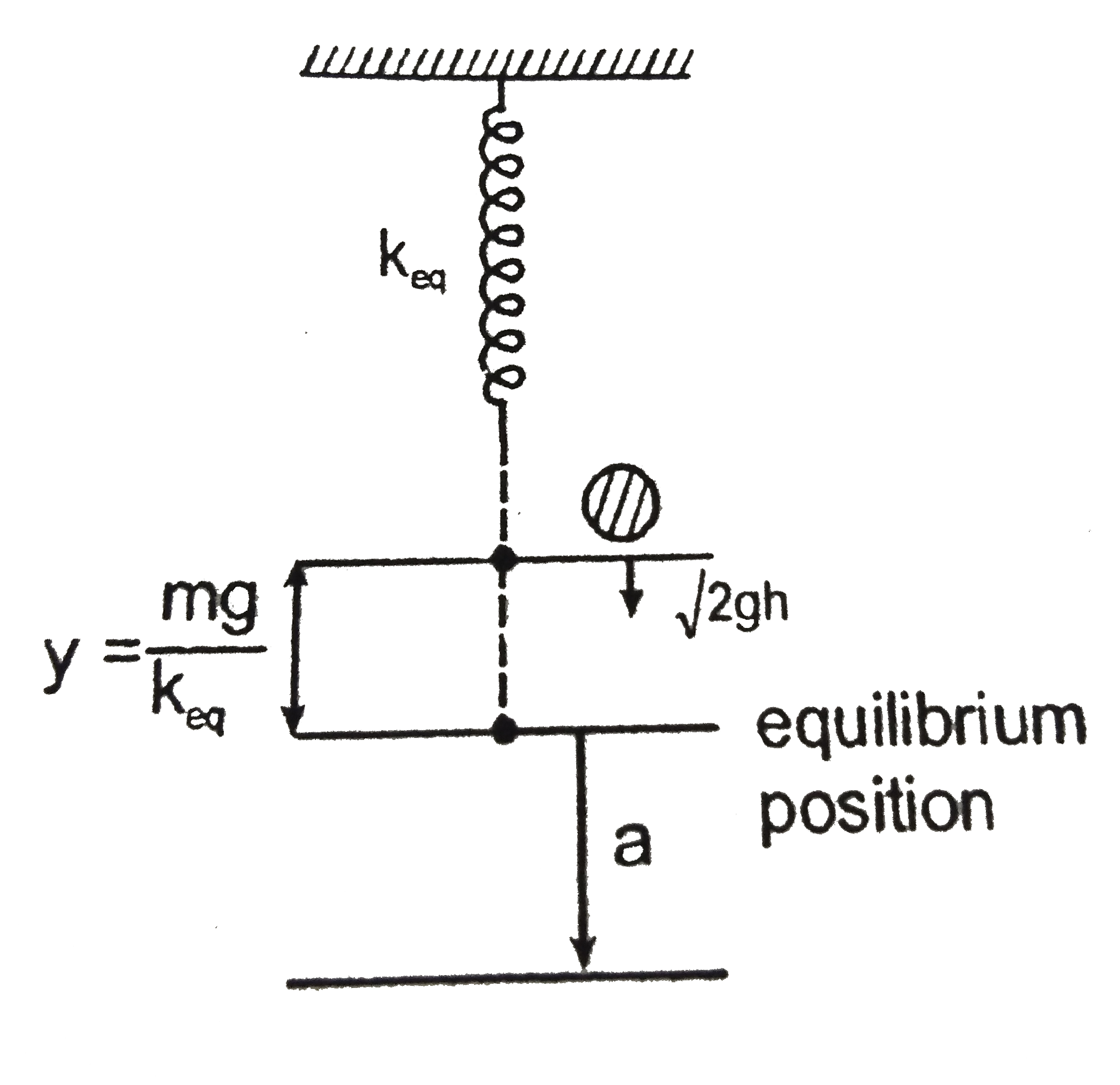
BY `S.H.M.`
`w=sqrt((k_(eq))/(m)) v=omegasqrt(a^(2)-y^(2))`
`sqrt(2gh)=sqrt((k_(eq))/(m))sqrt(a^(2)-y^(2))rArr sqrt((2mgh)/(k_(eq))+(m^(2)g^(2))/(k_(eq)^(2)))=a`
`max^(m)` extension `a+y=(mg)/(k_(eq))+sqrt((m^(2)g^(2))/(k_(eq))+(2mgh)/(k_(eq)))`

Promotional Banner

Topper's Solved these Questions

  • DAILY PRACTICE PROBLEMS

    RESONANCE|Exercise dpp 91 illustration|2 Videos
  • DAILY PRACTICE PROBLEMS

    RESONANCE|Exercise dpp 92 illustration|2 Videos
  • DAILY PRACTICE PROBLEMS

    RESONANCE|Exercise dpp 89 illustration|5 Videos
  • CURRENT ELECTRICITY

    RESONANCE|Exercise Exercise|54 Videos
  • ELASTICITY AND VISCOCITY

    RESONANCE|Exercise Advanced Level Problems|9 Videos

Similar Questions

Explore conceptually related problems

A ball of mass 'm' drops from a height which sticks to a massless hanger after striking it. Neglecting overturning. Find out the maximum extension in rod, assuming that the rod is massless.

Hanger is mass less a ball of mass m drops a height h which sticks to hanger after striking. Neglect over turning find out the maximum extension in rod. Assuming or id massless let maximum extension be x_(max) .

A mass M is in static equilibrium on a massless vertical spring as shown in the figure. A ball of mass m dropped from certain height sticks to the mass M after colliding with it. The oscillations they perform reach to height'a' above the original level of scales & depth 'b' below it. (a) Find the constant of force of the spring., (b) Find the oscillation frequency. (c ) What is the height above the initial level from which the mass m was dropped?

A ball of mass m is dropped from a height h in a tunnel, made across the earth (mass = M, radius = R) passing through its center. If h

A block of mass 180 g is placed on a spring (spring constant k = 120 N//m ) fixed from below. A ball of mass 20 g is dropped from height 20 m and the collision is completely inelastic. Find the maximum compression of the spring. Neglect the initial compression of the spring due to the block.

A block of mass 200 gm is suspended through a vertical spring. The spring is stretched by 1 cm when the block is in equilibrium. A particle of mass 120 gm is dropped on the block from a height of 45 cm. The particle sticks to the block after the impact. Find the maximum extension of the spring.

A ball of mass m is thrown straight up. It goes to a maximum height and then returns. Finally it strikes ground. In the whole process.

A block of mass m is dropped from height h above the ground. Find out the speed of the block when it reaches the ground.

A ball of mass 1kg is dropped from a height of 5m. (a) Find the kinetic of the ball just before it reaches the ground (b) What is the speed at this instant?