

Home
Class 11
PHYSICS
The Fig. showns a string of equally plac...

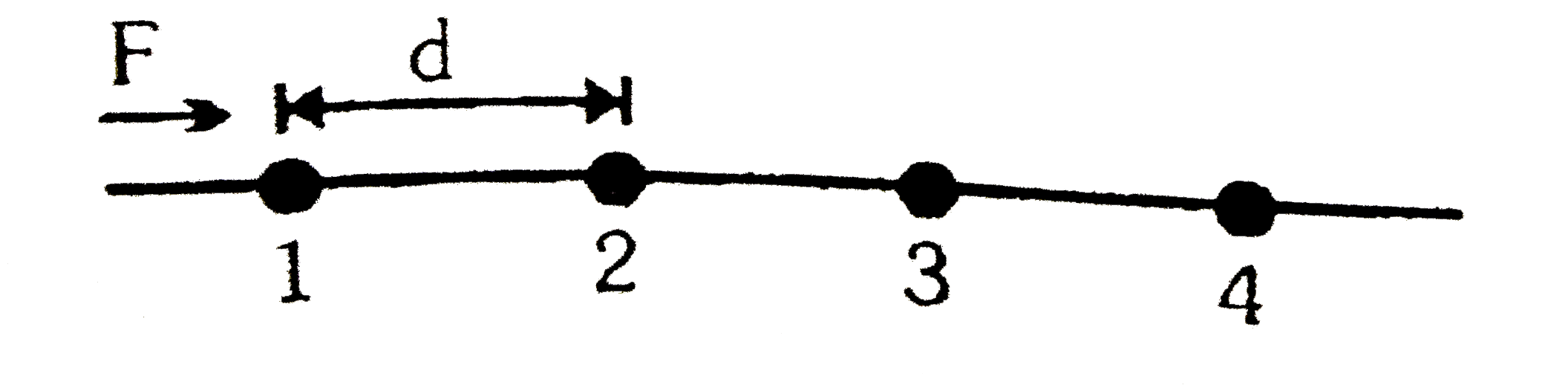
The Fig. showns a string of equally placed beads of mass m, separated by distance. The beads are free to slide without friction on a thin wire. A constant force F act on the first bead initially at rest till it makes collision with the second bead. The second bead then collides with the third and so on. Supposed that all collisions are elastic,

Promotional Banner

Similar Questions

Explore conceptually related problems

The Fig. shows a string of equally placed beads of mass m , separated by distance d . The beads are free to slide without friction on a thin wire. A constant force F act on the first bead initially at rest till it makes collision with the second bead. The second bead then collides with the third and so on. Supposed that all collisions are elastic,

The Fig. shows a string of equally placed beads of mass m , separated by distance d . The beads are free to slide without friction on a thin wire. A constant force F act on the first bead initially at rest till it makes collision with the second bead. The second bead then collides with the third and so on. Supposed that all collisions are elastic,

A bead of mass m is fitted on a rod and can move on it without friction. Initially the bead is at the middle of the rod moves transitionally in the vertical plane with an accleration a_(0) in direction forming angle alpha with the rod as shown. The acceleration of bead with respect to rod is: z

A bead of mass m is fitted on a rod and can move on it without friction. Initially the bead is at the middle of the rod moves transitionally in the vertical plane with an accleration a_(0) in direction forming angle alpha with the rod as shown. The acceleration of bead with respect to rod is: z

A rigeid insulated wire frame in the form of a right-angled traingle ABC is set in a vertical plane as shown in fig. two beads of equal masses m each and carrying charges q_(1) and q_(2) are connected by a cord of length l and can slide without friction on the wires. Cinsidering the case when the beads are stationary, determine (i) the angel alpha (ii) the tension in the cord, and (iii) The normal recation on teh beads. If the cord is now cut, what are the value of the charges for which the beads continue to remain stationary?

A rigid insulated wire frame in the form of a right-angled triangle ABC is set in a vertical plane as shown in fig. two beads of equal masses m each and carrying charges q_(1) and q_(2) are connected by a cord of length l and can slide without friction on the wires. Cinsidering the case when the beads are stationary, determine (i) the angel alpha (ii) the tension in the cord, and (iii) The normal recation on teh beads. If the cord is now cut, what are the value of the charges for which the beads continue to remain stationary?

A bead of mass m and diameter d is sliding back and forth with velocity v on a wire held between two right walls of length L. Assume that th ecollisions with the wall are perfectly elastic and ther is no friction. The average force that the bouncing bead exerts on the one of the walls is :_

A bead of mass m and diameter d is sliding back and forth with velocity v on a wire held between two right walls of length L. Assume that th ecollisions with the wall are perfectly elastic and ther is no friction. The average force that the bouncing bead exerts on the one of the walls is :_

A bead of mass m and diameter d is sliding back and forth with velocity v on a wire held between two right walls of length L. Assume that th ecollisions with the wall are perfectly elastic and ther is no friction. The average force that the bouncing bead exerts on the one of the walls is :_

A head slide without friction around a loop the (figure). The bead slide is released is from rest at a height h = 3.50R . How large is the normal force on the bead at point (A) if its mass is 50 g ?