

Home
Class 11
PHYSICS
An ideal liquid of density rho is filled...


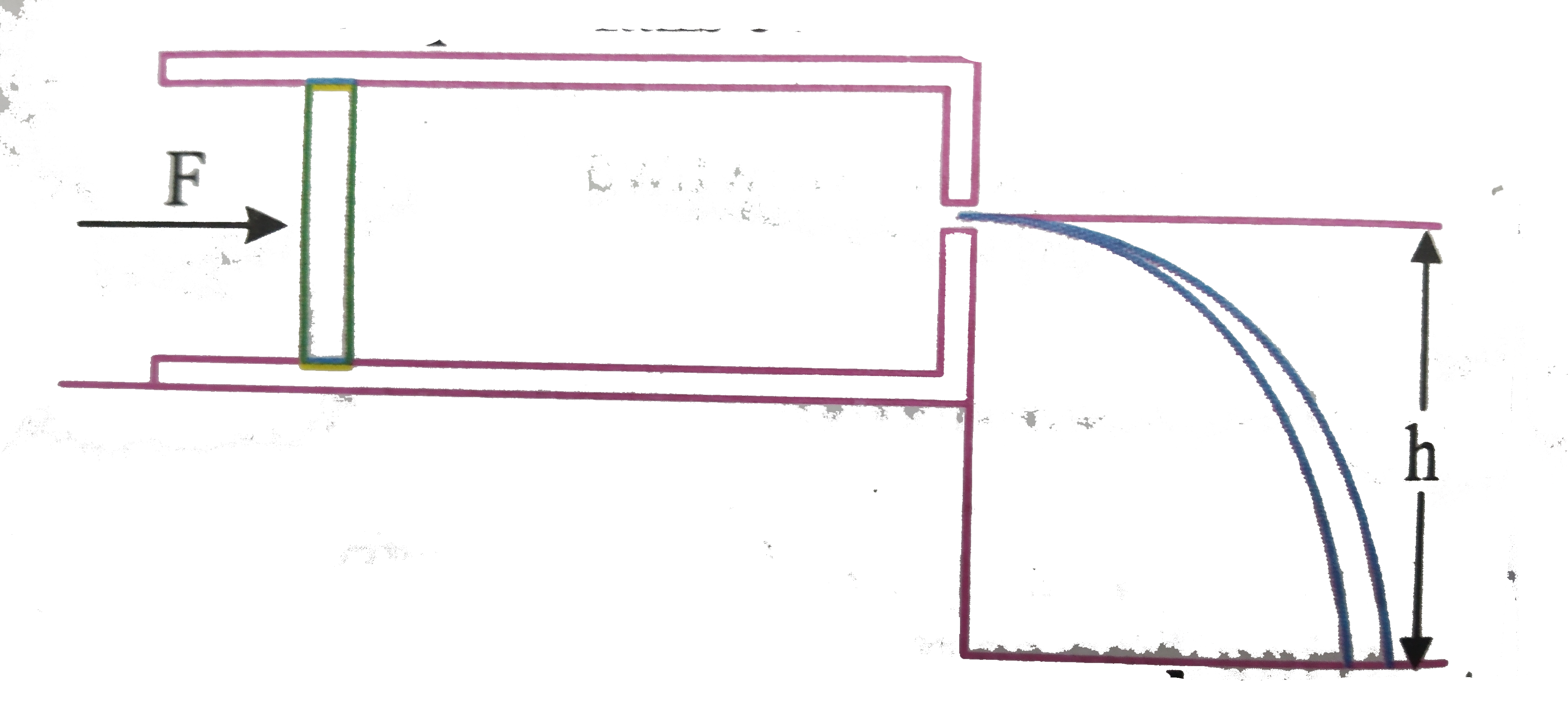
An ideal liquid of density `rho` is filled in a horizontally fixed syringe fitted with a piston. There is no friction between the piston and the inner surface of the syringe. Cross-sectional area of the syringe is A. At one end of the syringe, an orifice is made. When the piston is pushed into the syringe, the liquid comes out of the orifice and then following a parabolic path falls on the ground.
With what velocity the liquid strikes the ground?

Promotional Banner

Similar Questions

Explore conceptually related problems

An ideal liquid of density rho is filled in a horizontally fixed syringe fitted with a piston. There is no friction between the piston and the inner surface of the syringe. Cross-sectional area of the syringe is A. At one end of the syringe, an orifice is made. When the piston is pushed into the syringe, the liquid comes out of the orifice and then following a parabolic path falls on the ground. With what velocity does the liquid come out of the orifice?

Is the air from the syringe also warm ?

Why does the liquid rise in a syringe when its piston is pulled up?

Do you find any change in volume of air in syringe ?

Press the piston after closing the nozzle of thesyringe.What will happen to the volume of air inside'the syringe ?

When is it easier to press the syringe with water or air ?

A doctor applies a force of 50 n to the piston of syringe of area 1.5 m^2 . The increase in pressure of the fluid in the syringe is

A syringe containing water is held horizontally with its nozzle at a height h above the ground as shown in fig the cross sectional areas of the piston and the nozzle are A and a respectively the piston is pushed with a constant speed v. Find the horizontal range R of the stream of water on the ground.

A syringe containing water is held horizontally with its nozzle at a height h above the ground as shown in fig the cross sectional areas of the piston and the nozzle are A and a respectively the piston is pushed with a constant speed v. Find the horizontal range R of the stream of water on the ground.