

Home
Class 11
PHYSICS
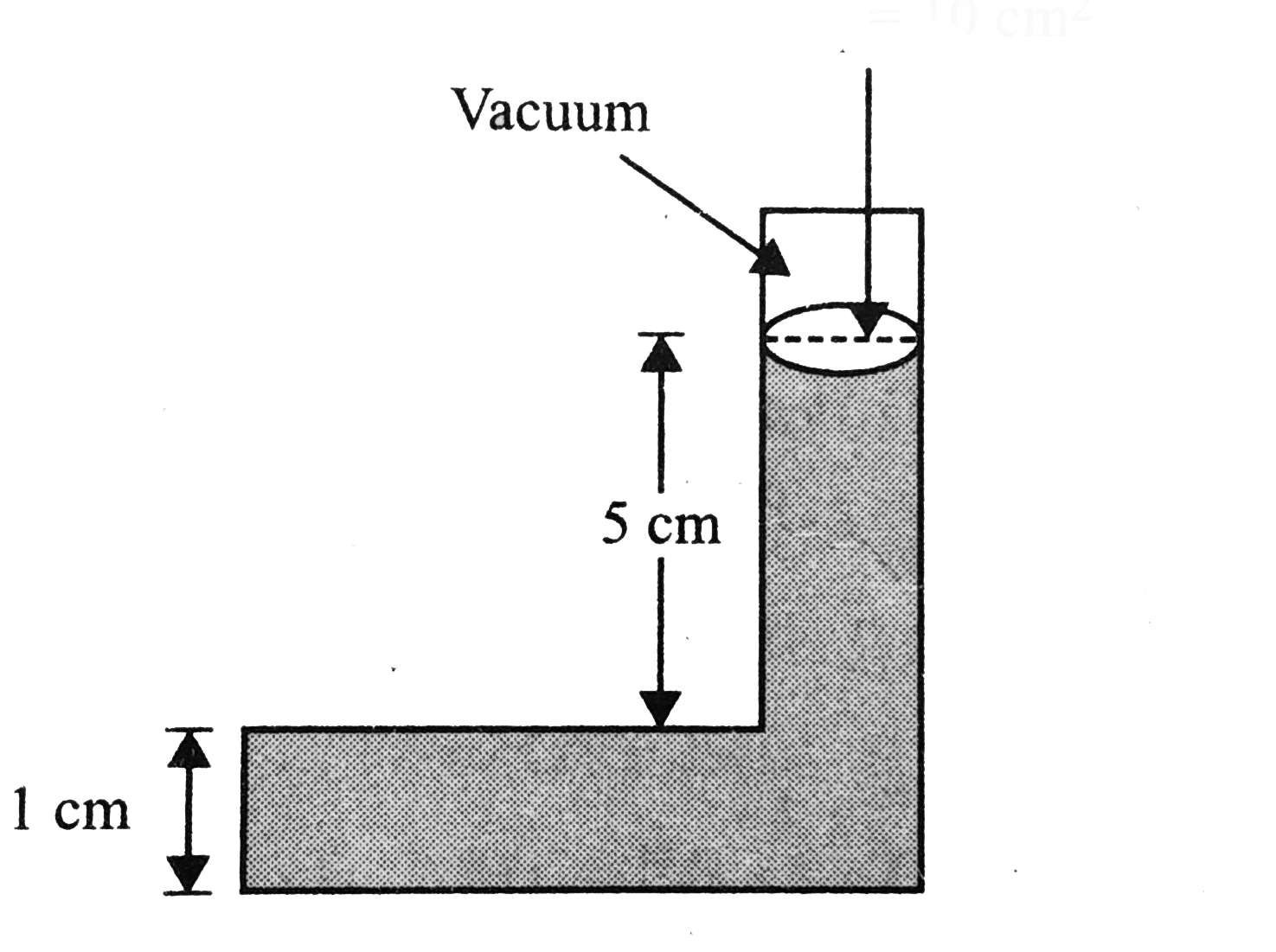
The vessel shown in the figure contains ...

The vessel shown in the figure contains water, take `rho_("water")=1000kg//m^(2), g=m//s^(2)`). For this arrangement, answer the following questions:

The net force acting on the base of the vessel is

Promotional Banner

Similar Questions

Explore conceptually related problems

The vessel shown in the figure contains water, take rho_("water")=1000kg//m^(2), g=m//s^(2) ). For this arrangement, answer the following questions: Mark out the correct statement(s).

An open rectangular tank of dimensions 6mxx5mxx4m contains water upto height of 2m. The vessel is accelerated horizontally with an acceleration of a m//s^(2) as shown. Take rho_("water")=10^(3)kg//m^(3) g=10m//s^(2) atmospheric pressure =10^(5)N//m^(2) . Bese on above information answer the following questions: Instead of open top if the vessel is closed then absolute pressure at point A would be [take a=(20)/(3)m//s^(2) and initially height of water in tank is 2m]

An open rectangular tank of dimensions 6mxx5mxx4m contains water upto height of 2m. The vessel is accelerated horizontally with an acceleration of am//s^(2) as shown. Take rho_("water")=10^(3)kg//m^(3) g=10m//s^(2) atmospheric pressure =10^(5)N//m^(2) . Bese on above information answer the following questions: Determine the maximum value of a so that no water comes out from tan k.

An open rectangular tank of dimensions 6mxx5mxx4m contains water upto height of 2m. The vessel is accelerated horizontally with an acceleration of a m//s^(2) as shown. Take rho_("water")=10^(3)kg//m^(3) g=10m//s^(2) atmospheric pressure =10^(5)N//m^(2) . Bese on above information answer the following questions: Determine the height to which the water should be filled in the tank so that when a=5m//s^(2) no water comes out from the tank

A cylindrical vessel of a very large cross sectional area is containing two immiscible liquids of density rho_(1)=600kg//m^(3) and rho_(2)=1200kg//m^(3) as shown in the figure. A small hole having cross sectional area 5cm^(2) is made in right side vertical wall as shown. Take atmospheric pressure as p_(0)=10^(5)N//m^(2), g=10m//s^(2) . For this situation mark out the correct statement (s). Take cross sectional area of the cylindrical vessel as 1000cm^(2) . Neglect the mass of the vessel.

A cylindrical vessel of a very large cross sectional area is containing two immiscible liquids of density rho_(1)=600kg//m^(3) and rho_(2)=1200kg//m^(3) as shown in the figure. A small hole having cross sectional area 5cm^(2) is made in right side vertical wall as shown. Take atmospheric pressure as p_(0)=10^(5)N//m^(2), g=10m//s^(2) . For this situation mark out the correct statement (s). Take cross sectional area of the cylindrical vessel as 1000cm^(2) . Neglect the mass of the vessel.

A mass m of volume V=10cm^(2) is tied with a string to the base of a container filled with a liquid of density (P_(l)=10^(3)kg//m^(3)) as shown in the figure. The container is then accelerated with acceleration (a_(x)=9m//s^(2)) and (a_(y)=2m//s^(2)) a shown in the figure. [ g=10((m)/(s^(2))) acceleration due to gravity] the net buoyancy force acting on the mass is

A mass m of volume V=10cm^(2) is tied with a string to the base of a container filled with a liquid of density (P_(l)=10^(3)kg//m^(3)) as shown in the figure. The container is then accelerated with acceleration (a_(x)=9m//s^(2)) and (a_(y)=2m//s^(2)) a shown in the figure. [ g=10((m)/(s^(2))) acceleration due to gravity] the net buoyancy force acting on the mass is