Home
Class 11
PHYSICS
A block attached to a spring, pulled by ...

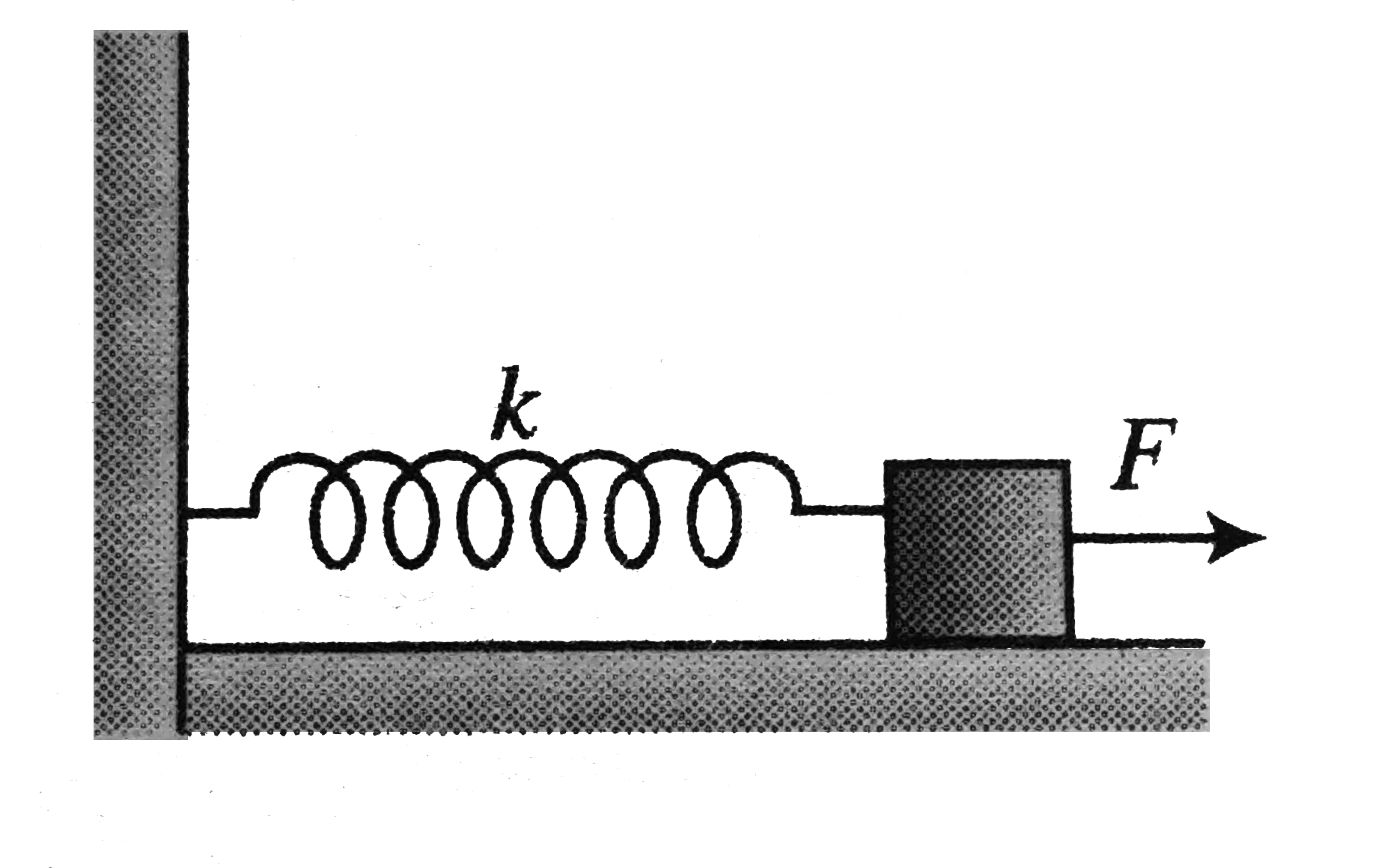
A block attached to a spring, pulled by a constant horizontal force, is kept on a smooth surface as shown in figure. Initially, the spring is in the natural length state. Then the maximum positive work that the applied force F can do is (give that string does not break)

A

`(F^(2))/K`

B

`(2F^(2))/K`

C

`oo`

D

`(F^(2))/(2K)`

Text Solution

Verified by Experts

The correct Answer is:

B

Applying work energy theorema on block

`Fl-1/2kl^(2)=0 :. L=(2F)/k` or
Work done `=Fl=(2F^(2))/k`
Promotional Banner

Topper's Solved these Questions

Similar Questions

Explore conceptually related problems

A block of mass m is attached to a spring of force constant k whose other end is fixed to a horizontal surface. Initially the spring is in its natural length and the block is released from rest. The average force acting on the surface by the spring till the instant when the block has zero acceleration for the first time is

Four blocks each of mass M connected by a massless strings are pulled by a force F on a smooth horizontal surface, as shown in figure.

The two blocks A and B of same mass connected to a spring and placed on a smooth surface. They are given velocities (as shown in the figure) when the spring is in its natural length :

A body kept on a smooth horizontal surface is pulled by a constant horizontal force applied at the top point of the body. If the body rolls purely on the surface, its shape can be-

A block of mass m is attached to the two springs in vertical plane as shown in the figure - 3.95. If initially both the springs are at their natural lengths then velocity of the block is maximum at displacement x given as

A dumbbell consists of two balls A and B of mass m=1 kg and connected by a spring. The whole system is placed on a smooth horizontal surface as shown in the figure. Initially the spring is at its natural length, the ball B is imparted a velocity v_(0)=8/(sqrt(7))m//s in the direction shown. The spring constant of the spring is adjusted so that the length of the spring at maximum elongation is twice that of the natural, length of the spring. Find the maximum potential energy stored (in Joule) in the spring during the motion.

A block attached with an ideal spring is kept on a smooth horizontal surface. Now the free end of the spring is pulled with a constant velocity u horizontally. Then the maximum energy stored in the spring and bock system during subsequent motion is :

Two blocks having masses 8kg and 16kg are connected to the two ends of a light spring. The system is placed on a smooth horizontal floor. An inextensible string also connects B with ceiling as shown in the figure at the initial moment. Initially the spring has its natural length. A constant horizontal force F is applied to the heavier block as shown. What is the maximum possible value of F so the lighter block doesn't loose contact with ground?

A block of mass m connected to a spring of stiffness k is placed on horizontal smooth surface. When block is at x=0 , spring is in natural length. The block is also subjected to a force F=(k|x|)/(@) then

A system of wedge and block as shown in figure, is released with the spring in its natural length. All surfaces are frictionless. Maximum elongation in the spring will be .

RESONANCE-WORK POWER AND ENERGY-Exercise
  1. In the figure, block A is released from rest when the spring is its na...

    Text Solution

    |

  2. In the figure shown initial spring is in unstretched state and blocks ...

    Text Solution

    |

  3. A block attached to a spring, pulled by a constant horizontal force, i...

    Text Solution

    |

  4. A body is projected with kinetic energy k at angle phi with the vertic...

    Text Solution

    |

  5. A man places a chain (of mass m and length l) on a table slowly. Initi...

    Text Solution

    |

  6. Power supplied to a mass 2 kg varies with time as P = (3t^(2))/(2) wat...

    Text Solution

    |

  7. A constant power P is applied to a particle of mass m. The distance tr...

    Text Solution

    |

  8. A rigid body is acted upon by a horizontal force which is inversely pr...

    Text Solution

    |

  9. The graph between the resistive force F acting on a body and the dista...

    Text Solution

    |

  10. A particle move in a straight line with retardation proportional to it...

    Text Solution

    |

  11. A body is falling under gravity . When it loses a gravitational potent...

    Text Solution

    |

  12. A block of mass m is attached to two unstretched springs of spring con...

    Text Solution

    |

  13. A body of mass m dropped from a certain height strikes a light vertica...

    Text Solution

    |

  14. A particle moves with a velocity v=(5hati-3hatj + 6hatk) ms^(-1) under...

    Text Solution

    |

  15. An electric motor creates a tension of 4500 newton in a hoisting cable...

    Text Solution

    |

  16. The potential energy of a partical veries with distance x as shown in ...

    Text Solution

    |

  17. The potential energy of a force filed vec(F) is given by U(x,y)=sin(x+...

    Text Solution

    |

  18. A spring of force constant 800N//m has an extension of 5cm. The work d...

    Text Solution

    |

  19. A body is moved along a straight line by a machine delivering constant...

    Text Solution

    |

  20. The total work done on a particle is equal to the change in its mechan...

    Text Solution

    |

