

Home
Class 11
PHYSICS
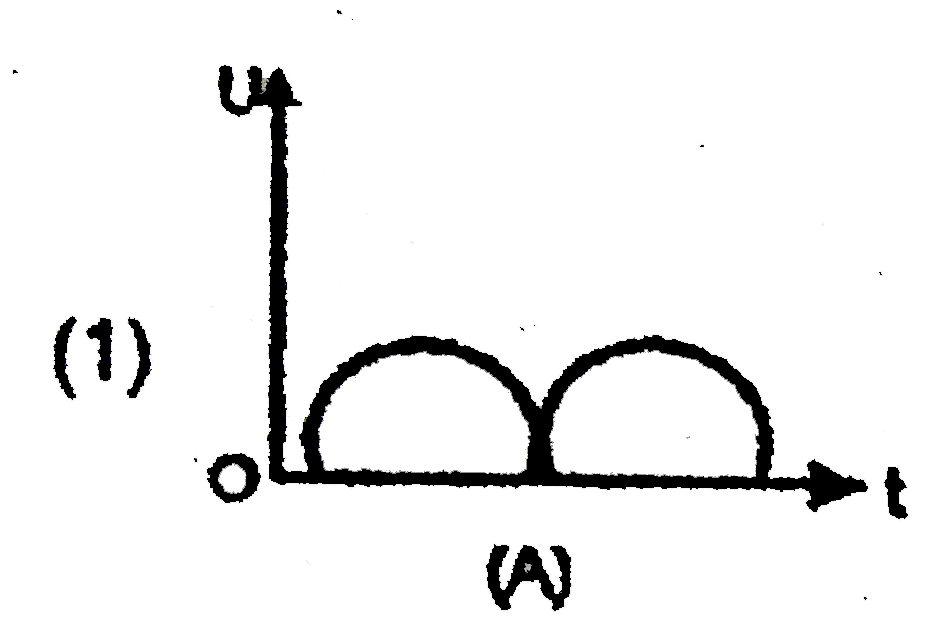
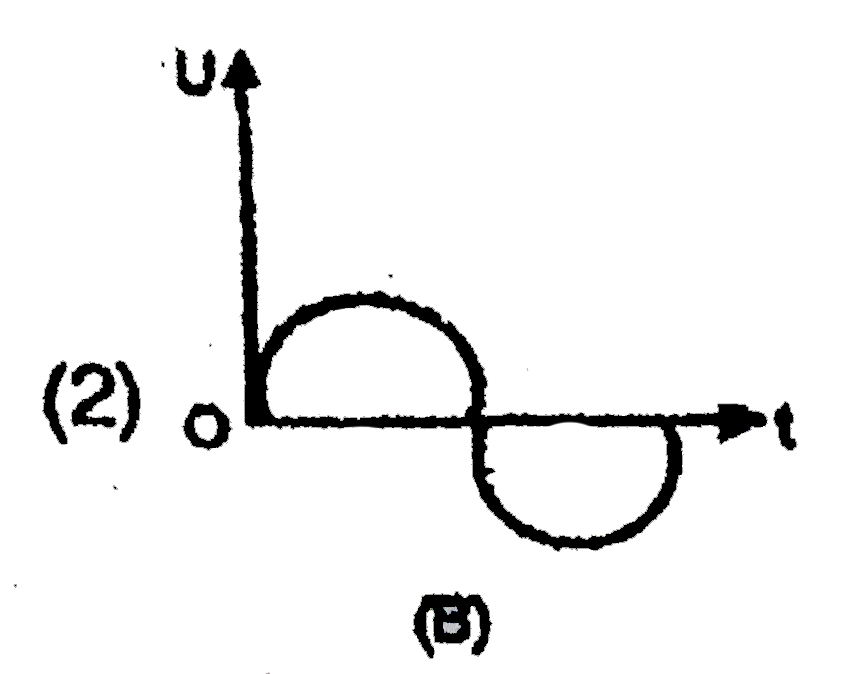
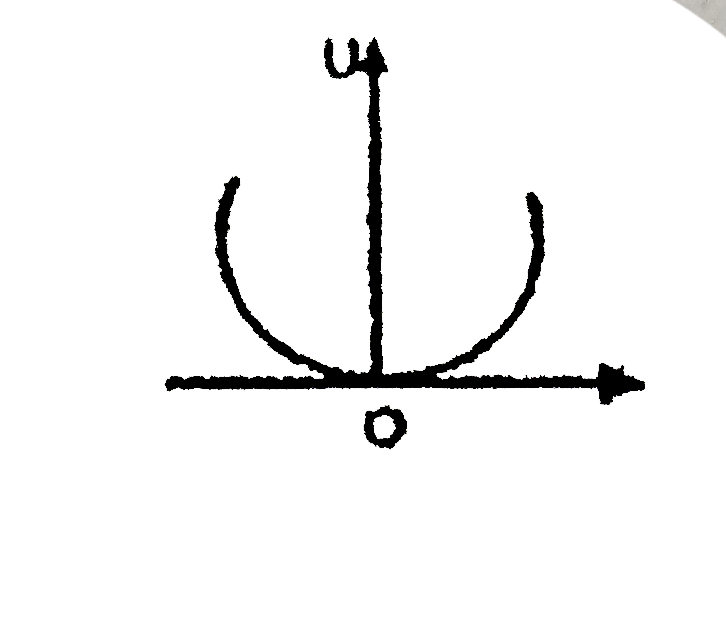
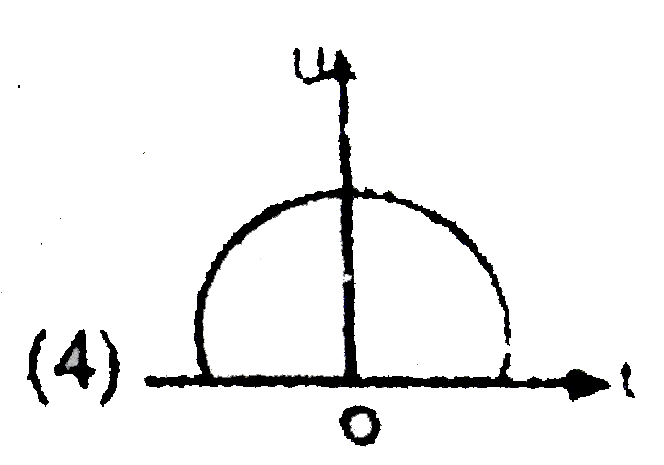
In S.H.M., potential energy (U) V/s, tim...

In S.H.M., potential energy (U) V/s, time (t) . Graph is

A

B

C

D

Text Solution

AI Generated Solution

The correct Answer is:
To determine the potential energy versus time graph for a particle undergoing simple harmonic motion (S.H.M.), we can follow these steps: ### Step-by-Step Solution: 1. **Understand the Equation of S.H.M.**: The displacement \( x \) of a particle in S.H.M. can be described by the equation: \[ x(t) = A \sin(\omega t + \phi) \] where: - \( A \) is the amplitude, - \( \omega \) is the angular frequency, - \( \phi \) is the phase constant. 2. **Potential Energy in S.H.M.**: The potential energy \( U \) of a particle in S.H.M. is given by: \[ U = \frac{1}{2} k x^2 \] where \( k \) is the spring constant. 3. **Substituting the Displacement**: Substitute the expression for \( x(t) \) into the potential energy formula: \[ U(t) = \frac{1}{2} k (A \sin(\omega t + \phi))^2 \] This simplifies to: \[ U(t) = \frac{1}{2} k A^2 \sin^2(\omega t + \phi) \] 4. **Analyzing the Graph**: The term \( \frac{1}{2} k A^2 \) is a constant. The potential energy \( U(t) \) is proportional to \( \sin^2(\omega t + \phi) \). The graph of \( \sin^2(x) \) oscillates between 0 and 1, meaning \( U(t) \) will oscillate between 0 and \( \frac{1}{2} k A^2 \). 5. **Graph Characteristics**: - The graph will always be above the time axis (since \( \sin^2 \) is always non-negative). - If \( \phi = 0 \), the graph starts at \( U = 0 \) when \( t = 0 \). - If \( \phi \) is not zero, the graph will be shifted horizontally. 6. **Final Graph**: The resulting graph of potential energy versus time will be a sinusoidal wave that oscillates between 0 and \( \frac{1}{2} k A^2 \), resembling a sine squared function.

To determine the potential energy versus time graph for a particle undergoing simple harmonic motion (S.H.M.), we can follow these steps: ### Step-by-Step Solution: 1. **Understand the Equation of S.H.M.**: The displacement \( x \) of a particle in S.H.M. can be described by the equation: \[ x(t) = A \sin(\omega t + \phi) ...
Promotional Banner

Topper's Solved these Questions

  • SEMICONDUCTORS

    RESONANCE|Exercise Exercise|29 Videos
  • SOUND WAVES

    RESONANCE|Exercise Exercise- 3 PART - II|1 Videos

Similar Questions

Explore conceptually related problems

When the displacement of a particle in S.H.M. is 0.2m, its Potential energy is equal to 2 J. The force constant of the S.H.M. is

For a particle executing S.H.M., the kinetic energy K is given K = K_(0) cos ^(2)omega t . The maximum value of potential energy is:

Which of the following graph is correct between kinetic energy E , potential energy (U) and height (h) from the ground of the partical

As a body performs SHM its potential energy U. varies with time as indicated in

In S.H.M., the graph between kinetic energy K and time 't' is

A body performs S.H.M. Its kinetic energy K varies with time t as indicated by graph

At the surface of earth, potential energy of a particle is U and potential is V.Change in potential energy and potential at height h=R are suppose DeltaU" and " Delta V .Then

The potential energy of a particle perfonning S.H.M. is

RESONANCE-SIMPLE HARMONIC MOTION-Exercise
  1. The amplitude of a particle performing SHM is 'a'. The displacement at...

    Text Solution

    |

  2. In S.H.M., the graph between kinetic energy K and time 't' is

    Text Solution

    |

  3. In S.H.M., potential energy (U) V/s, time (t) . Graph is

    Text Solution

    |

  4. The variation of the acceleration (f) of the particle executing S.H.M....

    Text Solution

    |

  5. The graph in the figure shows how the displacement of a particle descr...

    Text Solution

    |

  6. For a simple harmonic vibrator frequency n, the frequency of kinetic e...

    Text Solution

    |

  7. A particle is executing SHM with an amplitude 4 cm. the displacment at...

    Text Solution

    |

  8. For a particle executing S.H.M. which of the following statements hold...

    Text Solution

    |

  9. The equation of SHM of a particle is (d^2y)/(dt^2)+ky=0, where k is a ...

    Text Solution

    |

  10. The total energy of the body excuting S.H.M. is E . Then the kinetic e...

    Text Solution

    |

  11. A linear harmonic oscillator of force constant 2 xx 10^6 N//m and ampl...

    Text Solution

    |

  12. A particle excuting S.H.M. of amplitude 4 cm and T = 4 sec .The time t...

    Text Solution

    |

  13. The potential energy of a particle execuring S.H.M. is 2.5 J, when its...

    Text Solution

    |

  14. A body of mass m is suspended from three springs as shown in figure. I...

    Text Solution

    |

  15. One mass m is suspended from a spring. Time period of oscilation is T....

    Text Solution

    |

  16. A spring has a certain mass suspended from it and its period for verti...

    Text Solution

    |

  17. Two objects A and B of equal mass are suspended from two springs const...

    Text Solution

    |

  18. If the period of oscillation of mass M suspended from a spring is one ...

    Text Solution

    |

  19. A simple pendulum suspended from the ceilling of a stationary trolley ...

    Text Solution

    |

  20. If length of simple pendulum is increased by 6% then percentage change...

    Text Solution

    |