Home
Class 11
PHYSICS
A charge particle 'q' is shot towards an...

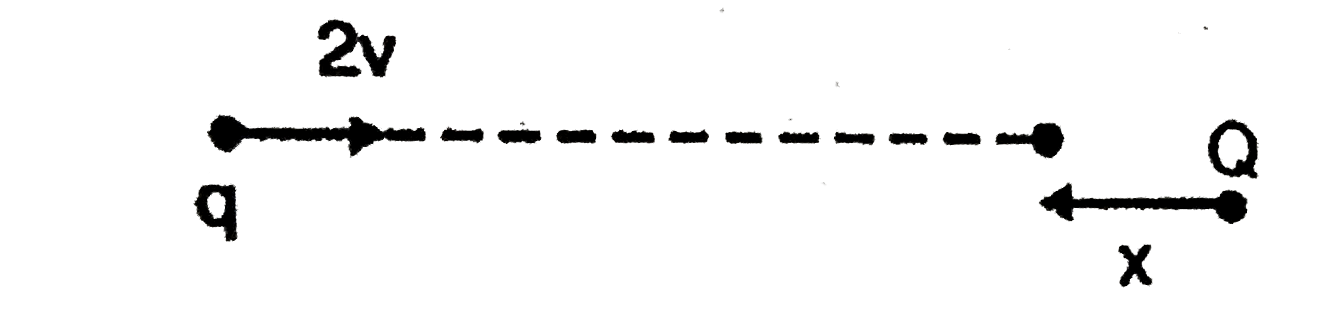
A charge particle 'q' is shot towards another charged particle 'Q' which is fixed, with a speed 'v'. It approaches 'Q' upto a closest distance r and then returns. If q were given a speed of '2v' the closest distances of approach would be

A

r

B

2r

C

r/2

D

r/4

Text Solution

Verified by Experts

The correct Answer is:
D


From the given data, using energy conservation
`1/2 mv^(2)=(KQq)/r`
when particle is shot with a speed eV, let distance of closest approach =x
`1/2 m.4v^(2)=(KQq)/xrArr x=r/4`
Promotional Banner

Topper's Solved these Questions

  • ELECTROMAGNETIC INDUCTION

    RESONANCE|Exercise Exercise|43 Videos
  • FLUID MECHANICS

    RESONANCE|Exercise Advanced Level Problems|8 Videos

Similar Questions

Explore conceptually related problems

A charged particle q is shot from a large distance twoards another charged particle Q which is fixed, with speed v. It approaches Q up to as closed distance r and then returns. If q were given a speed 2v, the distasnce of approach would be

A particle of mass m, charge q gt 0 and initial kinetic energy K is projected from infinity towards a heavy nucleus of charge Q assumed to have a fixed position. (a) If the aim is perfect, how close to the centre of the nucleus is the particle when it comes instantaneously to rest ? (b) With a particular imperfect aim, the particle's closest approach to nucleus is twicw the distance determined in (a). Determine speed of particle at the closest distance of approach.

A long straight wire carries a current i. A particle having a positive charge q and mass m, kept at distance x_0 from the wire is projected towards it with speed v. Find the closest distance of approach of charged particle to the wire.

A charged particle of charge 'Q' is held fixed and another charged particle of mass 'm' and charge 'q' (of the same sign) is released from a distance 'r'. The impulse of the force exerted by the external agent on the fixed charge by the time distance between 'Q' and 'q' becomes 2 r is

Q:6DTQ Two particles of mass m and 2m carry a charge q each.Initially the heavier particle is at rest on a smooth horizontal plane and the other is projected along the plane directly towards the first from a distance d with speed u.If the closest distance of approach is (3q^(2)d)/(nq^(2)+4 pi varepsilon_(0)u^(2)d) then find the value of n .

A charge "Q" of mass "m" is at rest on a smooth horizontal plane.Another identical particle is projected with a velocity v towards it from long distance then

Two particles of mass m and 2m carry a charge q each.Initially the heavier particle is at rest on a smooth horizontal plane and the other is projected along the plane directly towards the first from a distance d with speed u .If the closest distance of approach is (3q^(2)d)/(nq^(2)+4 pi e_(0)u^(2)d) then find the value of n .

Figure shows a charge +Q clamped at a point in free space. From a large distance another charge particle of charge -q an.d mass m is thrown toward +Q with an impact parameter d as shown with speed v. Find the distance of closest approach of the two particles.

Two identical particles of mass m carry a charge Q , each. Initially one is at rest on a smooth horizontal plane and the other is projected along the plane directly towards first particle from a large distance with speed v. The closest distance of approach be .

A particle of mass m and charge +q approaches from a very large distance towards a uniformly charged ring ofradius Rand charge, mass same as that of particle, with initial velocity v_(0) along the axis of the ring as shown in the figure-1.420. What is the closest distance of approach between the ring and the particle? Assume the space to be gravity free and frictionless :

RESONANCE-ELECTROSTATICS-Exercise
  1. If the electric flux entering and leaving an enclosed surface respecti...

    Text Solution

    |

  2. The number of electrons to be put on a spherical conductor of radius 0...

    Text Solution

    |

  3. A charge particle 'q' is shot towards another charged particle 'Q' whi...

    Text Solution

    |

  4. A point charge +Q is placed at the centroid of an equilateral triangle...

    Text Solution

    |

  5. Four positive charges (2sqrt2-1)Q are arranged at the four corners of ...

    Text Solution

    |

  6. Point charges +4q, -q are kept on the x-axis at points x=0,x=a and X=2...

    Text Solution

    |

  7. A simple pendulum of mass m and charge +q is suspended vertically by a...

    Text Solution

    |

  8. The diagram shows the arrangement of three small uniformally charged s...

    Text Solution

    |

  9. Figure, shown above, shows three situations involving a charged partic...

    Text Solution

    |

  10. There are three concentric thin spheres of radius a,b,c (agtbgtc). The...

    Text Solution

    |

  11. A particle of charge -q and mass m moves in a circle of radius r aroun...

    Text Solution

    |

  12. The figure shown represents the electric field between two large metal...

    Text Solution

    |

  13. The variation of electric field on the y-axis as a function of 'y' is ...

    Text Solution

    |

  14. A ring carries a uniform linear charge density on one half and the lin...

    Text Solution

    |

  15. Two very large thin conducting plates having same cross sectional are...

    Text Solution

    |

  16. Two semicircular rings lying in same plane, of uniform linear charge d...

    Text Solution

    |

  17. A non-uniformly charged ring is kept near an uncharged conducting soli...

    Text Solution

    |

  18. A mercury drop of water has potential 'V' on its surface. 1000 such dr...

    Text Solution

    |

  19. A point charge of 5C is placed at point P (as shown in figure). A unit...

    Text Solution

    |

  20. An electron is revolving around a proton. The total work done in one r...

    Text Solution

    |

