Home
Class 11
PHYSICS
A point charge q moves from point P to p...

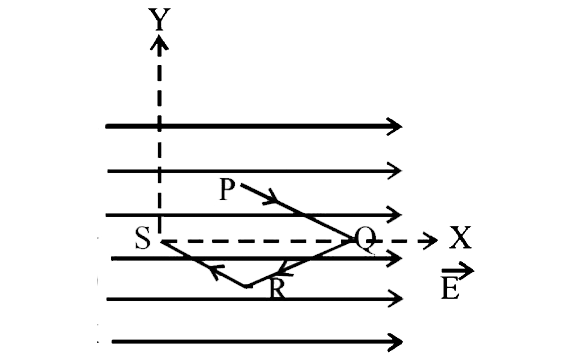
A point charge q moves from point P to pont S along the path PQRS (fig.) in a uniform electric field E pointing parallel to the poistive direction of the X-axis. The coordinates of the points P, Q, R and S are(a, b, O), (2a, O, O)(a, -b,`ulO`) and `(O, O, O) respectively. The work done by the field in the above process is given by the expresison............

A

`qEsqrt(a^(2)+b^(2))`

B

qEb

C

`-qEa`

D

qEa

Text Solution

Verified by Experts

The correct Answer is:

C

Work done by electric field
`=qvec(E).Deltavec(r)=q(Ehati).[(0hati+0hatj+0hatk)-(ahati+bhatj)]`
=-qEa
Promotional Banner

Topper's Solved these Questions

  • ELECTROMAGNETIC INDUCTION

    RESONANCE|Exercise Exercise|43 Videos
  • FLUID MECHANICS

    RESONANCE|Exercise Advanced Level Problems|8 Videos

Similar Questions

Explore conceptually related problems

Write the coordinate of each of the points P,Q, R,S,T and O from the figure

A point charge q moves from A to B along a parabolic(x2 =2ay) path (AB is latus rectum). Electric field is along x-axis. The work done by the field is

A positive point charge q is carried from a point B to a point A in the electric field of a point charge +Q at O. If the permittivity of free space is epsi_0 , the work done in the process is given by (where a = OA and b = OB ) -

In given diagrams write the direction of magnetic field produced at point P in forom of ox and o. .

In an uniform electric field of strength E, a charge particle Q moves point A to point B in the direction of the field and back from B to A. Calculate the ratio of the work done by the electric field in taking the charge particle from A to B and from B to A.

Two point charges +q and -q are held fixed at (-d,o) and (d,0) respectively of a x-y coordinate system. Then

Calculate the distance between the point P(O, 6) and Q(0, -2) .

In the electric field of a point chargde q , a cetrain charge is carried from point A to B, C, D and E . Then the ork done

RESONANCE-ELECTROSTATICS-Exercise
  1. S1: When a positively charged particle is released in an electric fiel...

    Text Solution

    |

  2. A point charge q is located at the centre fo a thin ring of radius R ...

    Text Solution

    |

  3. Two small balls having equal positive charge Q (coulumb) on each suspe...

    Text Solution

    |

  4. A point charge q moves from point P to pont S along the path PQRS (fig...

    Text Solution

    |

  5. A large nonconducting sheet M is given a uniform charge density. Two u...

    Text Solution

    |

  6. At a distance of 5 cm and 10 cm outward from the surface of a uniforml...

    Text Solution

    |

  7. An electric dipole is kept in the electric field produced by a point c...

    Text Solution

    |

  8. The electric potential decreases uniformly from 180V to 20V as one mov...

    Text Solution

    |

  9. Two positive point charges each of magnitude 10 C are fixed at positio...

    Text Solution

    |

  10. A square loop of side 'l' having uniform linear charge density 'lambda...

    Text Solution

    |

  11. In the following figure an isolated charged conductor is shown. The co...

    Text Solution

    |

  12. If the above question, the potential has correct relations as given=

    Text Solution

    |

  13. In the above question, the surface charge densities have the correct r...

    Text Solution

    |

  14. A family of equipotential surface are shown. The direction of the elec...

    Text Solution

    |

  15. A and B are two concentric spherical shells. If A is given a charge +q...

    Text Solution

    |

  16. Mark the wrong statement-

    Text Solution

    |

  17. A hollow conducting sphere is placed in an electric field produced by ...

    Text Solution

    |

  18. A point charge is kept at the centre of a metallic insulated spherical...

    Text Solution

    |

  19. STATEMENT 1: When a negative charge -q is released at a distance R fro...

    Text Solution

    |

  20. Assertion: A positively charged rod is held near a neutral conducting ...

    Text Solution

    |
