Home
Class 11
PHYSICS
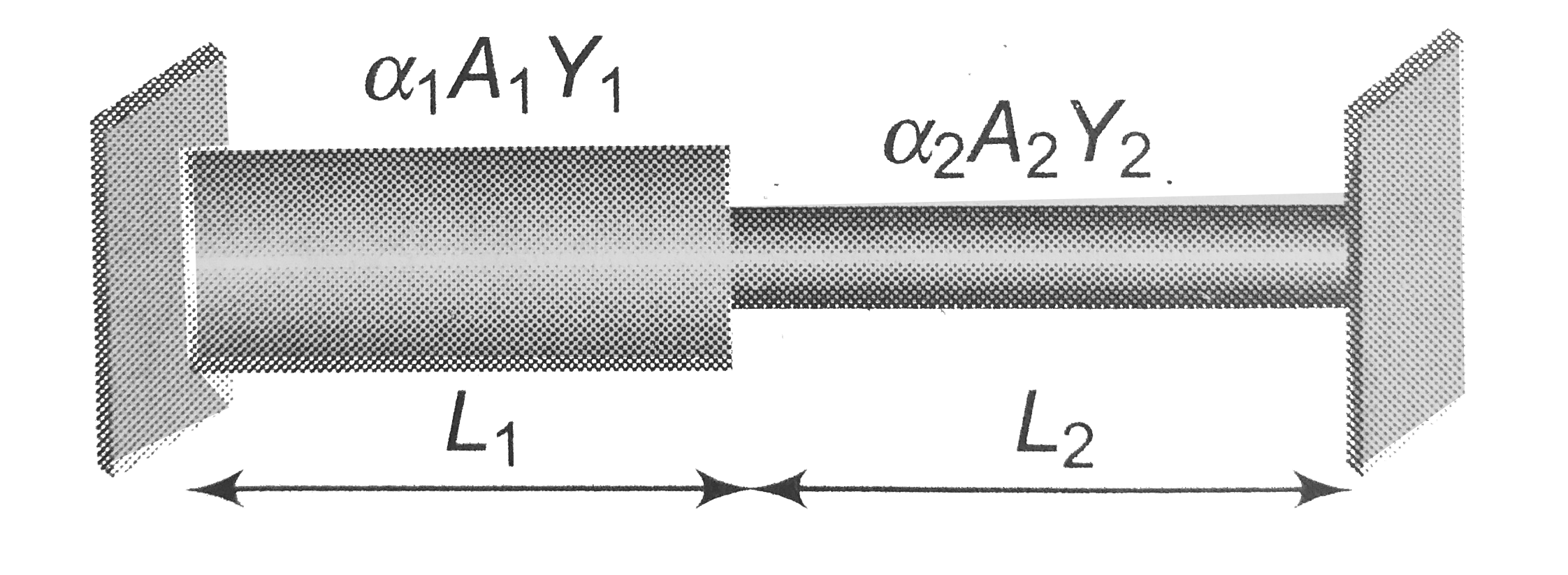
Two rods are joined between fixed suppor...

Two rods are joined between fixed supports as shown in the figure. Condition for no change in the length of individual rods with the increase of temperature will be
`"(" alpha_(1), alpha_(2)=` linear expansion coefficient
`A_(1), A_(2)=` Area of rods
`Y_(1), Y_(2)=` Young modulus `")"`

A

`(A_(1))/(A_(2))=(alpha_(1)Y_(1))/(alpha_(2)Y_(2))`

B

`(A_(1))/(A_(2))=(L_(1)alpha_(1)Y_(1))/(L_(2)alpha_(2)Y_(2))`

C

`(A_(1))/(A_(2))=(L_(2)alpha_(2)Y_(2))/(L_(1)alpha_(1)Y_(1))`

D

`(A_(1))/(A_(2))=(alpha_(2)Y_(2))/(alpha_(1)Y_(1))`

Text Solution

Verified by Experts

The correct Answer is:

D

`Y=("Stress")/("Strain")=(T//A)/(Deltal//l)`
`T=(Y.Deltal)/l A=Y.A alpha DeltaT`
In both the rods tension will be same so
`T_(1)=T_(2)`
Hence `Y_(1)A_(1)alpha_(1)DeltaT=Y_(2)A_(2)alpha_(2)DeltaT`
`(A_(1))/(A_(2))=(Y_(2)alpha_(2))/(Y_(1)alpha_(1))`
Promotional Banner

Topper's Solved these Questions

Similar Questions

Explore conceptually related problems

The variation of lengths of two moles rods A and B with change in temperature is shown in figure . The ratio of (alpha_(a))/(alpha_(B)) is :-

Two rods AB and BC of equal cross-sectional area are joined together and clamped between two fixed supports as shown in the figure. For the rod AB and road BC lengths are l_(1) and l_(2) coefficient of linear expansion are alpha_(1) and alpha_(2) , young's modulus are Y_(1) and Y_(2) , densities are rho_(1) and rho_(2) respectively. Now the temperature of the compound rod is increased by theta . Assume of that there is no significant change in the lengths of rod due to heating. then the time taken by transverse wave pulse to travel from end A to other end C of the compound rod is directly proportional to

Two metal rods are fixed end to end between two rigid supports as shown in figure. Each rod is of length l and area of cross-section is A . When the systeam is heated up,datermine the condition when the juncation between rods does not shift ? ( Y_(1) and Y_(2) are Young's modulus of materials of rods, alpha_(1) and alpha_(2) are coefficients of linear expansion)

Two metal rods are fixed end to end between two rigid supports, as shown in figure. Each rod is of length 'l' and area of cross-section is A. When the system is heated up, determine the conditioin whenthe juction between rods does not shift. [Given, Y_(1) and Y_(2) are Young's modulus of materials of the rods, alpha_(1) and alpha_(2) are coefficient at linear expansion.

Two rods of different materials having coefficient of thermal expansion alpha_(1), alpha_(2) and young's modulii Y_(1) ,Y_(2) respectively are fixed between two rigid massive walls. The rods are heated such that they undergo the same increase in temperature. There is no bending of rods. If alpha_(1) :alpha_(2)=2 : 3 , the thermal stresses developed in the two rods are equal provided Y_(1) : Y_(2) is equal to

Two rods of equal cross sections, one of copper and the other of steel, are joined to form a composite rod of length 2.0 m at 20^@C , the length of the copper rod is 0.5 m. When the temperature is raised to 120^@C , the length of composite rod increases to 2.002m. If the composite rod is fixed between two rigid walls and thus not allowed to expand, it is found that the lengths of the component rods also do not change with increase in temperature. Calculate Young's moulus of steel. (The coefficient of linear expansion of copper, alpha_c=1.6xx10^(-5@)C and Young's modulus of copper is 1.3xx10^(13)N//m^(2) ).

The coefficient of linear expansion of a rod is alpha and its length is L. The increase in temperature required to increase its legnth by 1% is

RESONANCE-PART TEST 2-Exercise
  1. For an ideal gas four processes are marked as 1,2,3 and 4 on P-V diagr...

    Text Solution

    |

  2. A circular hole is made in a plate. The plate is now heated. Which of ...

    Text Solution

    |

  3. At pressure P and absolute temperature T a mass M of an ideal gas fill...

    Text Solution

    |

  4. Two identical rooms in a perfectly insulated house are connected by an...

    Text Solution

    |

  5. The molar heat capacity of oxygen gas at STP is nearly 2.5 R. As the t...

    Text Solution

    |

  6. An ideal gas heat engine operates in a Carnot cycle between 27^(@)C an...

    Text Solution

    |

  7. Curve in the figure shows an adiabatic compression of an ideal gas fro...

    Text Solution

    |

  8. If there is no heat loss, the heat released by the condensation of x g...

    Text Solution

    |

  9. All the rods have same conductance 'K' and same area of cross section ...

    Text Solution

    |

  10. A conducting container containing an ideal gas (He) is kept in ice-wat...

    Text Solution

    |

  11. One litre of helium gas at a pressure 76 cm. Of Hg and temperature 27^...

    Text Solution

    |

  12. 4 gm of steam at 100^(@)C is added to 20 gm of water at 46^(@)C in a c...

    Text Solution

    |

  13. Two rods are joined between fixed supports as shown in the figure. Con...

    Text Solution

    |

  14. A partition divides a container having insulated walls into two compar...

    Text Solution

    |

  15. A uniform metallic object of circular shape which is free to expand in...

    Text Solution

    |

  16. If the piston is moved so as to reduce the volume of gas by half keepi...

    Text Solution

    |

  17. Two rods of same length and areas of cross section A1 and A2 have thei...

    Text Solution

    |

  18. A rod of length l and cross sectional area A has a variable conductivi...

    Text Solution

    |

  19. A Carnot engine takes 3xx10^6 cal of heat from a reservoir at 627^@C a...

    Text Solution

    |

  20. Statement 1: A gas has a unique value of specific heat. Statement 2:...

    Text Solution

    |
