Home
Class 11
PHYSICS
Two particles of charge q(1) and q(2) ar...

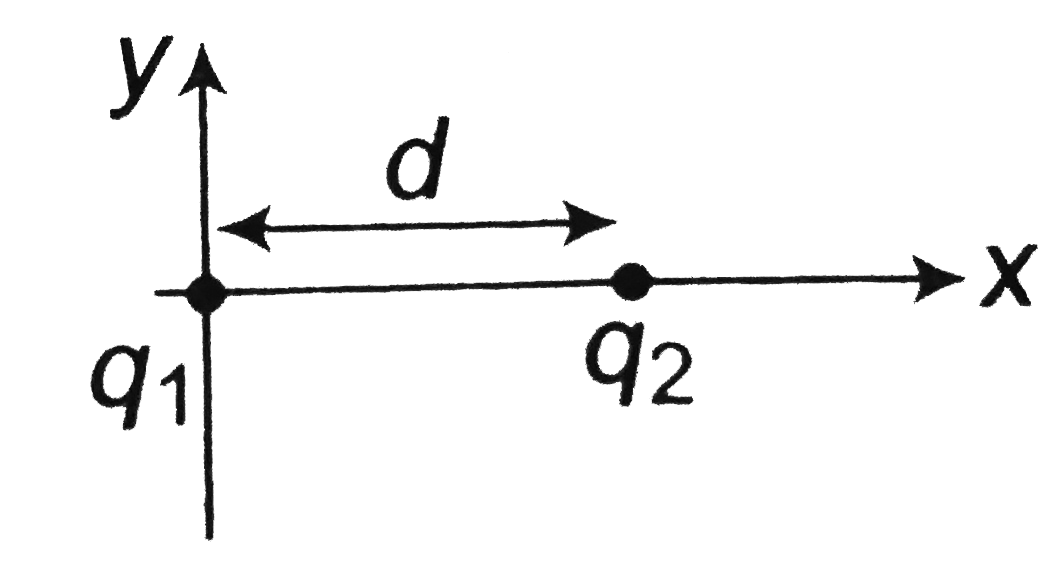
Two particles of charge `q_(1)` and `q_(2)` are separated by distance `d` as shown in figure. Chrage `q_(1)` is situarted at the origin. The net electirc field due to the particles is zero at `x = d//4`. With `V = 0` at infinity, the location of a point in terms of `d` on the `x` axis (other at infinfity) at which the elctrical potential due to the two particles is zero, is given by:

A

d/4

B

16d

C

`-16 d`

D

no point on the axis

Text Solution

Verified by Experts

The correct Answer is:

D

`vec(E)` is zero in between the two charges. So both charges must have the same sign.
Therefore, electric potential cannot be zero anywhere on the axis.
Promotional Banner

Topper's Solved these Questions

Similar Questions

Explore conceptually related problems

Two point charges Q and - Q //4 are separated by a distance X . Then .

Two charge Q_(1)=18muC and Q_(2)=-2 mu C are separted by a distance R, and Q_(1) is on the left off Q_(2) . The distance of the point where the net electric field is zero is

two point charges + 16 q and -4q located at x=0 and x=L respectively. the location of a point on the x-axis from x=0, at which the net electric field due to these two charges is zero is

Two point charges +8q and -2q are located at x=0 and x=L respectively. The location of a point on the x axis at which the net electric field due to these two point charges is zero is

Two particles of masses p and q (p gt q) are separated by a distance d . The shift in the centre of mass when the two particles are interchanged is

Two unlike charges of magnitude q are separated by a distance 2d . The potential at a point midway between them is

Two positive point charges q_1=16muC and q_2=4muC are separated in vacuum by a distance of 3.0m . Find the point on the line between the charges where the net electric field is zero.-

A point dipole is kept at the origin. The potential and electric field due to this dipole on the y-axis at a distance d are, respectively: (Take V = 0 at infinity)

RESONANCE-PART TEST 5-Exercise
  1. Figure shows a solid hemisphere with a charge of 5 nC distributed unif...

    Text Solution

    |

  2. Figure shows two concentric shells of radii a and b uniformly distribu...

    Text Solution

    |

  3. Two particles of charge q(1) and q(2) are separated by distance d as s...

    Text Solution

    |

  4. A fixed ring of radius R is given a charge q. A charge q0 is brought s...

    Text Solution

    |

  5. In the figure two concentric conducting shells of radius R & 2R are sh...

    Text Solution

    |

  6. Two equipotential spherical surface having potential 20V and 0V are as...

    Text Solution

    |

  7. The electric field intensity at all points in space is given by vecE =...

    Text Solution

    |

  8. Two concentric conducting thin shells of radius R and 2 R carry charge...

    Text Solution

    |

  9. A uniformly charged non-conducting spherical shell is given +q charge ...

    Text Solution

    |

  10. Find out the potential of the junction S (in volts) if all the dark wi...

    Text Solution

    |

  11. In the figure shown R = 100 Omega L = (2)/(pi) H and C = (8)/(pi) mu F...

    Text Solution

    |

  12. A uniform field is exists in the region directed away from the page. A...

    Text Solution

    |

  13. When the number of turns in a coil is doubled without any change in th...

    Text Solution

    |

  14. The potential difference across 8 ohm resistance is 48 volt as shownin...

    Text Solution

    |

  15. In the given circuit, in steady state we may say: (capacitors are init...

    Text Solution

    |

  16. Two circular rings of identical radii and resistance of 36Omega each a...

    Text Solution

    |

  17. At distance 'r' from a point charge, the ratio (U)/(V^(2)) (where 'U' ...

    Text Solution

    |

  18. A graph between current and time during charging of a capacitor by a b...

    Text Solution

    |

  19. An electron passes between two parallel plate of a capacitor as shown ...

    Text Solution

    |

  20. Three distinct current carrying wires intersect a finite rectangular p...

    Text Solution

    |
