Home
Class 12
PHYSICS
A neutron collides elastically with an i...

A neutron collides elastically with an initially stationary deuteron. Find the fraction of the kinetic energy lost by the neutron (a) in a head-on collision , (b) in scattering at right angles.

Text Solution

Verified by Experts

The correct Answer is:
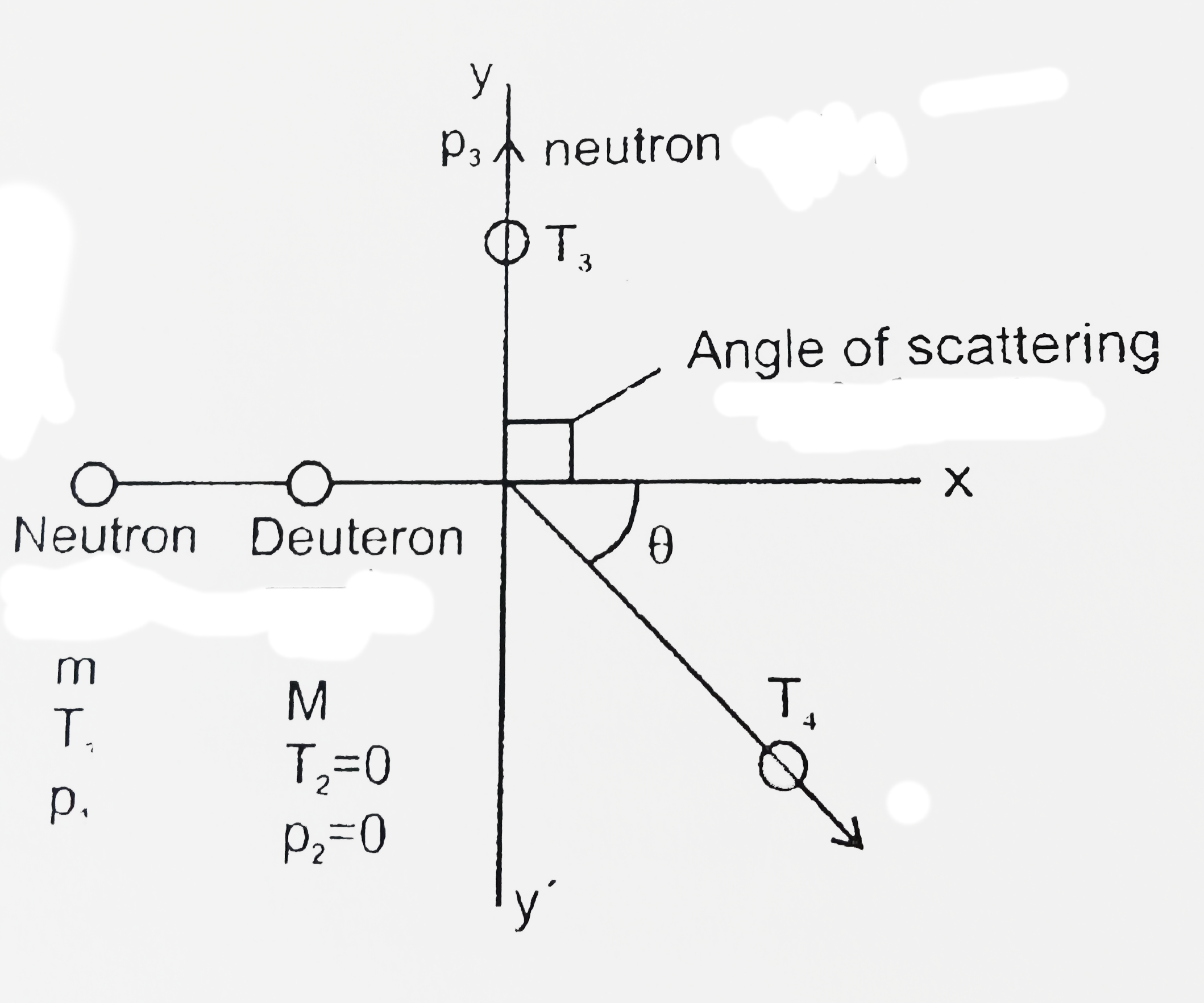
(a) `eta=4mM//(m+M)^(2)=0.89`
(b)`eta=2m//(m+M)=2//3`
Here `m` and `M` are the masses of a neutron and deutron.

According conservation principal of momentum,
`vec(p)_(1)+vec(p)_(2)=vec(p)_(3)+vec(p)_(4)`
or `p_(1)=p_(3)+p_(4)`.....(4)
According conservation principle of kinetic energy
`T_(1)+T_(2)=T_(3)+T_(4) or T_(1)=T_(3)+T_(4)`
or `(p_(1)^(2))/(2m)=(p_(3)^(2))/(2m)+(p_(4)^(2))/(2m)`
or `(p_(1)^(2))/(2m)=((p_(1)-p_(4))^(2))/(2m)+(p_(4)^(2))/(2m)` (from eqn.(i))
or `(p_(1)^(2))/(2m)=(p_(1)^(2)+p_(4)^(2)-2p_(1p_(4)))/(2m)+(p_(4)^(2))/(2m) or (p_(1)^(2))/(2m)=(p_(1)^(2))/(2m)+(p_(4)^(2))/(2m)+(p_(4)^(2))/(2m)`
or `p_(4)((1)/(m)+(1)/(M))=(2p_(1p4))/(2m) or p_(4)((1)/(m)+(1)/(M))=(2p_(1))/(m)`
or `p_(4)=((2M)/(m+M))p_(1)`
`:. p_(4)^(2)=((2M)/(m+M))^(2)p_(1)^(2)`.....(ii)
`:.` Loss in kinetic energy of neuton `=Delta T_(1)=` gain in `K.E`. of deuteron
`DeltaT_(1)=T_(4)=(p_(4)^(2))/(2M)`
Fraction =`(DeltaT_(1))/(T_(1))=(((2M)/(m+M))^(2)(p_(1)^(2))/(2M))/((p_(1)^(2))/(2m))`
`eta=((2M)/(m+M))((m)/(M))=(4mM)/((m+M)^(2))`
Here `M~~2m`
`:.` Fraction in `eta=(8)/(9)=0.89`
(b) According to conservation priciple of momentum,
`vec(p)_(1)+vec(p)_(2)=vec(p)_(3)+vec(p)_(4)`
or `vec(p_(1))+0=vec(p)_(3)+vec(p)_(4)`
or `vec(p)_(1)-vec(p)_(3)^(2)-2p_(1)p_(3)+vec(p)_(4)`
Applying parallelogram law of vectors
`p_(1)^(2)+p_(3)^(2)-2p_(1)p_(3)cos 90^(@)=p_(4)^(2)`
According to conservation principle of kinetic energy
`T_(1)+T_(2)=T_(3)+T_(4)`
or `T_(1)+0=T_(3)+T_(4)`
or `(p_(1)^(2))/(2m)=(p_(3)^(2))/(2m)+(p_(4)^(2))/(2m)`
or `(p_(1)^(2))/(2m)=(p_(3)^(2))/(2m)+(p_(1)^(2)+p_(3)^(2))/(2M)`
or `(p_(1)^(2))/(2m)((1)/(m)-(1)/(M))=(p_(3)^(2))/(1)((1)/(m)-(1)/(M))`
or `p_(1)^(2)(p_(1)^(2))/(2m)((M-m)/(mN))= +p_(3)^(2)((m+M)/(mM))`
or `p_(3)^(2)=((m-M)/(m+M))p_(1)^(2)`
`:.` Loss in kinetic energy of neutron is
`DeltaT=T_(1)-T_(3)`
`=(p_(1)^(2))/(2m)-(p_(3)^(2))/(2m)=(p_(1)^(2)-p_(3)^(2))/(2m)`
`eta=(DeltaT)/(T_(1))=((p_(1)^(2)-p_(3)^(2))/(2m))/((p_(1)^(2))/(2m))`
`1-(p_(3)^(2))/(p_(1)^(2))=1-((M-m)/(M+m))(p_(1)^(2))/(p_(1)^(2))`
`h=1-((M=m)/(M+m))=(2m)/(M+m)=(2)/(3)`
Promotional Banner

Topper's Solved these Questions

  • NUCLEAR PHYSICS

    RESONANCE|Exercise Exercise -3 Part-III CBSE PROBLEMS (LAST 10 YEARS)|33 Videos
  • GRAVITATION

    RESONANCE|Exercise HIGH LEVEL PROBLEMS|16 Videos
  • REVISION DPP

    RESONANCE|Exercise All Questions|444 Videos

Similar Questions

Explore conceptually related problems

A neutron makes is a head - on elastic collision with a stationary deuteron The fraction energy loss of the neutron in the collision is

A neutron collides head-on and elasticity with an atom of mass number A , which is initially at rest. The fraction of kinetic energy retained by neutron is

A neutron in a nuclear reactor collides head on elastically with the nucleus of a carbon atom initially at rest. The fraction of kinetic energy transferred from the neutron to the carbon atom is

A moving body of mass m makes a head on elastic collision with another body of mass 2m which is initially at rest. Find the fraction of kinetic energy lost by the colliding particles after collision.

A particle of mass m_1 experienced a perfectly elastic collision with a stationary particle of mass m_2 . What fraction of the kinetic energy does the striking particle lose, if (a) it recoils at right angles to its original motion direction, (b) the collision is a head-on one?

A neutron with velocity V strikes a stationary deuterium atom, its kinetic energy changes by a factor of

A neutron moving at a speed v undergoes a head-on elastic collision with a nucleus of mass number A at rest. The ratio of the kinetic energies of the neutron after and before collision is :

RESONANCE-NUCLEAR PHYSICS-Advanced level solutions
  1. A radioactive element decays by beta-emission. A detector records n be...

    Text Solution

    |

  2. A 100ml solution having activity 50 dps is kept in a beaker It is now ...

    Text Solution

    |

  3. what kinetic energy must an alpha-particle possess to split a deuteron...

    Text Solution

    |

  4. Suppose a nucleus initally at rest undergoes alpha decay according to...

    Text Solution

    |

  5. A neutron collides elastically with an initially stationary deuteron. ...

    Text Solution

    |

  6. Find the binding energy of a nucleus consisting of equal numbers of pr...

    Text Solution

    |

  7. A radio nuclide with half life T = 69.31 second emits beta-particles ...

    Text Solution

    |

  8. (a) Find the energy needed to remove a neutron from the nucleus of the...

    Text Solution

    |

  9. A nucleus X, initially at rest , undergoes alpha dacay according to th...

    Text Solution

    |

  10. 100 millicuries of radon which emits 5.5 MeV alpha- particles are cont...

    Text Solution

    |

  11. Radium being a member of the uranium series occurs in uranium ores. If...

    Text Solution

    |

  12. .^(90)Sr decays to .^(90)Y by beta decay with a half-life of 28 years....

    Text Solution

    |

  13. The element Curium (96)^(248Cm has a mean life of 10^(13) second. Its ...

    Text Solution

    |

  14. Nucleus .(3)A^(7) has binding energy per nucleon of 10 MeV. It absorbs...

    Text Solution

    |

  15. The nucleus of .(90)^(230)Th is unstable against alpha-decay with a ha...

    Text Solution

    |

  16. When .^(30)Si bombarded with a deutron. .^(31)Si is formed in its grou...

    Text Solution

    |

