Home
Class 12
BIOLOGY
Direction : Carefully read the following...

Direction : Carefully read the following information to answer Q.no.1 and Q.no.2
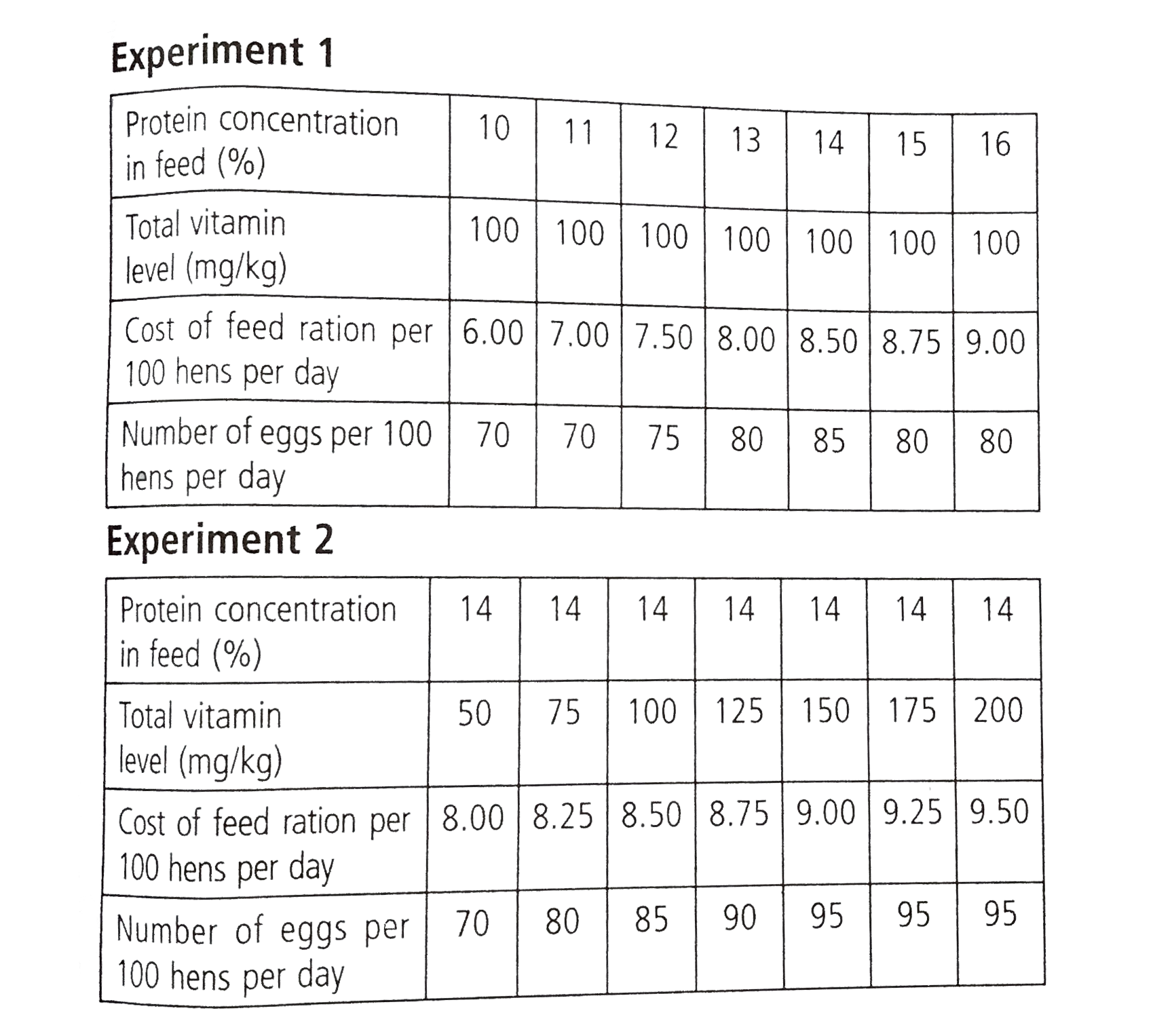
An egg farmer is experimetnting with different feed rations with the aim of increasing his production whilst reducing the cost of the feed per egg produced. The data from two feeding experiments is given below.

Which feed composition give the least cost per egg produced ?

A

`{:("Protein (concentration (%)",,"Total vitamin level" (mg//kg)),(16,,100):}`

B

`{:("Protein (concentration (%)",,"Total vitamin level" (mg//kg)),(14,,50):}`

C

`{:("Protein (concentration (%)",,"Total vitamin level" (mg//kg)),(14,,100):}`

D

`{:("Protein (concentration (%)",,"Total vitamin level" (mg//kg)),(14,,150):}`

Text Solution

Verified by Experts

The correct Answer is:

D

In experiment 1, cost per egg produced from different protein concentrations can be calculated as follows:
Cost per egg `= ("Cost of feed per 100 hens per day")/("Number of eggs per 100 hens per day")`
The calculations show that the cost per egg for different protein concentrations is `0.085, 0.100, 0.100, 0.100, 0.109` and `0.112` respectively.
Similarly in experiment 2, cost per egg is found to be `0.114, 0.103, 0.100, 0.097, 0.094, 0.097` and `0.100` respectively with increased vitamin level. Hence, on analysing the given experimental results, it becomes clear that least cost per egg in incurred in feed with `10%` protein concentration and vitamin level at `100 mg//kg` but out of the given options, option (d) i.e., feed ration with `14%` protein concentration and `150 mg//kg` vitamin level gives the least cost per egg i.e., `0.094`.
Promotional Banner

Topper's Solved these Questions

  • SEXUAL REPRODUCTION IN FLOWERING PLANTS

    NCERT FINGERTIPS|Exercise Sexual Reproduction In Flowering Plants|145 Videos

Similar Questions

Explore conceptually related problems

Direction : Carefully read the following information to answer Q.no.1 and Q.no.2 An egg farmer is experimetnting with different feed rations with the aim of increasing his production whilst reducing the cost of the feed per egg produced. The data from two feeding experiments is given below. What are the independent variable in each of the two experiments?

Directions: Read the following information carefully and answer the question given below: P, Q, R, S, T, V and W are sitting around a circle facing the centre. R is third to the right of V, who is second to the right of P. T is second to the left of Q, who is second to the left of W. V is sitting between S and W. Who is on the immediate left of R? 1) Q 2) T 3) P 4) Data inadequate 5) None of these

Directions: Read the following information carefully and answer the question given below: P, Q, R, S, T, V and W are sitting around a circle facing the centre. R is third to the right of V, who is second to the right of P. T is second to the left of Q, who is second to the left of W. V is sitting between S and W. Who is sitting between R and W? 1) Only Q 2) Only P 3) Only PT 4) Data inadequate 5) None of these

Directions: Read the following information carefully and answer the question given below: P, Q, R, S, T, V and W are sitting around a circle facing the centre. R is third to the right of V, who is second to the right of P. T is second to the left of Q, who is second to the left of W. V is sitting between S and W. Who is sitting between T and V? 1) None 2) R 3) S 4) Data inadequate 5) None of these

Directions: Read the following information carefully and answer the question given below: P, Q, R, S, T, V and W are sitting around a circle facing the centre. R is third to the right of V, who is second to the right of P. T is second to the left of Q, who is second to the left of W. V is sitting between S and W. Who is third to the left of T? 1) P 2) S 3) V 4) W 5) None of these

Directions: Study the following information carefully and answer the question given below: P, Q,R, S, T,V and W are sitting around a circle facing at the centre. R is third to the left of V who is second to the left of T. W is second to the right of P who is not an immediate neighbour of V. S is not an immediate neighbour of W. Who is second to the right of R? 1) T 2) W 3) Q 4) Data inadequate 5) None of these

Directions: Study the following information carefully and answer the question given below: P, Q,R, S, T,V and W are sitting around a circle facing at the centre. R is third to the left of V who is second to the left of T. W is second to the right of P who is not an immediate neighbour of V. S is not an immediate neighbour of W. Which of the following pairs represents the immediate neighbours of R? 1) PT 2) PQ 3) WT 4) PW 5) Data inadequate

Directions: Study the following information carefully and answer the question given below: P, Q,R, S, T,V and W are sitting around a circle facing at the centre. R is third to the left of V who is second to the left of T. W is second to the right of P who is not an immediate neighbour of V. S is not an immediate neighbour of W. In which of the following pairs is the first person sitting to the immediate right of the second person? 1) PR 2) PT 3) RW 4) QV 5) None of these

Directions: Study the following information carefully and answer the question given below: J, K, H, R, F, L, N and Q are sitting around a circular table facing the centre. H is third to the left of L and is to the immediate right of K. R is third to the left of N but is not a neighbour of H or L. J is second to the right of Q. Which of the following groups of persons has the first person sitting between the next two? 1) LKN 2) QFL 3) JHR 4) JHF 5) None of these

NCERT FINGERTIPS-STRATEGIES FOR ENHANCEMENT IN FOOD PRODUCTION-Strategies For Enhancement In Food Production
  1. Given below is the flow chart showing the process of somatic hybridis...

    Text Solution

    |

  2. The enzymes required to obtain protoplast from a plant cell are

    Text Solution

    |

  3. Direction : Carefully read the following information to answer Q.no.1 ...

    Text Solution

    |

  4. Direction : Carefully read the following information to answer Q.no.1 ...

    Text Solution

    |

  5. A certain type of grass has a diploid chromosome number of 8. A simila...

    Text Solution

    |

  6. Inbreeding for five generations led to production of homozygous transg...

    Text Solution

    |

  7. Many attempts to improve livestock in the tropics have been made by 'u...

    Text Solution

    |

  8. Which of the following statements does not provide an explanation for ...

    Text Solution

    |

  9. The changes contracting bird flu from a properly cooked (above 100^(@)...

    Text Solution

    |

  10. A group of animals which are related by descent and share many similar...

    Text Solution

    |

  11. Inbreeding is carried out in animal husbandry because it

    Text Solution

    |

  12. Sonalika and Kalyan Sona are varieties of

    Text Solution

    |

  13. Which one of the following is not a fungal disease ?

    Text Solution

    |

  14. In virus-infected plants the meristematic tissues in both apical and a...

    Text Solution

    |

  15. Several South Indian states raise 2-3 crops of rice annually. The agro...

    Text Solution

    |

  16. Which of the following combination would a sugarcane farmer look for i...

    Text Solution

    |

  17. Fungicides and antibiotics are chemicals that

    Text Solution

    |

  18. Use of certain chemicals and radiation to change the base sequences of...

    Text Solution

    |

  19. The scientific process by which crop plants are enriched with certain ...

    Text Solution

    |

  20. The term 'totipotency' refers to the capacity of a

    Text Solution

    |
