Home
Class 12
BIOLOGY
The given graphs shows the productivity ...

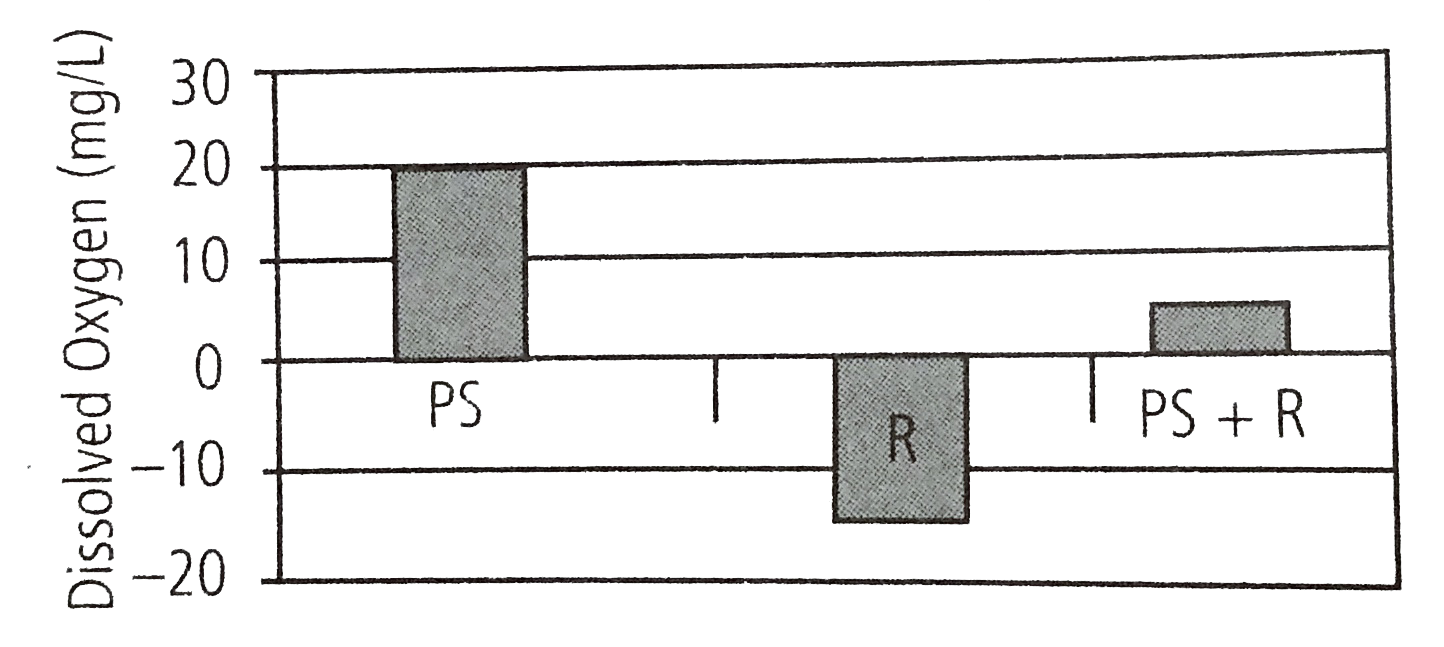
The given graphs shows the productivity of an aquatic ecosystem measured in terms of dissolved oxygen produced and consumed by green plants and photosynthetic algae where PS=photosynthesis and R=respiration.

A

PS will be increase, R will be decreased

B

PS will be decreased, R will be increased.

C

PS and R will not change.

D

PS+R will increase.

Text Solution

Verified by Experts

The correct Answer is:

D

During photosynthesis, green plants produce oxygen which leads to increase in dissolved oxygen in an aquatic ecosystem. Respiration uses oxygen and hence causes decrease in dissolved oxygen. The excess growth of planktonic algae that causes colouration of water is called algal bloom. The increased growth in photosynthetic algae will lead to more photosynthesis which will increase PS+ R ultimately.
Promotional Banner

Topper's Solved these Questions

  • BIOTECHNOLOGY AND ITS APPLICATION

    NCERT FINGERTIPS|Exercise Biotechnology And Its Application|137 Videos
  • ENVIRONMENTAL ISSUES

    NCERT FINGERTIPS|Exercise Environmental Issues|142 Videos

Similar Questions

Explore conceptually related problems

The given graph shows the amount of pollutants in four rivers P, Q, R and S. The river that can continue to support the most number of aquatic plants and animals is _______.

Math List-I with List-II and select the correct answer using the codes given below the lists {:(,"List-I",,"List-II"),(A.,"The amount of energy accumulation in green plants through the process of photosynthesis",1.,"Gross primary productivity"),(B.,"The total organic matter synthesized by the producers in the process of photosynthesis per unit time and area",2.,"Primary productivity"),(C.,"Rate of storage of organic matter in plant tissues in excess of the respiratory utilization during the measurement period",3.,"Secondary productivity"),(D.,"Rate of energy storage at consumer level",4.,"Net primary productivity"):}

Food chains are very important for the survival of most species. When only one element is removed from the food chain it can result in extinction of a species in some cases. The foundation of the food chain consists of primary producers Primary producers, or autotrophs, can use either solar energy or chemical energy to create complex organic compounds, whereas species at higher trophic levels cannot and so must consume producers or other life that itself consumes producers. Because the sun's light is necessary for photosynthesis, most life could not exist if the sun disappeared. Even so, it has recently been discovered that there are some forms of life, chemotrophs, that appear to gain all their metabolic energy from chemosythesis driven by hydrothermal vents, thus showing that some life may not require solar energy to thrive. If 10,000 J solar energy falls on green plants in a terrestrial ecosystem, what percentage of solar energy will be converted into food energy?

The graph given below shows the variations in the population of producers, primary consumers and secondary consumers as well as the amount of dissolved mineral salts in a pond Which one of the following correctly matches each graph?

Read the passage given below and answer the question: Biopolymers are polymers that are generated from renewable natural sources, are often biodegradable and nontoxic. They can be produced by biological systems (i.e. microorganisms, plants and animals), or chemically synthesized from biological materials (e.g., sugars, starch, natural fats or oils, etc.). Two strategies are applied in converting these raw materials into biodegradable polymers: extraction of the native polymer from a plant or animal tissue, and a chemical or biotechnological route of monomer polymerization. Biodegradable biopolymers (BDP) are an alternative to petroleum-based polymers (traditional plastics). Some BDP degrade in only a few weeks, while the degradation of others takes several months. In principle the properties relevant for application as well as biodegradability are determined by the molecular structure. According to the American Society for Testing and Materials, biopolymers are degradable polymers in which degradation results from the action of naturally occurring microorganisms such as bacteria, fungi and algae. Polylactic acid (PLA) is an example of biopolymer. It is a thermoplastic polyester. Generally, there are two major routes to produce polylactic acid from the lactic acid ( CH_(3)CH(OH) COOH ) monomer. The first route involves condensation-water removal by the use of solvent under high vacuum and temperature. This approach produces a low to intermediate molar mass polymer. An alternative method is to remove water under milder conditions, without solvent, to produce a cyclic intermediate dimer, referred to as lactide. This intermediate is readily purified by vacuum distillation. Ring opening polymerization of the dimer is accomplished under heat, again without the need for solvent. By controlling the purity of the dimer it is possible to produce a wide range of molar masses .PLA is a good material for production of clothing, carpet tiles, interior and outdoor furnishing, geotextiles, bags, filtration systems, etc. The primary biodegradability of PLA was tested using hydrolysis tests at various composting temperatures and pH. It was demonstrated that composting is a useful method for PLA biodegradation. The degradation rate is very slow in ambient temperatures. A 2017 study found that at 25^(@)C in sea water, PLA showed no degradation over a year. As a result, it is poorly degraded in landfills and household composts, but is effectively digested in hotter industrial composts. (source: Flieger, M., Kantorová, M., Prell, A., Rezanka, T., & Votruba, J. (2003). Biodegradable plastics from renewable sources. Folia Microbiologica, 48(1), 27 44. doi:10.1007/bf02931273) In the question, a statement of assertion followed by a statement of reason is given. Choose the correct answer out of the following choices on the basis of the above passage. Assertion: Biodegradable polymers degrade in few weeks. Reason: Microorganisms bring about degradation of biopolymers.

Read the passage given below and answer the question: Biopolymers are polymers that are generated from renewable natural sources, are often biodegradable and nontoxic. They can be produced by biological systems (i.e. microorganisms, plants and animals), or chemically synthesized from biological materials (e.g., sugars, starch, natural fats or oils, etc.). Two strategies are applied in converting these raw materials into biodegradable polymers: extraction of the native polymer from a plant or animal tissue, and a chemical or biotechnological route of monomer polymerization. Biodegradable biopolymers (BDP) are an alternative to petroleum-based polymers (traditional plastics). Some BDP degrade in only a few weeks, while the degradation of others takes several months. In principle the properties relevant for application as well as biodegradability are determined by the molecular structure. According to the American Society for Testing and Materials, biopolymers are degradable polymers in which degradation results from the action of naturally occurring microorganisms such as bacteria, fungi and algae. Polylactic acid (PLA) is an example of biopolymer. It is a thermoplastic polyester. Generally, there are two major routes to produce polylactic acid from the lactic acid (CH_(3)CH(OH) COOH) monomer. The first route involves condensation-water removal by the use of solvent under high vacuum and temperature. This approach produces a low to intermediate molar mass polymer. An alternative method is to remove water under milder conditions, without solvent, to produce a cyclic intermediate dimer, referred to as lactide. This intermediate is readily purified by vacuum distillation. Ring opening polymerization of the dimer is accomplished under heat, again without the need for solvent. By controlling the purity of the dimer it is possible to produce a wide range of molar masses .PLA is a good material for production of clothing, carpet tiles, interior and outdoor furnishing, geotextiles, bags, filtration systems, etc. The primary biodegradability of PLA was tested using hydrolysis tests at various composting temperatures and pH. It was demonstrated that composting is a useful method for PLA biodegradation. The degradation rate is very slow in ambient temperatures. A 2017 study found that at 25^(@)C in sea water, PLA showed no degradation over a year. As a result, it is poorly degraded in landfills and household composts, but is effectively digested in hotter industrial composts. (source: Flieger, M., Kantorová, M., Prell, A., Rezanka, T., & Votruba, J. (2003). Biodegradable plastics from renewable sources. Folia Microbiologica, 48(1), 27 44. doi:10.1007/bf02931273) In the question, a statement of assertion followed by a statement of reason is given. Choose the correct answer out of the following choices on the basis of the above passage. Assertion: Lactic acid undergoes condensation polymerisation Reason: Lactic acid is a bifunctional monomeric unit.

Read the passage given below and answer the question: Biopolymers are polymers that are generated from renewable natural sources, are often biodegradable and nontoxic. They can be produced by biological systems (i.e. microorganisms, plants and animals), or chemically synthesized from biological materials (e.g., sugars, starch, natural fats or oils, etc.). Two strategies are applied in converting these raw materials into biodegradable polymers: extraction of the native polymer from a plant or animal tissue, and a chemical or biotechnological route of monomer polymerization. Biodegradable biopolymers (BDP) are an alternative to petroleum-based polymers (traditional plastics). Some BDP degrade in only a few weeks, while the degradation of others takes several months. In principle the properties relevant for application as well as biodegradability are determined by the molecular structure. According to the American Society for Testing and Materials, biopolymers are degradable polymers in which degradation results from the action of naturally occurring microorganisms such as bacteria, fungi and algae. Polylactic acid (PLA) is an example of biopolymer. It is a thermoplastic polyester. Generally, there are two major routes to produce polylactic acid from the lactic acid (CH_(3)CH(OH) COOH) monomer. The first route involves condensation-water removal by the use of solvent under high vacuum and temperature. This approach produces a low to intermediate molar mass polymer. An alternative method is to remove water under milder conditions, without solvent, to produce a cyclic intermediate dimer, referred to as lactide. This intermediate is readily purified by vacuum distillation. Ring opening polymerization of the dimer is accomplished under heat, again without the need for solvent. By controlling the purity of the dimer it is possible to produce a wide range of molar masses .PLA is a good material for production of clothing, carpet tiles, interior and outdoor furnishing, geotextiles, bags, filtration systems, etc. The primary biodegradability of PLA was tested using hydrolysis tests at various composting temperatures and pH. It was demonstrated that composting is a useful method for PLA biodegradation. The degradation rate is very slow in ambient temperatures. A 2017 study found that at 25 ^(@)C in sea water, PLA showed no degradation over a year. As a result, it is poorly degraded in landfills and household composts, but is effectively digested in hotter industrial composts. (source: Flieger, M., Kantorová, M., Prell, A., Rezanka, T., & Votruba, J. (2003). Biodegradable plastics from renewable sources. Folia Microbiologica, 48(1), 27 44. doi:10.1007/bf02931273) In the question, a statement of assertion followed by a statement of reason is given. Choose the correct answer out of the following choices on the basis of the above passage. Assertion: PLA is poorly degraded in landfills. Reason: The degradation rate of PLA is very slow in ambient temperatures.

NCERT FINGERTIPS-ECOSYSTEM-Ecosystem
  1. The given diagram represents the relationships between organisms in a ...

    Text Solution

    |

  2. The graph given below shows the variations in the population of produc...

    Text Solution

    |

  3. The given graphs shows the productivity of an aquatic ecosystem measur...

    Text Solution

    |

  4. Decomposers like fungi and bacteria are

    Text Solution

    |

  5. The process of mineralisation by microorganisms helps in the relase of

    Text Solution

    |

  6. Productivity is the rate of production of biomass expressed in terms o...

    Text Solution

    |

  7. An inverted pyramid of biomass can be found in which ecosystem?

    Text Solution

    |

  8. Which of the pyramid of biomass can be found in which ecosystem?

    Text Solution

    |

  9. Which of the following ecosystems is most productive in terms of net p...

    Text Solution

    |

  10. Pyramid of numbers is

    Text Solution

    |

  11. Approximately how much of the solar energy that falls on the leaves of...

    Text Solution

    |

  12. Among the following where do you think the process of decomposition wo...

    Text Solution

    |

  13. How much of the net primary productivity of a terrestrial ecosystem is...

    Text Solution

    |

  14. During the process of ecological succession, the changes that take pla...

    Text Solution

    |

  15. Climax community is in a state of

    Text Solution

    |

  16. Among the following biogeochemical cycles, which one does not have los...

    Text Solution

    |

  17. The sequence of communities of primary succession in water is

    Text Solution

    |

  18. The reservoir for the gaseous type of biogeochemical cycle exists in

    Text Solution

    |

  19. If the carbon atoms fixed by producers already have passed through thr...

    Text Solution

    |

  20. Which of the following types of ecosystem is expected in an area where...

    Text Solution

    |
