

Home
Class 11
PHYSICS
Two identical blocks, each of mass m, ar...

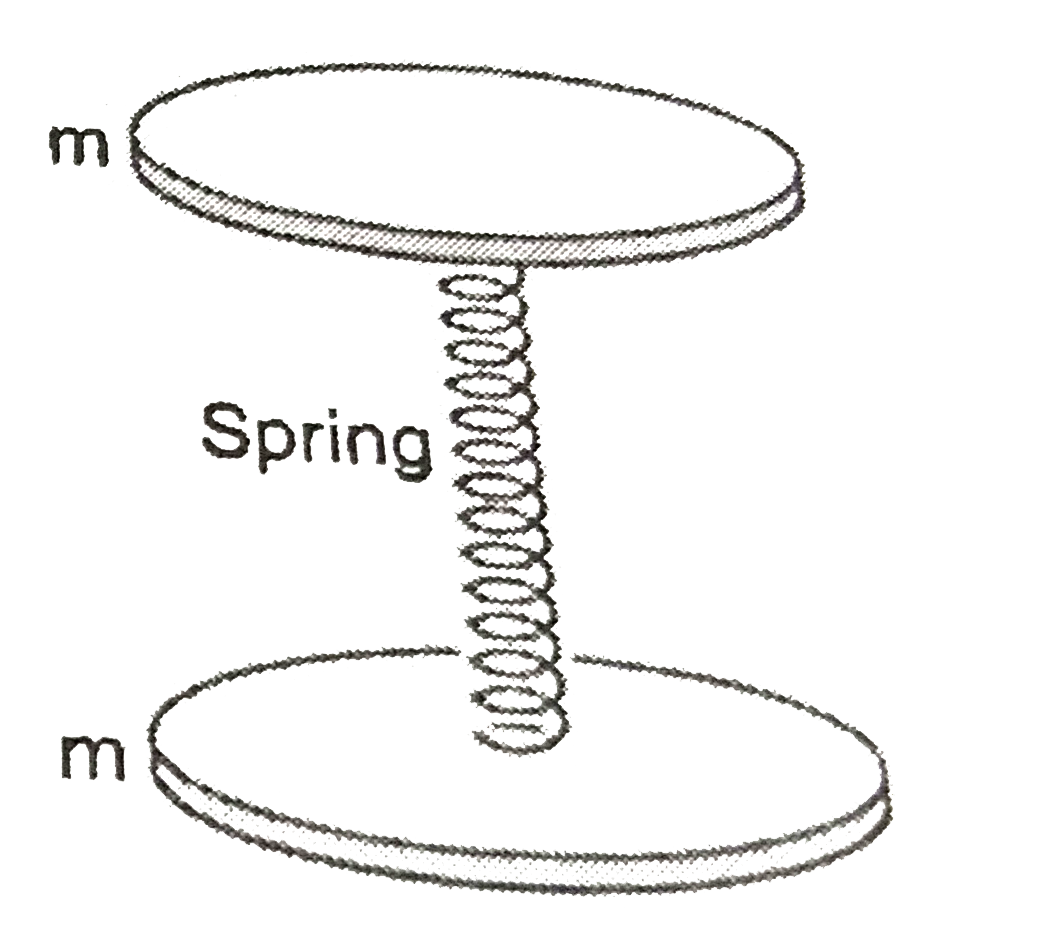
Two identical blocks, each of mass m, are connected through a massless spring of force constant k and arranged as shown in fig the spring is compressed by an amount y by applying an external force and released
(a) What is the velocity of upper block when the spring is relaxed
(b) What should be the initial compression of the spring so that the lower block is just raised above the floor ?

Promotional Banner

Similar Questions

Explore conceptually related problems

Two blocks A and B of masses m and 2m, respectively , are connected by a massless spring of force constant k and are placed on a smooth horizontal plane. The spring is stretched by an amount x and then released . The relative velocity of the blocks when the spring comes to its natural length is

A block of mass m initially at rest is dropped from a height h on to a spring of force constant k . the maximum compression in the spring is x then

A block of mass m is connected to another .block of mass M by a massless spring of spring constant k. A constant force f starts action as shown in figure, then:

A block of mass m is connected to another .block of mass M by a massless spring of spring constant k. A constant force f starts action as shown in figure, then:

Two blocks A and B of mass 2m and m respectively are connected to a massless spring of force constant K as shown in figure A and B are moving on the horizontal frcitionless surface with velocity v to right with underformed spring. If B collides with C elastically, then maximum compression of the spring will be

Two blocks A and B of mass 2m and m respectively are connected to a massless spring of force constant K as shown in figure A and B are moving on the horizontal frcitionless surface with velocity v to right with underformed spring. If B collides with C elastically, then maximum compression of the spring will be

Two identical blocks A and B, each of mass m=2kg are connected to the ends of an ideal spring having force constant K=1000Nm^-1 . System of these blocks and spring is placed on a rough floor. Coefficient of friction between blocks and floor is m=0.5 . Block B is passed towards left so that spring gets compressed. Calculate initial minimum compression x_0 of spring such that block A leaves contact with the wall when system is released.

Two identical blocks A and B, each of mass m=2kg are connected to the ends of an ideal spring having force constant K=1000Nm^-1 . System of these blocks and spring is placed on a rough floor. Coefficient of friction between blocks and floor is m=0.5 . Block B is passed towards left so that spring gets compressed. Calculate initial minimum compression x_0 of spring such that block A leaves contact with the wall when system is released.

A block of mass m held touching the upper end of a light spring of force constant K as shown in figure. Find the maximum potential energy stored in the spring if the block is released suddenly on the spring.