Home
Class 12
CHEMISTRY
Standard reduction potentials (SRP) for ...

Standard reduction potentials (SRP) for different systems can be used to decide the spontaneity of a reaction e.g., `E_(2n^(2+)//Zn)^(@)=-0.76V`, hence for the reaction `Zn+2H^(+)rarrZn^(2+)+H_(2),DeltaG^(@)` is negative. It has been found experimentally that if (SRP of an oxidant-SRP of a reductant) is more than 1.7V, then their combination may lead to explosion (though it may be prevented by kinetic factors).
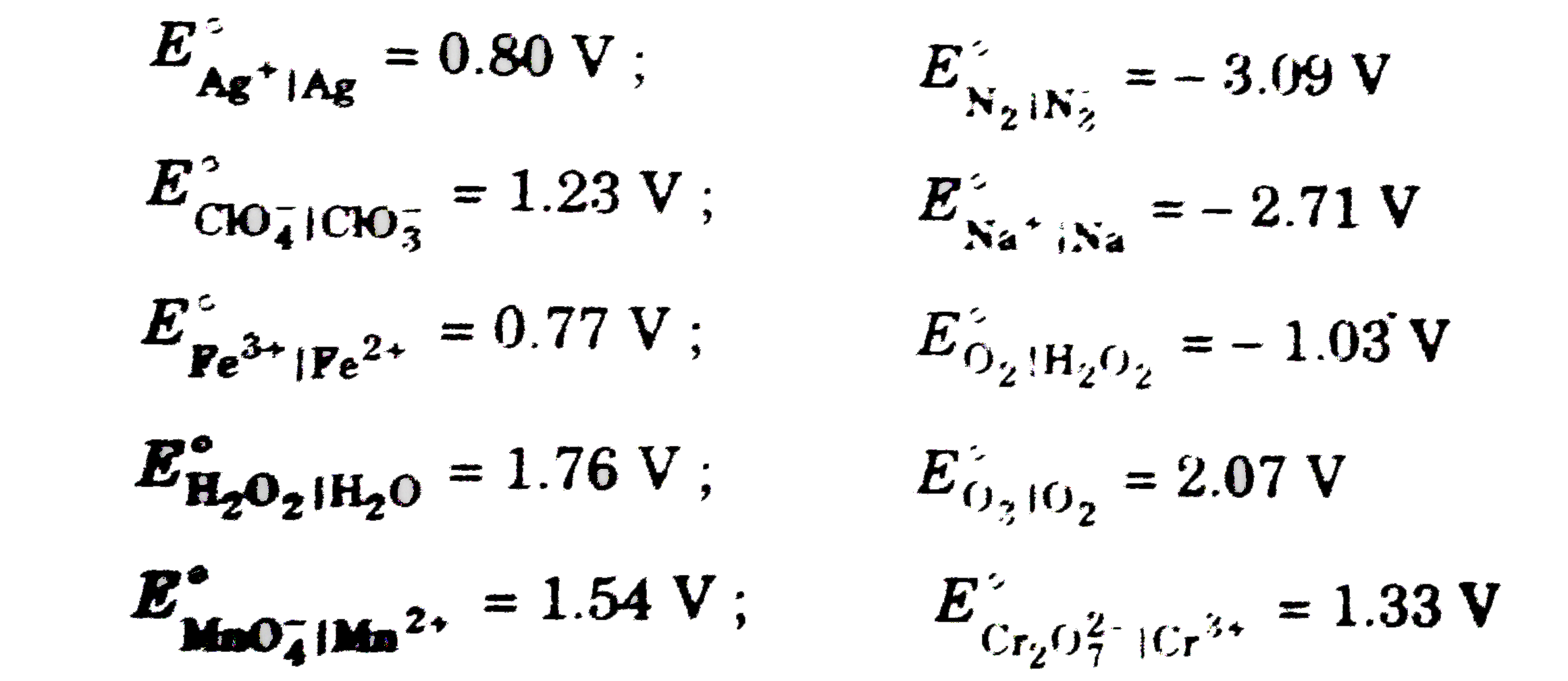
Now go through the following data and answer the questions.
Data:

Which of the following ionic combinations may lead to the formation of explosive substance?

A

sodium ion and azide ion

B

silver ion and perchlorate ion

C

silver ion and azide ion

D

`Fe^(3+)` ion and azide ion

Text Solution

Verified by Experts

Promotional Banner

Similar Questions

Explore conceptually related problems

Standard reduction potentials (SRP) for different systems can be used to decide the spontaneity of a reaction e.g., E_(2n^(2+)//Zn)^(@)=-0.76V , hence for the reaction Zn+2H^(+)rarrZn^(2+)+H_(2),DeltaG^(@) is negative. It has been found experimentally that if (SRP of an oxidant-SRP of a reductant) is more than 1.7V, then their combination may lead to explosion (though it may be prevented by kinetic factors). Now go through the following data and answer the questions. Data: Which statement about standard reduction potentials in correct?

Standard reduction potentials (SRP) for different systems can be used to decide the spontaneity of a reaction e.g., E_(2n^(2+)//Zn)^(@)=-0.76V , hence for the reaction Zn+2H^(+)rarrZn^(2+)+H_(2),DeltaG^(@) is negative. It has been found experimentally that if (SRP of an oxidant-SRP of a reductant) is more than 1.7V, then their combination may lead to explosion (though it may be prevented by kinetic factors). Now go through the following data and answer the questions. Data: Which of the following ion will be capable of causing catalytic decomposition of H_(2)O_(2) ?

E_(Zn^(2+)//Zn)^(0)=-0.76V The EMF of the cell Zn//Zn_((1M))^(2+)"||"HCl(pH=2)|H_2(1 atm)"),Pt is

Use the standard reduction potentials to find the standard cell potential E^(@) , for the reaction: Zn(s)+2Tl^(+)(aq)rarrZn^(2+)(aq)+2Tl(s)

The standard reduction potential E^(@) , for the half reaction are : {:(Zn rarr Zn^(2+) + 2e^(-),,,E^(@) = 0.76 V),(Cu rarr Cu^(2+) + 2e^(-),,,E^(@) = 0.34 V):} The emf for the cell reaction, Zn(s)+Cu^(2+) rarr Zn^(2+) + Cu(s) is :

The standard oxidation potential E^(@) for the half cell reactions are Zn rarrZn^(2+)+2e^(-):E^(@)=+0.76V FerarrFe^(2+)+2e^(-)"E^(@)=+0.41V EMF of the cell reaction Fe^(2+)+ZnrarrZn^(2+)+Fe will be

Standard reduction electrode potential of Zn^(2+)//Zn is -0.76V . This means:

The standard reduction potential E^(@) for the half reactions are as : E^(@) Znrightarrow Zn^2+),E^(@) = +0.76V Fe rightarrow Fe^(2+)+ 2e^(-), E^(@) = 0.41V , The emf for the cell reaction, Fe^(2+)+ZnrightarrowZn^(2+) + Fe is ,

