Home
Class 12
CHEMISTRY
Standard reduction potentials (SRP) for ...

Standard reduction potentials (SRP) for different systems can be used to decide the spontaneity of a reaction e.g., `E_(2n^(2+)//Zn)^(@)=-0.76V`, hence for the reaction `Zn+2H^(+)rarrZn^(2+)+H_(2),DeltaG^(@)` is negative. It has been found experimentally that if (SRP of an oxidant-SRP of a reductant) is more than 1.7V, then their combination may lead to explosion (though it may be prevented by kinetic factors).
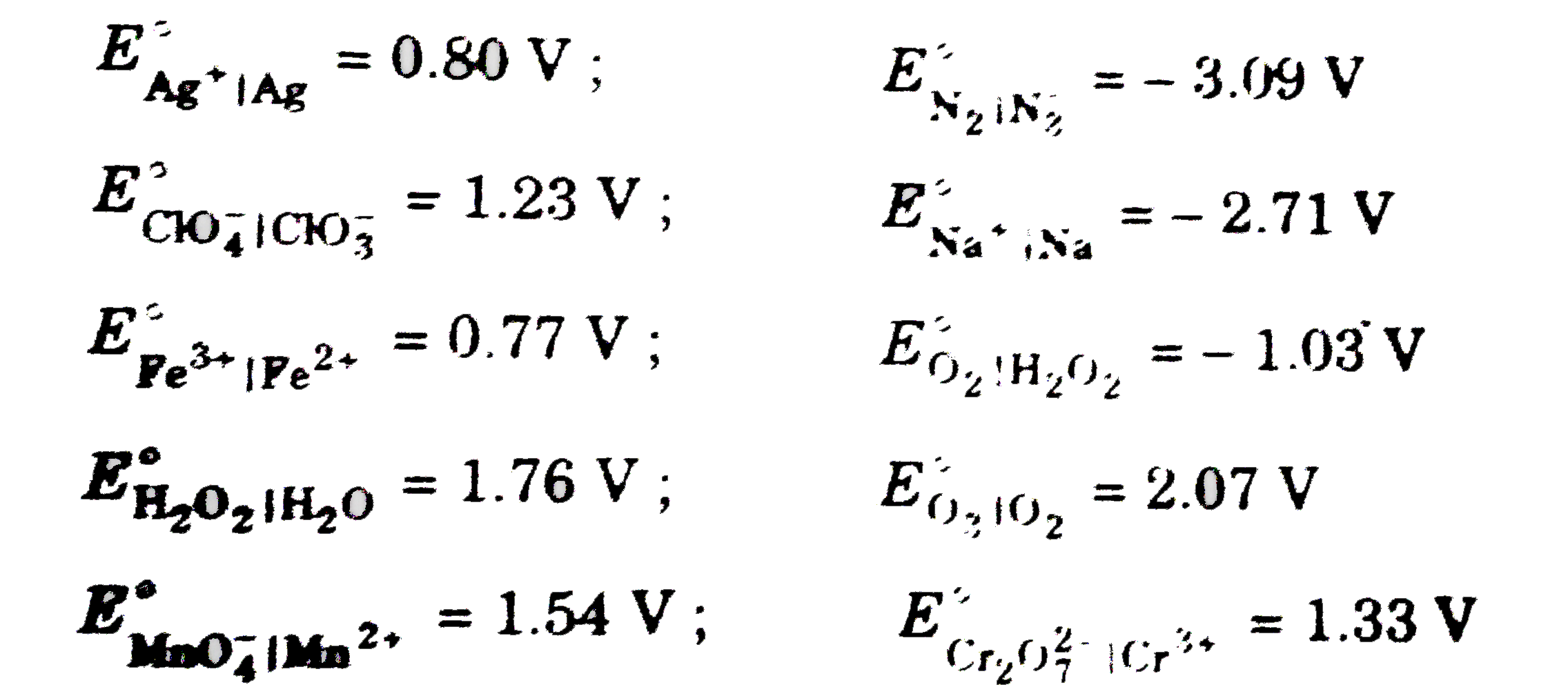
Now go through the following data and answer the questions.
Data:

Which of the following ion will be capable of causing catalytic decomposition of `H_(2)O_(2)`?

A

`Fe^(3+)`

B

`Fe^(2+)`

C

`Na^(+)`

D

`Ag^(+)`

Text Solution

Verified by Experts

Promotional Banner

Similar Questions

Explore conceptually related problems

Standard reduction potentials (SRP) for different systems can be used to decide the spontaneity of a reaction e.g., E_(2n^(2+)//Zn)^(@)=-0.76V , hence for the reaction Zn+2H^(+)rarrZn^(2+)+H_(2),DeltaG^(@) is negative. It has been found experimentally that if (SRP of an oxidant-SRP of a reductant) is more than 1.7V, then their combination may lead to explosion (though it may be prevented by kinetic factors). Now go through the following data and answer the questions. Data: Which of the following ionic combinations may lead to the formation of explosive substance?

Standard reduction potentials (SRP) for different systems can be used to decide the spontaneity of a reaction e.g., E_(2n^(2+)//Zn)^(@)=-0.76V , hence for the reaction Zn+2H^(+)rarrZn^(2+)+H_(2),DeltaG^(@) is negative. It has been found experimentally that if (SRP of an oxidant-SRP of a reductant) is more than 1.7V, then their combination may lead to explosion (though it may be prevented by kinetic factors). Now go through the following data and answer the questions. Data: Which statement about standard reduction potentials in correct?

E_(Zn^(2+)//Zn)^(0)=-0.76V The EMF of the cell Zn//Zn_((1M))^(2+)"||"HCl(pH=2)|H_2(1 atm)"),Pt is

Use the standard reduction potentials to find the standard cell potential E^(@) , for the reaction: Zn(s)+2Tl^(+)(aq)rarrZn^(2+)(aq)+2Tl(s)

The standard reduction potential E^(@) , for the half reaction are : {:(Zn rarr Zn^(2+) + 2e^(-),,,E^(@) = 0.76 V),(Cu rarr Cu^(2+) + 2e^(-),,,E^(@) = 0.34 V):} The emf for the cell reaction, Zn(s)+Cu^(2+) rarr Zn^(2+) + Cu(s) is :

The standard oxidation potential E^(@) for the half cell reactions are Zn rarrZn^(2+)+2e^(-):E^(@)=+0.76V FerarrFe^(2+)+2e^(-)"E^(@)=+0.41V EMF of the cell reaction Fe^(2+)+ZnrarrZn^(2+)+Fe will be

Standard reduction electrode potential of Zn^(2+)//Zn is -0.76V . This means:

The standard reduction potential E^(@) for the half reactions are as : E^(@) Znrightarrow Zn^2+),E^(@) = +0.76V Fe rightarrow Fe^(2+)+ 2e^(-), E^(@) = 0.41V , The emf for the cell reaction, Fe^(2+)+ZnrightarrowZn^(2+) + Fe is ,

