Home
Class 12
PHYSICS
Two-wheeler can tilt while turning. But ...

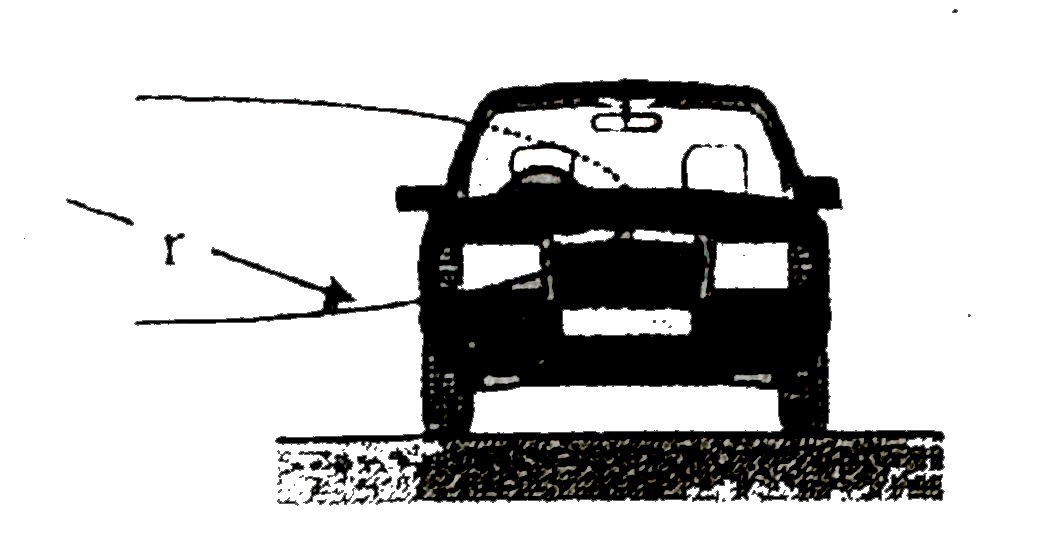
Two-wheeler can tilt while turning. But four-wheeler cannot. Estimate maximum safe speed of a four-wheeler on turn of radius 10m assuming coefficient of static friction between tires and the flat road to be 0.64 and acceleration due to gravity to be 10 `m//s^(2)` .

A

6.4 m/s

B

2.8 m/s

C

8 m/s

D

10 m/s

Text Solution

Verified by Experts

The correct Answer is:

C

`v_("max")=sqrt(mu_(s)rg)=8.0 m//s`
Promotional Banner

Topper's Solved these Questions

  • TEST PAPERS

    ALLEN|Exercise PAPER 2|60 Videos
  • TEST PAPERS

    ALLEN|Exercise PAPER 3|100 Videos
  • TEST PAPER 4

    ALLEN|Exercise PHYSICS|45 Videos
  • UNIT & DIMENSIONS, BASIC MATHS AND VECTOR

    ALLEN|Exercise Exercise (J-A)|7 Videos

Similar Questions

Explore conceptually related problems

What would be the maximum speed of a car on a road turn of radius 30 m, if the coefficient of fraction between the types and the road is 0.4 ?

What is the maximum speed at which a car can turn round a curve of 30 m radius on a level road if the coefficient of friction between the types and the road is 0.4 .(Given, acceleration due to gravity = 10 ms ^(-2)

What will be maximum speed of a car on a curved road of radius 30 m , If the coefficient of friction between the tyres and the road is 0.4? (g=9.8 m//s^(2))

A car is moving along a horizontal curve of radius 20 m , and coefficient of friction between the road and wheels of the car is 0.25 . If acceleration due to gravity is (9.8 m//s^(2)) , then its maximum speed is

What is the maximum velocity with which a vehicle can negotiate a turn of radius r safely when coefficient of friction between tyres and road is mu ?

The maximum speed of a car which can be safely driven along a curve of radius 10 m , If the coefficient of friction between the tyres and the road is 0.5, is (g=9.8 m//s^(2))

A car has to move on a level turn of radius 45 m. If the coefficient of static friction between the tire and the road is mu_s=2.0, find the maximum speed the car can take without skidding.

What is the maximum speed with which a car safely turn a around a curved horizontal road of radius 50 m ? [The coefficient of friction between the tyres and the surface of the road is 0.4 ]

A car is moving on a horizontal circular road of radius 0.1 km with constant speed. If coefficient of friction between tyres of car and road is 0.4, then speed of car may be (g=10m//s^(2))

ALLEN-TEST PAPERS-MATHS
  1. Two-wheeler can tilt while turning. But four-wheeler cannot. Estimate ...

    Text Solution

    |

  2. If complex number z(zne2) satisfies the equation z^(2)=4z+|z|^(2)+(16)...

    Text Solution

    |

  3. Let omegabe a complex number which satisfies iomega=(u^(2)-1)/(u^(2)+...

    Text Solution

    |

  4. If the function f(x)={{:((1+cospix)/(pi^(2)(x+1)^(2)),",",xlt-1),(ax...

    Text Solution

    |

  5. The value of the following limit lim(ntooo) n(n+1)(ln(1+(1)/(n))-sin((...

    Text Solution

    |

  6. number of solutions for x between 3 and 15 if int(0)^(x)[t]dt=int(0)^(...

    Text Solution

    |

  7. If the length of perpendicular from (0,0,0) to the plane ax+by+cz+d=0 ...

    Text Solution

    |

  8. A transversal cuts side AB and AD and diagonal AC of parallelogram ABC...

    Text Solution

    |

  9. Consider curve y=(1+x)^(y)+sin^(-1)(sin^(2)x). Which of the following ...

    Text Solution

    |

  10. The x-intercept of the tangent to a curve is equal to the ordinate of ...

    Text Solution

    |

  11. Suppose y=f(x)andy=g(x) are two functions whose graph intersect at th...

    Text Solution

    |

  12. A function y=f(x) satisfies f"(x)=-(1)/(x^(2))-pisin(pix),f(2)=pi+(1)...

    Text Solution

    |

  13. Let(1+X^(2))^(2)(1+X)^(n)=sum(k=0)^(n+4)a(k)X^(k).ifa(1),a(2),a(3) ar...

    Text Solution

    |

  14. If f(x) is double differentiable function such that |f"(x)|le5 for ea...

    Text Solution

    |

  15. overline(x)andoverline(y) be two variable vectors satisfying simultan...

    Text Solution

    |

  16. The curve defined by sqrt((x)/(a))+sqrt((y)/(b))=1 gives a part of pa...

    Text Solution

    |

  17. The curve defined by sqrt((x)/(a))+sqrt((y)/(b))=1 gives a part of pa...

    Text Solution

    |

  18. In a problem of differentiation of (f(x))/(g(x)), one student writes ...

    Text Solution

    |

  19. In a problem of differentiation of (f(x))/(g(x)), one student writes ...

    Text Solution

    |
