Home
Class 12
PHYSICS
A hollow smooth uniform A of mass 'm' ro...

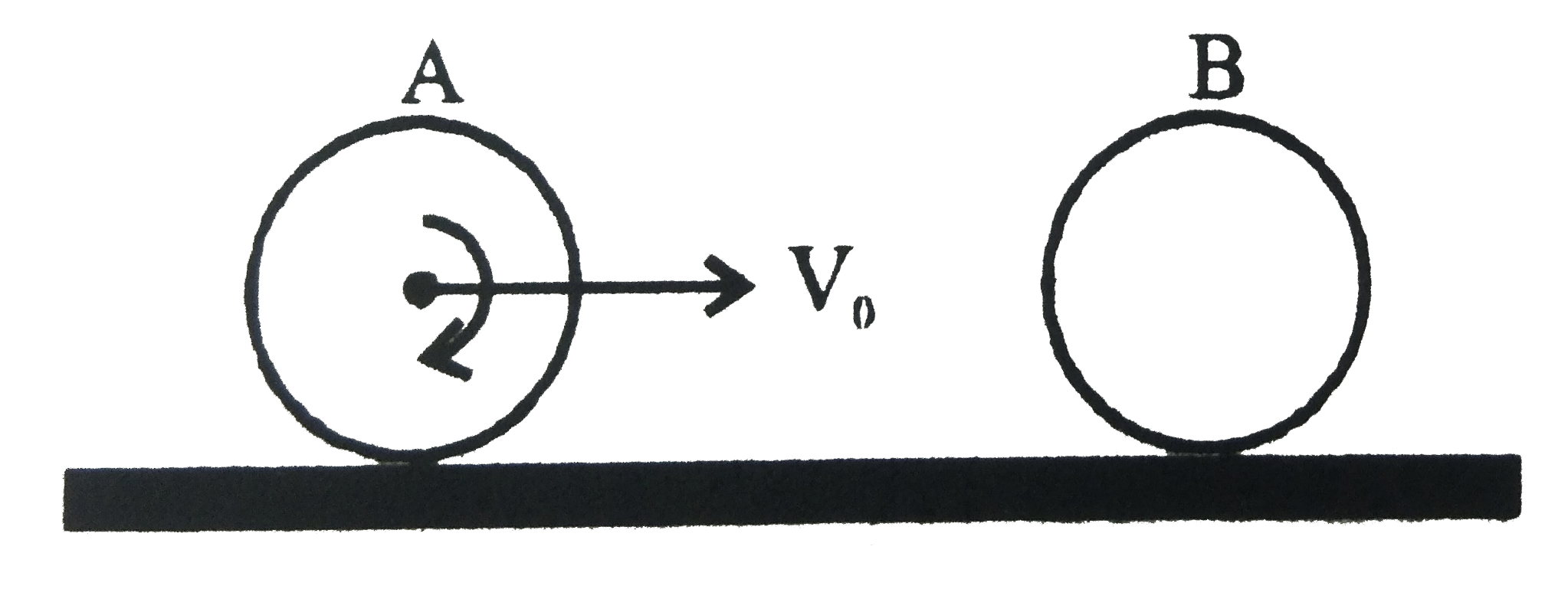
A hollow smooth uniform `A` of mass 'm' rolls without sliding on a smooth horizontal surface collides head to elastically with another stationary smooth solid sphere `B` of the same mass `m` and same radius. The ratio of kinetic energy of 'B' to that of 'A' just after the collision is -
.

A

`1:1`

B

`2:3`

C

`3:2`

D

`5:2`

Text Solution

Verified by Experts

The correct Answer is:
C


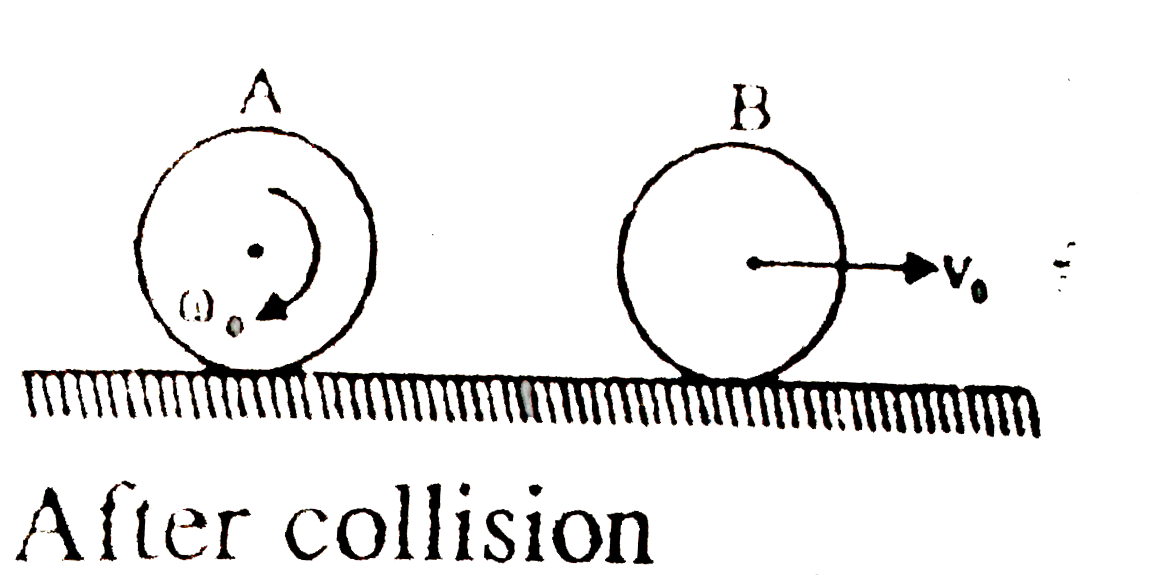
After collision
`K_(A)=(1)/(2)((2)/(3)mR^(2))((v_(0))/(R))^(2)=(1)/(3)mv_(0)^(2),K_(B)=(1)/(2)mv_(0)^(2)`
`rArr(K_(B))/(K_(A))=((1)/(2)mv_(0)^(2))/((1)/(3)mv_(0)^(2))=(3)/(2)`
Promotional Banner

Topper's Solved these Questions

  • TEST PAPERS

    ALLEN|Exercise PAPER 2|60 Videos
  • TEST PAPERS

    ALLEN|Exercise PAPER 3|100 Videos
  • TEST PAPER 4

    ALLEN|Exercise PHYSICS|45 Videos
  • UNIT & DIMENSIONS, BASIC MATHS AND VECTOR

    ALLEN|Exercise Exercise (J-A)|7 Videos

Similar Questions

Explore conceptually related problems

A uniform solid sphere A of mass m is rolling without sliding on a a smooth horizontal surface. It collides elastically and head - on with another stationary hollow sphere B of the same mass and radius. Assuming friction to be absent everywhere, the ratio of the kinetic energy of B to that of A just after the collision is

A solid sphere of mass m and radius R rolls without slipping on a horizontal surface such that v_(c.m.)=v_(0) .

A loop of mass M and radius R is rolling on a smooth horizontal surface with speed 'v'. It's total kinetic energy is

A particle of mass m and momentum p moves on a smooth horizontal table and collides directly and elastically with a similar particle (of mass m) having momentum -2p . The loss (-) or gain (+) in the kinetic energy of the first particle in the collision is

Sphere A of mass 'm' moving with a constant velocity u hits another stationary sphere B of the same mass. If e is the co-efficient of restitution, then ratio of velocities of the two spheres v_(A):v_(B) after collision will be :

A solid sphere rolls without slipping on a rough horizontal floor, moving with a speed v . It makes an elastic collision with a smooth vertical wall. After impact

Assertion : A solid sphere cannot roll without slipping on smooth horizontal surface Reason : If the sphere is left free on smooth inclined surface. It cannot roll without slipping.

ALLEN-TEST PAPERS-MATHS
  1. A hollow smooth uniform A of mass 'm' rolls without sliding on a smoot...

    Text Solution

    |

  2. If complex number z(zne2) satisfies the equation z^(2)=4z+|z|^(2)+(16)...

    Text Solution

    |

  3. Let omegabe a complex number which satisfies iomega=(u^(2)-1)/(u^(2)+...

    Text Solution

    |

  4. If the function f(x)={{:((1+cospix)/(pi^(2)(x+1)^(2)),",",xlt-1),(ax...

    Text Solution

    |

  5. The value of the following limit lim(ntooo) n(n+1)(ln(1+(1)/(n))-sin((...

    Text Solution

    |

  6. number of solutions for x between 3 and 15 if int(0)^(x)[t]dt=int(0)^(...

    Text Solution

    |

  7. If the length of perpendicular from (0,0,0) to the plane ax+by+cz+d=0 ...

    Text Solution

    |

  8. A transversal cuts side AB and AD and diagonal AC of parallelogram ABC...

    Text Solution

    |

  9. Consider curve y=(1+x)^(y)+sin^(-1)(sin^(2)x). Which of the following ...

    Text Solution

    |

  10. The x-intercept of the tangent to a curve is equal to the ordinate of ...

    Text Solution

    |

  11. Suppose y=f(x)andy=g(x) are two functions whose graph intersect at th...

    Text Solution

    |

  12. A function y=f(x) satisfies f"(x)=-(1)/(x^(2))-pisin(pix),f(2)=pi+(1)...

    Text Solution

    |

  13. Let(1+X^(2))^(2)(1+X)^(n)=sum(k=0)^(n+4)a(k)X^(k).ifa(1),a(2),a(3) ar...

    Text Solution

    |

  14. If f(x) is double differentiable function such that |f"(x)|le5 for ea...

    Text Solution

    |

  15. overline(x)andoverline(y) be two variable vectors satisfying simultan...

    Text Solution

    |

  16. The curve defined by sqrt((x)/(a))+sqrt((y)/(b))=1 gives a part of pa...

    Text Solution

    |

  17. The curve defined by sqrt((x)/(a))+sqrt((y)/(b))=1 gives a part of pa...

    Text Solution

    |

  18. In a problem of differentiation of (f(x))/(g(x)), one student writes ...

    Text Solution

    |

  19. In a problem of differentiation of (f(x))/(g(x)), one student writes ...

    Text Solution

    |

