Home
Class 12
PHYSICS
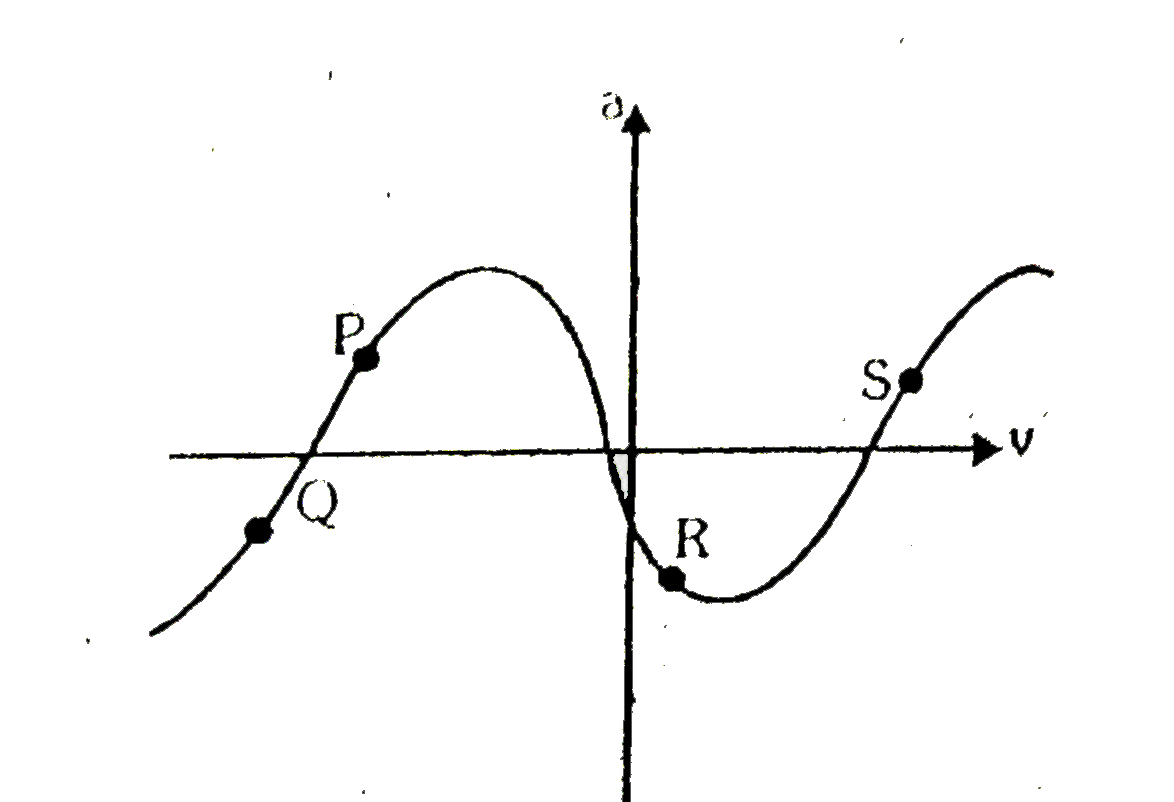
Assertion:- At point P object is speedin...

Assertion:- At point P object is speeding down.
ltbegt Reason:- If acceleration is positive, object must speed up.

A

If both Assertion `&` Reason are True `&` the Reason is a correct explanation of the Assertion.

B

If both Assertion `&` Reason are True but Reason is not a correct explanation of the Assertion.

C

If Assertion is True but the Reason is False.

D

If both Assertion `&` Reason are False.

Text Solution

Verified by Experts

The correct Answer is:

C
Promotional Banner

Topper's Solved these Questions

  • TEST PAPERS

    ALLEN|Exercise PAPER 2|60 Videos
  • TEST PAPERS

    ALLEN|Exercise PAPER 3|100 Videos
  • TEST PAPER 4

    ALLEN|Exercise PHYSICS|45 Videos
  • UNIT & DIMENSIONS, BASIC MATHS AND VECTOR

    ALLEN|Exercise Exercise (J-A)|7 Videos

Similar Questions

Explore conceptually related problems

Define speed of the object.

Assertion : At object may fall with a constant velocity. Reason : This happens when acceleration of the object is equal to accelertion due to gravity.

Assertion :- A particle has positive acceleration it means that its speed always increases. Reason :- Acceleration is the rate of change of speed with respect to time.

Under what conditionit is wrong to say that an object's acceleration is negative when the object is thrown upward. Does the sign of the acceleration depend at all on the direction. Can an object's acceleration be positive when the object is slowing down ?

Read each staremnt below carefully and state with reasons and expamples if it is true or false , (a) with zero speed at an instant may have non-zero accelration at that instant (b) with zero speed may have non-zero velocity (c ) with positive speed must have zero accleration (d) with positive value of acceleration must be speeding up.

Assertion: When an object is accelerating, it is either speeding up or slowing down. Reason: When an object moves on a circular path with uniform speed, the object accelerates.

Assertion : An object may have varying speed without having varying velocity. Reason : If the velocity is zero at an instant, the acceleration may not be zero at that instant.

Assertion: For motion in two or three diemensions, velocity and acceleration vecotrs must have any angle between 0^(@) and 90^(@) between them. Reason: For such motion velocity and acceleration of an object is always in the opposite direction.

ALLEN-TEST PAPERS-MATHS
  1. Assertion:- At point P object is speeding down. ltbegt Reason:- If ...

    Text Solution

    |

  2. If complex number z(zne2) satisfies the equation z^(2)=4z+|z|^(2)+(16)...

    Text Solution

    |

  3. Let omegabe a complex number which satisfies iomega=(u^(2)-1)/(u^(2)+...

    Text Solution

    |

  4. If the function f(x)={{:((1+cospix)/(pi^(2)(x+1)^(2)),",",xlt-1),(ax...

    Text Solution

    |

  5. The value of the following limit lim(ntooo) n(n+1)(ln(1+(1)/(n))-sin((...

    Text Solution

    |

  6. number of solutions for x between 3 and 15 if int(0)^(x)[t]dt=int(0)^(...

    Text Solution

    |

  7. If the length of perpendicular from (0,0,0) to the plane ax+by+cz+d=0 ...

    Text Solution

    |

  8. A transversal cuts side AB and AD and diagonal AC of parallelogram ABC...

    Text Solution

    |

  9. Consider curve y=(1+x)^(y)+sin^(-1)(sin^(2)x). Which of the following ...

    Text Solution

    |

  10. The x-intercept of the tangent to a curve is equal to the ordinate of ...

    Text Solution

    |

  11. Suppose y=f(x)andy=g(x) are two functions whose graph intersect at th...

    Text Solution

    |

  12. A function y=f(x) satisfies f"(x)=-(1)/(x^(2))-pisin(pix),f(2)=pi+(1)...

    Text Solution

    |

  13. Let(1+X^(2))^(2)(1+X)^(n)=sum(k=0)^(n+4)a(k)X^(k).ifa(1),a(2),a(3) ar...

    Text Solution

    |

  14. If f(x) is double differentiable function such that |f"(x)|le5 for ea...

    Text Solution

    |

  15. overline(x)andoverline(y) be two variable vectors satisfying simultan...

    Text Solution

    |

  16. The curve defined by sqrt((x)/(a))+sqrt((y)/(b))=1 gives a part of pa...

    Text Solution

    |

  17. The curve defined by sqrt((x)/(a))+sqrt((y)/(b))=1 gives a part of pa...

    Text Solution

    |

  18. In a problem of differentiation of (f(x))/(g(x)), one student writes ...

    Text Solution

    |

  19. In a problem of differentiation of (f(x))/(g(x)), one student writes ...

    Text Solution

    |
