Home
Class 12
PHYSICS
Figure shows the relationship between te...

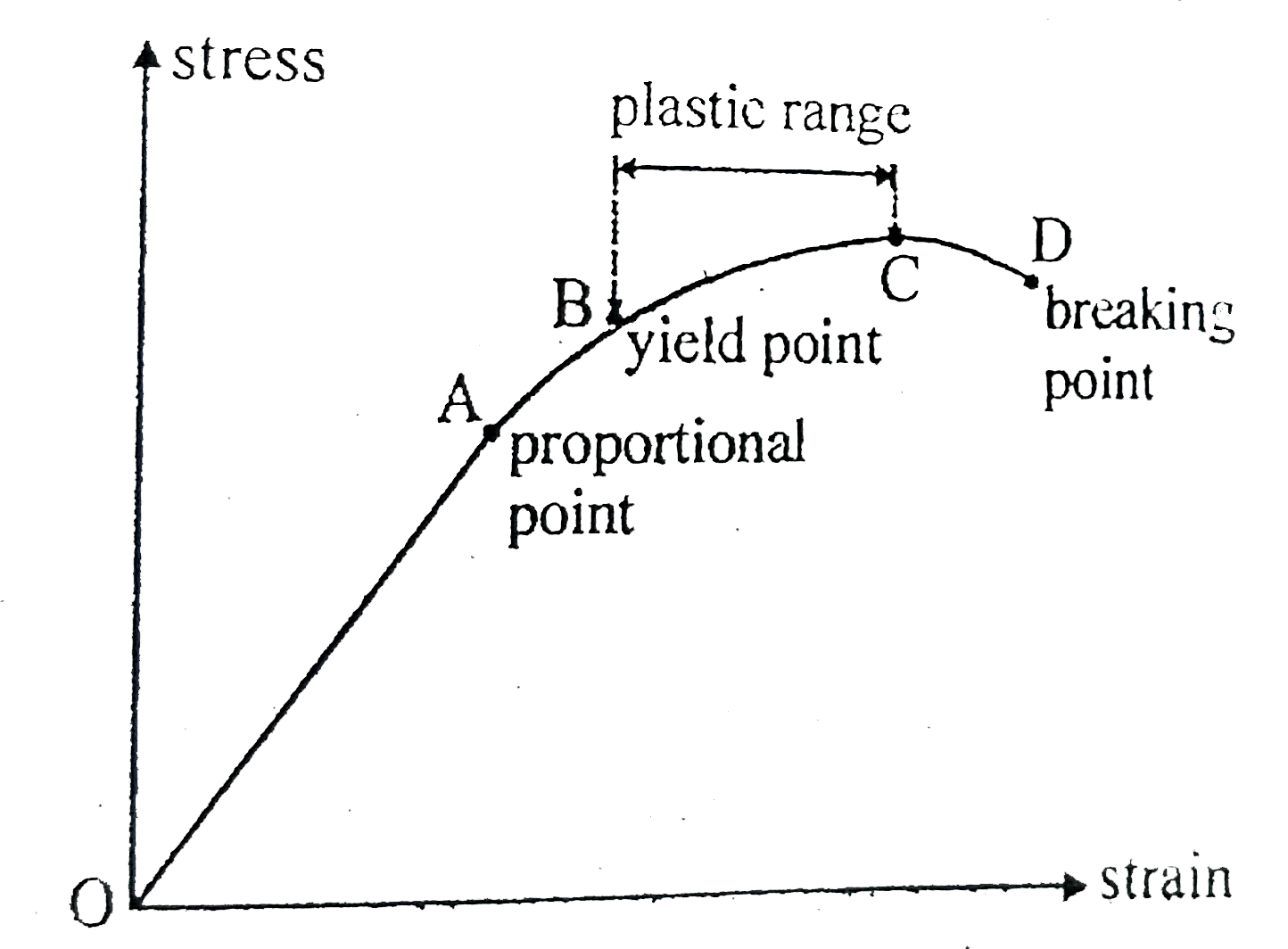
Figure shows the relationship between tensile stress and strain for a typical material. Below proportional point A, stress is directly proportional to strain which means Young's moudulus (Y) is a constant. In this region the material obeys Hooke's law.

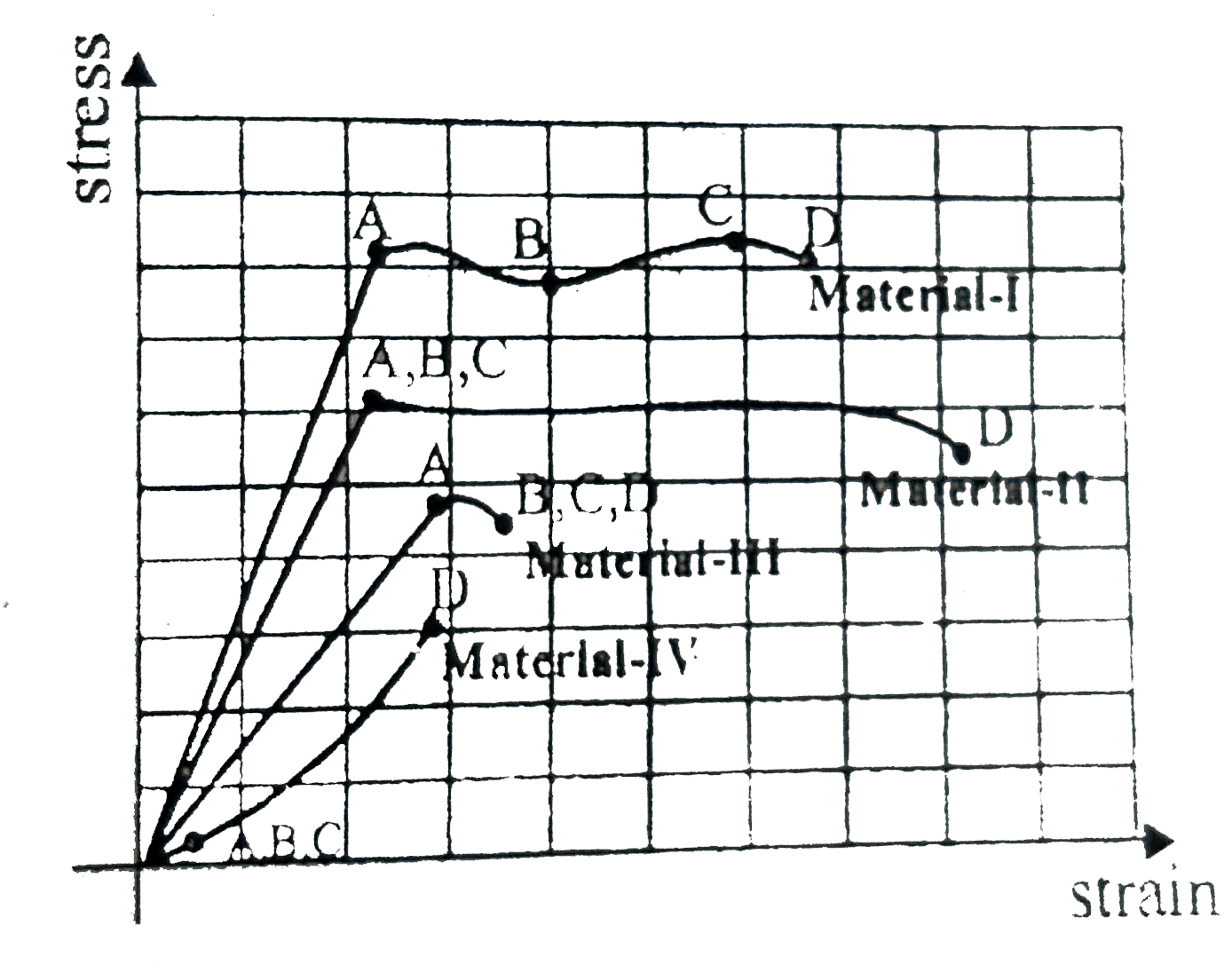
Provided the strain is below the yield point 'B' the material returns to its original shape and size when the force is removed. Beyond the yield point, the material retains a permancnt deformation after the stress is removed. For stresses beyond the yeld point, the material exhibit plastic flow, which means that it continues to elongate for little increases in the stress. Beyond C a local constriction occurs. The material fractures at D (i.e. breaking point). The graph below shows the stress-strain curve for 4 different materials.

Material which is most brittle is

A

Material-I

B

Material-II

C

Material-III

D

Material-IV

Text Solution

Verified by Experts

The correct Answer is:

C

Material which breaks just after proportional point.
Promotional Banner

Topper's Solved these Questions

  • TEST PAPERS

    ALLEN|Exercise Part-1 Physics|15 Videos
  • TEST PAPERS

    ALLEN|Exercise part-2 physics|63 Videos
  • TEST PAPERS

    ALLEN|Exercise PAPER 2|60 Videos
  • TEST PAPER 4

    ALLEN|Exercise PHYSICS|45 Videos
  • UNIT & DIMENSIONS, BASIC MATHS AND VECTOR

    ALLEN|Exercise Exercise (J-A)|7 Videos

Similar Questions

Explore conceptually related problems

Figure shows the relationship between tensile stress and strain for a typical material. Below proportional point A, stress is directly proportional to strain which means Young's moudulus (Y) is a constant. In this region the material obeys Hooke's law. Provided the strain is below the yield point 'B' the material returns to its original shape and size when the force is removed. Beyond the yield point, the material retains a permancnt deformation after the stress is removed. For stresses beyond the yeld point, the material exhibit plastic flow, which means that it continues to elongate for little increases in the stress. Beyond C a local constriction occurs. The material fractures at D (i.e. breaking point). The graph below shows the stress-strain curve for 4 different materials. Material which is good for making wires by stretching is

Figure shows the relationship between tensile stress and strain for a typical material. Below proportional point A, stress is directly proportional to strain which means Young's moudulus (Y) is a constant. In this region the material obeys Hooke's law. Provided the strain is below the yield point 'B' the material returns to its original shape and size when the force is removed. Beyond the yield point, the material retains a permancnt deformation after the stress is removed. For stresses beyond the yeld point, the material exhibit plastic flow, which means that it continues to elongate for little increases in the stress. Beyond C a local constriction occurs. The material fractures at D (i.e. breaking point). The graph below shows the stress-strain curve for 4 different materials. If you bough a new shoe which bites in the beginning and later on fits perfectly, then the material used to making the shoe is

The graph given is a stress-strain curve for

Stress & Strain

For a steel wire, stress is directly proportional to strain. This is possible only when

Assertion Upto the elastic limit, strain prop stress. Reason Upto elastic limit, material returns to its original shape and size, when external force is removed.

The graph between stress and strain represents the

Figure shows the strain - stress curve for a given material. The Young's modulus of the material is

Figure shows the strain stress curve for a given material. The Young's modulus of the material is

Figure shows the stress-strain graphs for materials . A and B . From the graph it follows that

ALLEN-TEST PAPERS-PAPER 3
  1. A loop is formed by two parallel conductors connected by a solenoid wi...

    Text Solution

    |

  2. Figure shows the relationship between tensile stress and strain for a ...

    Text Solution

    |

  3. Figure shows the relationship between tensile stress and strain for a ...

    Text Solution

    |

  4. Figure shows the relationship between tensile stress and strain for a ...

    Text Solution

    |

  5. A siphon tube is discharging a liquid of density 900(kg)/(m^(3)) as ...

    Text Solution

    |

  6. A siphon tube is discharging a liquid of density 900(kg)/(m^(3)) as ...

    Text Solution

    |

  7. A rope placed straight on a frictionless floor is pulled longtudinally...

    Text Solution

    |

  8. A steel ball strikes a fixed smooth steel plate placed on a horizontal...

    Text Solution

    |

  9. A ball is thrown vertically upwards. It was observed at a height h twi...

    Text Solution

    |

  10. The graph represents the decay of a newly-prepared sample of radioacti...

    Text Solution

    |

  11. Four tuning forks of frequencies 200,201,204 and 206 Hz are sounded to...

    Text Solution

    |

  12. Electrons used in an electron microscope are accelerated by a voltage ...

    Text Solution

    |

  13. A bead is free to slide down a smooth wire tightly stretched between p...

    Text Solution

    |

  14. As shown in the figure, initially both th springs are in normal length...

    Text Solution

    |

  15. One mole of an ideal gas undergoes a process whose molar heat capacity...

    Text Solution

    |

  16. A diatomic gas (gamma=1.4) does 2000J of work when it is expanded isob...

    Text Solution

    |

  17. n moles of an ideal triatomic linear gas undergoes a process in which ...

    Text Solution

    |

  18. A particle with the potentila energy shown in the graph is moving to t...

    Text Solution

    |

  19. The logic circuit shown has the input waveforms 'A' and 'B' as shown. ...

    Text Solution

    |

  20. If the B-H curves of two samples of P and Q of iron are as shown below...

    Text Solution

    |
