Home
Class 11
PHYSICS
A 250 g ball moving horizontally with ve...

A 250 g ball moving horizontally with velocity 10.0m/s strikes inclined surface of a 720g smooth wedge as shown in the figure. The wedge is placed at rest on a frictionless horizontal ground. If the coefficient of restitution is 0.8, calculate the velocity of the wedge after the impact.

Text Solution

Verified by Experts
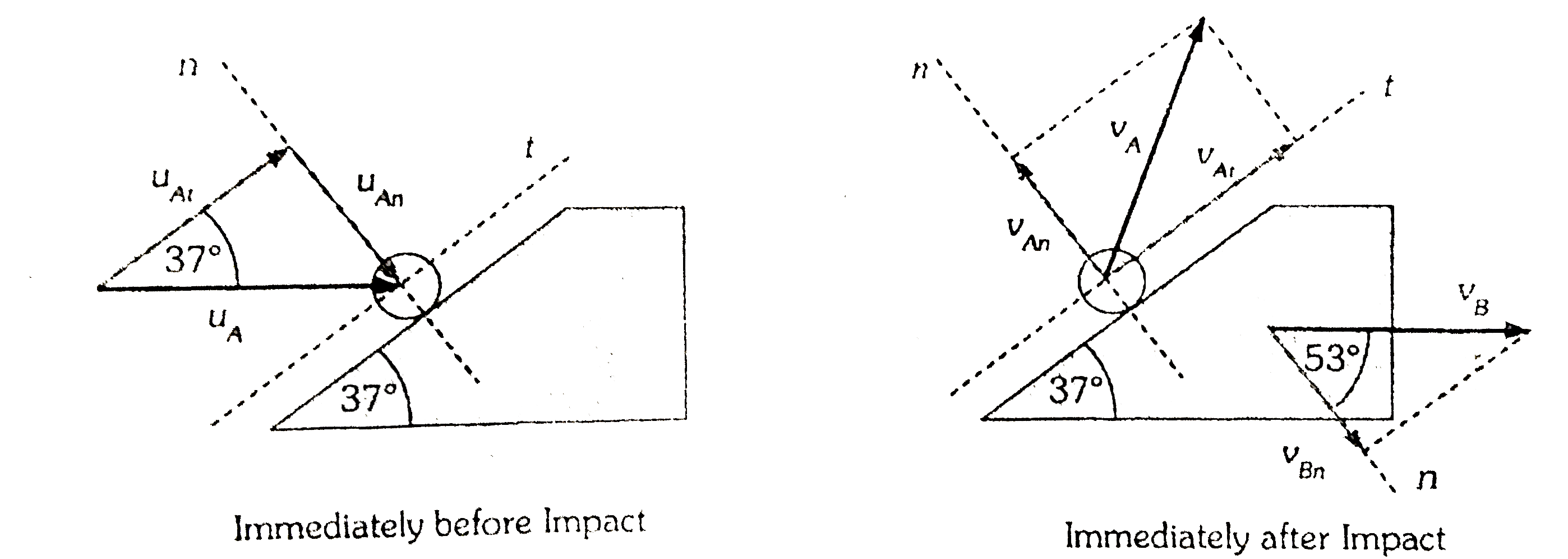
Let us consider the ball as the body A and the wedge as the body B. Before collision let velocity of ball is u^a after the impact, the ball bounces with velocity `v_(A)` and the wedge advances in horizontal direction with velocity `v_(B)`. These velocities and their t and n-components are immediately before and after the impact are shown in the following figures.

Component along t-axis The ball is free to move before and after the impact, therefore its t-component of momentum conserved. hence, t-component of velocities of the ball remains unchanged.
`v_(At)=U_(At)=10cos37.=8m//s` ...(i)
Momentum Conservation In the horizontal direction, there is no extrnal force on both the bodies. Therefore horizontal component of total momentum of both the bodies remain conserved. `m_(A) u_(A) = m_(A)(v_(At)cos37. -v_(An) cos53.) +m_Bv_(B)`
`0.25xx10=0.25(8xx4/5-(3v_(An))/5)+0.72v_B`
Coefficient of restitution Concept of coefficient of restitution e is applicable only for the n-component velocities.
`v_(Bn)-v_(An)=e(u_An-U_Bn)rarr 3v_B/5-v_An=0.8(6-0)` ...(iii)
From equations (i), (ii) and (iii), we obtain `v_(B) = 2.0 m//s`
Promotional Banner

Topper's Solved these Questions

  • CENTRE OF MASS

    ALLEN|Exercise EXERCISE-I|40 Videos
  • CENTRE OF MASS

    ALLEN|Exercise EXERCISE-II|43 Videos
  • BASIC MATHEMATICS USED IN PHYSICS &VECTORS

    ALLEN|Exercise EXERCISE-IV ASSERTION & REASON|11 Videos
  • ELASTICITY, SURFACE TENSION AND FLUID MECHANICS

    ALLEN|Exercise Exercise 5 B (Integer Type Questions)|3 Videos

Similar Questions

Explore conceptually related problems

A block of mass 2kg slides down the face of a smooth 45^@ wedge of mass 9 kg as shown in the figure. The wedge is placed on a frictionless horizontal surface. Determine the acceleration of the wedge.

The air of density rho and moving with a velocity v strikes perpendicular the inclined surface of area A and of a wedge kept on a horizontal surface. The mass of the wedge is m . Assuming the collisions to be perfectly inelastic, the minimum value of the coefficient of friction between the wedge and the ground so that the wedge does not move is (Assume mass of particles of air is negligible)

A ball of mass m=1kg falling vertically with a velocity v_(0)=2m//s strikes a wedge of mass M=2kg kept o a smooth, horizontal surface as shown in figure. The coefficient of resitution between the ball and the wege is e=1//2 . Find the velocity of the wedge is e=1/2. find the velocity of the wedge and the ball immediately after collison.

A small ball moving with a velocity 10m/s,horizontally (as shown in figure) strikes a rough horizontal surface having mu=0.5 .If the coefficient of restitution is e=0.4.Horizontal component of velocity of ball after Ist impact will be?(g=10m/ s^(2) )

A wedge of mass M is kept at rest on smooth surface a particle of mass m hits the wedge normally. Find the velocity of wedge and particle just after collision. Take coefficient of restitution as e .

A small particle of mass m = 2 kg moving with constant horizontal velocity u = 10 m//s strikes a wedge shaped block of mass M = 4 kg placed on smooth horizontal surface on its inclined surface as shown in figure. After collision particle starts moving up the inclined plane. Calculate the velocity of wedge immediately after collision.

A small block of mass m is kept on the inclined surface of a wedge of mass M. The inclined surface of the wedge makes an angle theta with the horizontal. The wedge is kept on a frictionless rigid horizontal floor. You can neglect friction between the block and the wedge also. An external agent applies a horizontal force F on the wedge. The value of the force F so that the wedge remains at rest is F_(1) . Which of the options is incorrect?

ALLEN-CENTRE OF MASS-EXERCISE-V B
  1. A 250 g ball moving horizontally with velocity 10.0m/s strikes incline...

    Text Solution

    |

  2. Two particles of masses m(1) and m(2) in projectile motion have veloci...

    Text Solution

    |

  3. Two blocks of masses 10 kg and 4 kg are connected by a spring of negli...

    Text Solution

    |

  4. A particle moves in the X-Y plane under the influence of a force such ...

    Text Solution

    |

  5. Two small particles of equal masses stant moving in opposite directio...

    Text Solution

    |

  6. Look at the drawing given in the figure which has been drawn with ink ...

    Text Solution

    |

  7. A particle of mass m is projected from the ground with an initial spee...

    Text Solution

    |

  8. A tennis ball dropped on a barizoontal smooth surface , it because bac...

    Text Solution

    |

  9. Two balls , having linear momenta vec(p)(1) = p hat(i) and vec(p)(2) =...

    Text Solution

    |

  10. STATEMENT-l : In an elastic collision between two bodies, the relative...

    Text Solution

    |

  11. Satement-1: if there is no external torque on a body about its centre ...

    Text Solution

    |

  12. A small block of mass M move on a frictionless surface of an inclimed...

    Text Solution

    |

  13. A small block of mass M move on a frictionless surface of an inclimed...

    Text Solution

    |

  14. A small block of mass M move on a frictionless surface of an inclimed...

    Text Solution

    |

  15. Two blocks of masses 2kg and M are at rest on an inclined plane and ar...

    Text Solution

    |

  16. A car P is moving with a uniform speed 5sqrt3 m//s towards a carriage ...

    Text Solution

    |

  17. A particle of mass m, moving in a cicular path of radius R with a cons...

    Text Solution

    |

  18. Two point masses m1 and m2 are connected by a spring of natural length...

    Text Solution

    |

  19. A rectangular plate of mass M and dimension axxb is held in horizonta...

    Text Solution

    |

  20. Three objects A , B and C are kept in a straight line on a smooth hori...

    Text Solution

    |

