

Home
Class 12
PHYSICS
Four identical spheres having mass M and...

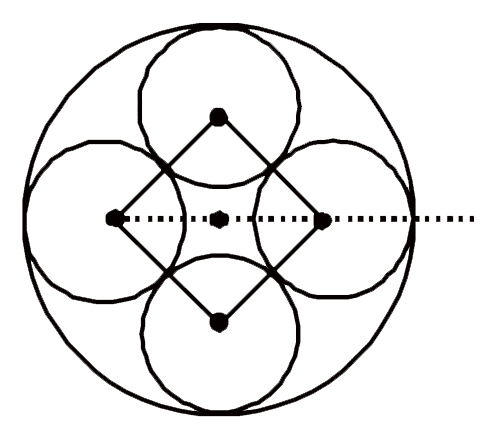
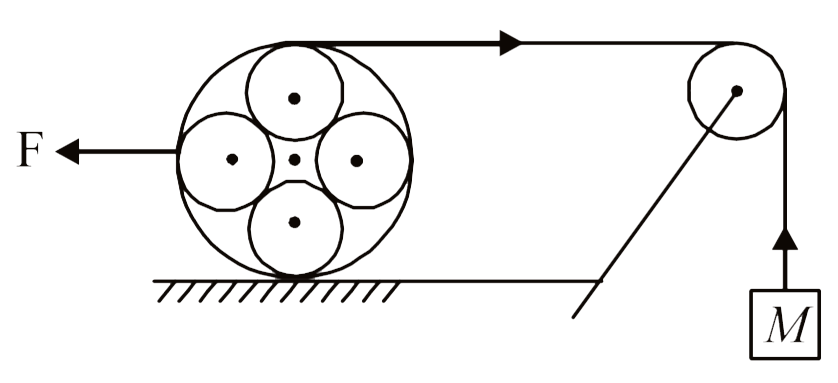
Four identical spheres having mass M and radius R are fixed tightly within a massless ring such that the centres of all spheres lie in the plane of ring. The ring is kept on a rough horizontal table as shown. The string is wrapped around the ring can roll without slipping. The other end of the string is passed over a massless frictionless pulley to a block of mass M. A force F is applied horizontally on the ring, at the same level as the centre, so that the system is in equilibrium.

The moment of inertia of the combined ring system about the centre of ring will be

Promotional Banner

Similar Questions

Explore conceptually related problems

Four identical spheres having mass M and radius R are fixed tightly within a massless ring such that the centres of all spheres lie in the plane of ring. The ring is kept on a rough horizontal table as shown. The string is wrapped around the ring can roll without slipping. The other end of the string is passed over a massless frictionless pulley to a block of mass M. A force F is applied horizontally on the ring, at the same level as the centre, so that the system is in equilibrium. The magnitude of F is

Four identical spheres having mass M and radius R are fixed tightly within a massless ring such that the centres of all spheres lie in the plane of ring. The ring is kept on a rough horizontal table as shown. The string is wrapped around the ring can roll without slipping. The other end of the string is passed over a massless frictionless pulley to a block of mass M. A force F is applied horizontally on the ring, at the same level as the centre, so that the system is in equilibrium. If the masses of the spheres were doubled keeping their dimensions same, the force of friction between the ring and the horizontal surface would

Consider the arrangement shown in figure. The string is wrapped around a uniform cylinder which rolls without slipping. The other end of the string is passed over a masslessm frictionless pulley to a falling weight, determine the acceleration of the falling mass m in terms of only the mass of the cylinder M , the mass m and g

Consider the arrangement shown in figure. The string is wrapped around a uniform cylinder which rolls without slipping. The other end of the string is passed over a masslessm frictionless pulley to a falling weight, determine the acceleration of the falling mass m in terms of only the mass of the cylinder M , the mass m and g

An impulse J is applied on a ring of mass m along a line passing through its centre O . The ring is placed on a rough horizontal surface. The linear velocity of centre of ring once it starts rolling without slipping is

An impulse J is applied on a ring of mass m along a line passing through its centre O . The ring is placed on a rough horizontal surface. The linear velocity of centre of ring once it starts rolling without slipping is

A force (F=Mg) is applied on the top of a circular ring of mass M and radius R kept on a rough horizontal surface. If the ring rolls without slipping, then minimum coefficient of friction required is

Two masses m and m (mgtm) are connected by massless flexible and inextensible string passed over massless and frictionless pulley. The acceleration of centre of mass is