

Home
Class 11
PHYSICS
Two identical harmonic pulses travelling...

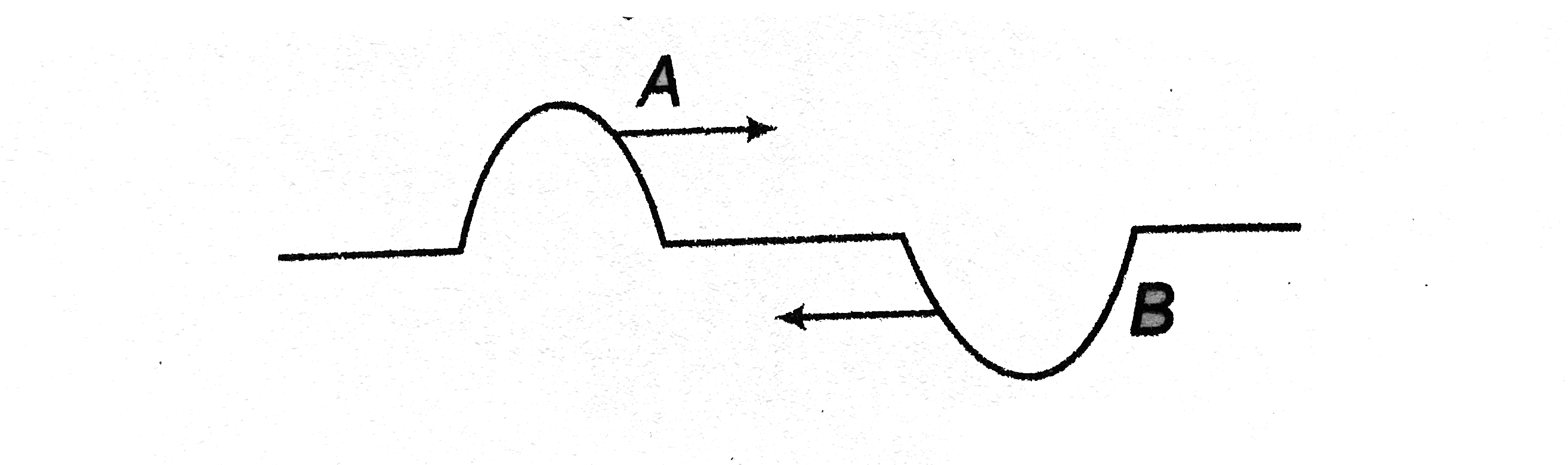
Two identical harmonic pulses travelling in opposite directions in a taut string approach each other. At the instant when they completely overlap, the total energy of the string will be
.

Promotional Banner

Similar Questions

Explore conceptually related problems

Two wave pulses travel in opposite directions on a string and approach each other. The shape of the one pulse in inverted with respect to the other.

Two wave pulses travel in opposite directions on a string and approach each other. The shape of one pulse is inverted with respect to the other

Two wave pulses travel in opposite directions on a string and approch each other. The shape of the one pulse is same with respect to the other

Two wave pulses travel in opposite directions on a string and approch each other. The shape of the one pulse is same with respect to the other

(a) Two identical sinusoidal pulses move in opposite directions on a stretched string. Kinetic energy of each pulse is k. At the instant they overlap completely, what is kinetic energy of the resulting pulse? (b) “A string clamped at both ends is vibrating. At the moment the string looks flat, the instantaneous transverse velocity of points along the string, excluding its end-points, must be same everywhere except at nodes.” Is this statement correct?

Two wave pulses travel in opposite directions on a string and approach each other. The shape of the one pulse is inverted with respect to the other. What does that mean?

Two pulses travelling in opposite directions along a string are shown for t=0 in the figure. Plot the shape of the string at t= 1.0, 2.0, 3.0, 4.0 and 5.0s respectively .

Two pulses on a string approach each other at speeds of 1m//s what is the shape of the string at t=6s?

Two sinusoidal waves with identical wavelengths and amplitudes travel in opposite directions along a string with a speed of 15 cm/s. If the time interval between instants when the string is fiat is 0.20 s, what is the wavelength of the waves?