

Home
Class 11
PHYSICS
(i) A spinning disk has a hole at its ce...

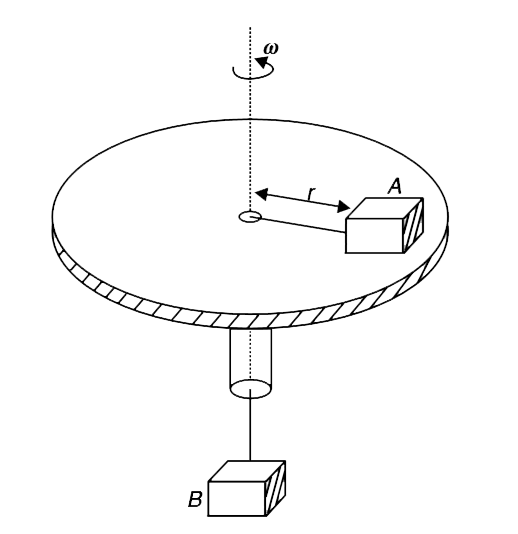
(i) A spinning disk has a hole at its centre. The surface of the disk is horizontal and a small block A of mass m = 1 kg is placed on it.

Block A is tied to a light inextensible string, other end of which passes through the hole and supports another block B of mass M = 2 kg. The coefficient of friction between A and the disk surface is 0.5. It was observed that the disk is spinning with block A remaining at rest relative to the disk. Block B was found to be stationary. It was estimated that length of horizontal segment of the string (r) was anywhere between 1.0 m to 1.5 m. With this data what estimate can be made about the angular speed `(omega)` of the disk. `[g = 10 m//s^(2)`] (ii) A spring has force constant equal to `k = 100 Nm^(–1)`. Ends of the spring are joined to give it a circular shape of radius R = 20 cm. Now the spring is rotated about its symmetry axis (perpendicular to its plane) such that the circumference of the circle increases by `1%`. Find the angular speed `(omega)`. Mass of one meter length of the spring is `lambda = 0.126 gm^(–1)`.

Promotional Banner

Similar Questions

Explore conceptually related problems

A block A of mass m_1 rests on a horizontal table . A light string connected to it passes over a frictionless pulley at the edge of table and from its other end another block B of mass m_2 is suspended . The coefficient of kinetic friction between the block and the table is mu . When the block A is sliding on the table the tension in the string is :

A block of mass m_(1) rests on a horizontal table. A string tied to the block is passed on a frictionless pulley fixed at the end of the table and to the other end of string is hung another block of mass m_(2) . The acceleration of the system is

A block of mass m_(1) rests on a horizontal table. A string tied to the block is passed on a frictionless pulley fixed at the end of the table and to the other end of string is hung another block of mass m_(2) . The acceleration of the system is

Block A has a mass of 2 kg and block B has a mass of 20 kg if the coefficient of kinetic friction between block B and the horizontal surface is 0.1, and B is accelerating towards the right with a = 2 m//s^(2) , then the mass of the block C will be -

A block of mass 1 kg lies on a horizontal surface in a truck. The coefficient of static friction between the block and the surface is 0.6. If the acceleration of the truck is 5m//s^2 , the frictional force acting on the block is…………newtons.

A block of mass 1 kg lies on a horizontal surface in a truck. The coefficient of static friction between the block and the surface is 0.6. If the acceleration of the truck is 5m//s^2 , the frictional force acting on the block is…………newtons.

A block of mass 1 kg lies on a horizontal surface in a truck. The coefficient of static friction between the block and the surface is 0.6. If the acceleration of the truck is 5m//s^2 , the frictional force acting on the block is…………newtons.

A block of mass 5 kg resting on a horizontal surface is connected by a cord, passing over a light frictionless pulley to a hanging block of mass 5 kg. The coefficient of kinetic friction between the block and the surface is 0.5. Tension in the cord is ( g =9.8m//s^(2) )