

Home
Class 11
PHYSICS
When a mass m is connected individually ...

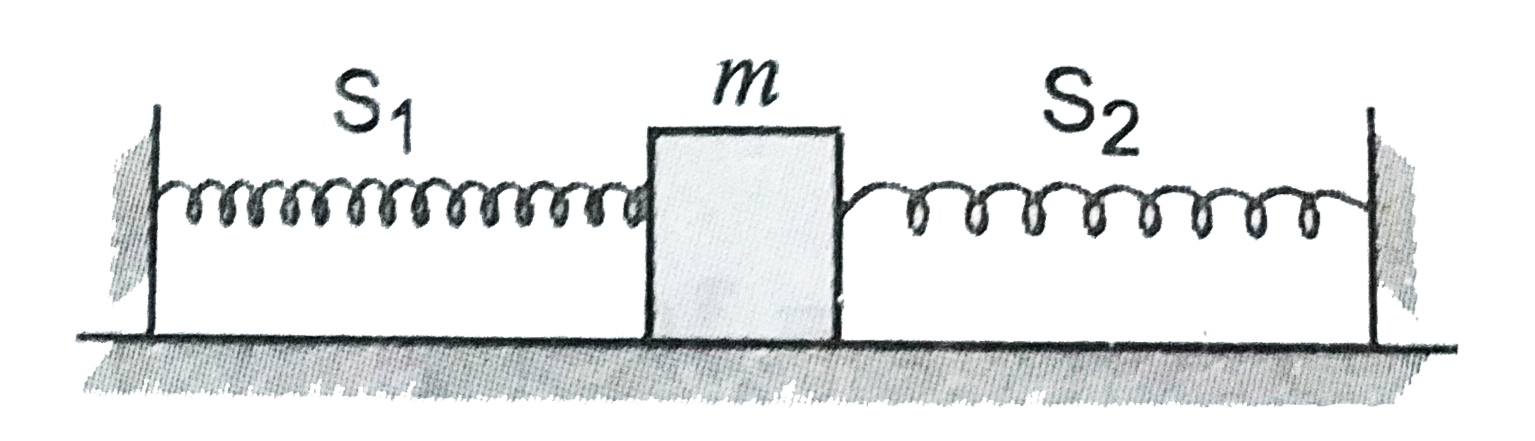
When a mass m is connected individually to two spring `S_(1)` and `S_(2)` , the oscillation frequencies are `v_(1) and v_(2)`. If the same mass is attached to the two springs as shwon in figure., the oscillation frequecy would be

Promotional Banner

Similar Questions

Explore conceptually related problems

When a mass m is connected individually to two springs S_(1) and S_(2) , the oscillation frequencies are v_(1) and v_(2) . If the same mass is attached to the two springs as shown in figure, the oscillation frequency would be

When a mass m is connected individually to two springs S_(1) and S_(2) , the oscillation frequencies are v_(1) and v_(2) . If the same mass is attached to the two springs as shown in figure, the oscillation frequency would be

When a mass m is connected individually to two springs S_(1)" and "S_(2) the oscillation frequencies are v_(1)" and "v_(2) . If the same mass is attached to the two springs as shown in figure, the oscillation frequency would be

When a mass m is connected individually to two springs S_(1) and S_2 , the oscillation frequencies are upsilon_(1) and upsilon_(2) . If the same mass is attached to the two springs as shown in figure, the oscillation frequency would be

When a mass m is connected individually to two springs S_(1) and S_2 , the oscillation frequencies are upsilon_(1) and upsilon_(2) . If the same mass is attached to the two springs as shown in figure, the oscillation frequency would be

Two masses m_(1) and m_(2) are attached to a spring balance S as shown in figure. m_(1) gt m_(2) then the reading of spring balance will be . .

A mass is suspended separately by two springs of spring constants k_(1) and k_(2) in successive order. The time periods of oscillations in the two cases are T_(1) and T_(2) respectively. If the same mass be suspended by connecting the two springs in parallel, (as shown in figure) then the time period of oscillations is T. The correct relations is

A mass is suspended separately by two springs of spring constants k_(1) and k_(2) in successive order. The time periods of oscillations in the two cases are T_(1) and T_(2) respectively. If the same mass be suspended by connecting the two springs in parallel, (as shown in figure) then the time period of oscillations is T. The correct relations is

There are two springs. One delicate and another stiffer. Same mass m is attached to both. For which spring the frequency of oscillation will be more?