

Home
Class 11
PHYSICS
A rod lying on a frictionless horizontal...

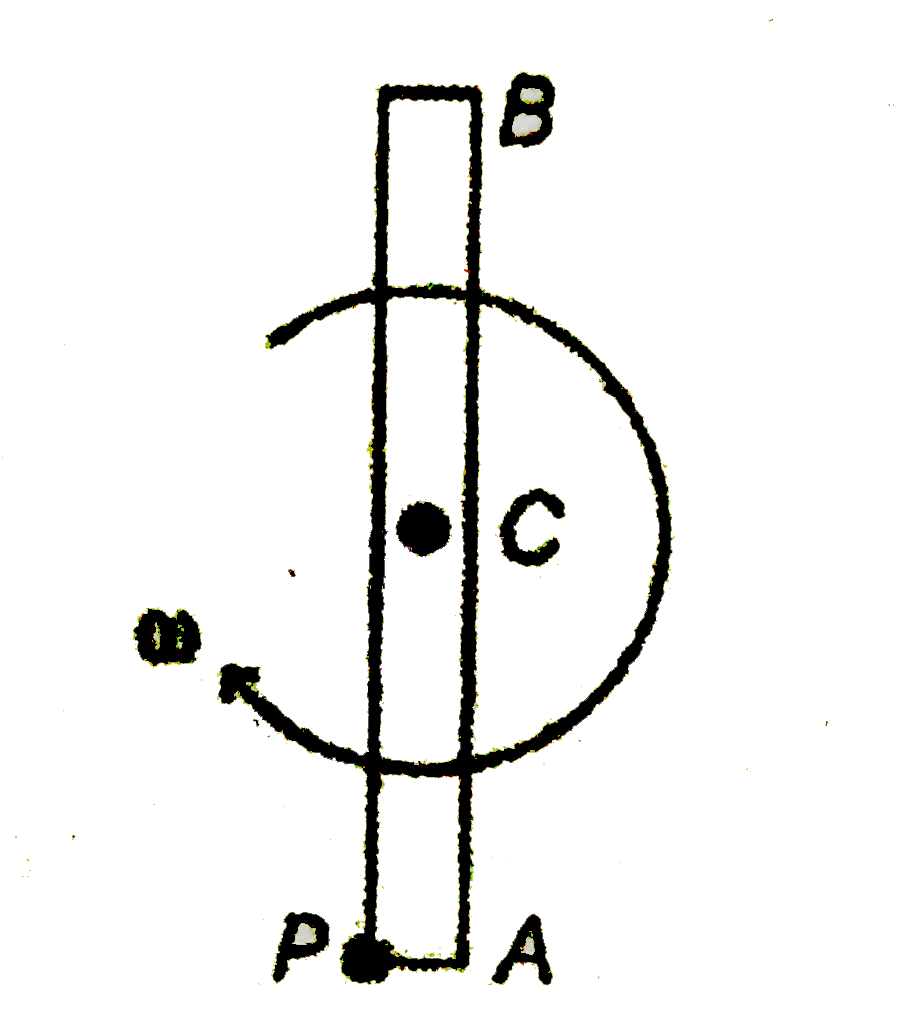
A rod lying on a frictionless horizontal surface is initially given an anglular velocity `omega` about vertical axis which passes through center of mass. The centre of mass is at rest but not fixed. The length of the rod is L. Subsequently, end A of the rod collides with nail P, which is near to A such that end A becomes stationery immediately after impact. Velocity of end B just after collision will be

Promotional Banner

Similar Questions

Explore conceptually related problems

A uniform rod of mass m and length l rotates in a horizontal plane with an angular velocity omega about a vertical axis passing through one end. The tension in the rod at a distance x from the axis is

A uniform rod of mass m and length l rotates in a horizontal plane with an angular velocity omega about a vertical axis passing through one end. The tension in the rod at a distance x from the axis is

A uniform rod of mass m and length l rotates in a horizontal plane with an angular velocity omega about a vertical axis passing through one end. The tension in the rod at a distance x from the axis is

Find the moment of inertia of thin and massless rod about an axis passing through its centre of mass of rod and pair of mass is suspended on both end of this rod.

A uniform rod of length l and density rho is revolving about a vertical axis passing through its one end. If omega is the angular velocity of the rod then the centrifugal force per unit area of the rod is

A thin uniform copper rod of length l and mass m rotates uniformly with an angular velocity omega in a horizontal plane about a vertical axis passing through one of its ends. Determine the tension in the rod as a function of the distance r from the rotation axis. Find the elongation of the rod.

A thin uniform copper rod of length l and mass m rotates uniformly with an angular velocity omega in a horizontal plane about a vertical axis passing through one of its ends. Determine the tension in the rod as a function of the distance r from the rotation axis. Find the elongation of the rod.

A uniform rod of length L pivoted at one end P is freely rotated in a horizontal plane with an angular velocity omega about a vertical axis passing through P. If the temperature of the system is increased by Delta T , angular velocity becomes omega/2 . If coefficient of linear expansion of the rod is alpha (altlt1) , then DeltaT will be