

Home
Class 12
PHYSICS
A thin slice is cut out of a glass cylin...

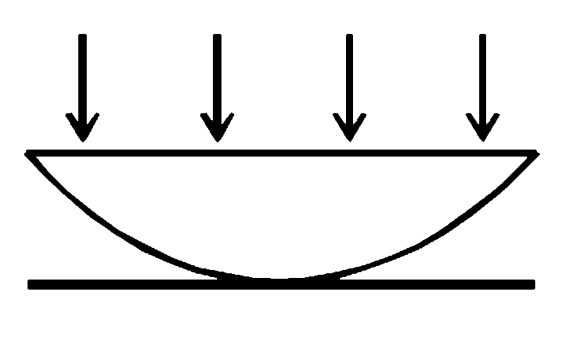
A thin slice is cut out of a glass cylinder along a plane parallel to its axis. The slice is placed on a flat glass plate as shown in Figure. The observed interference fringes from this combination shall be

Promotional Banner

Similar Questions

Explore conceptually related problems

A thin slice is cut out of a glass cylinder along a plane parallel to its axis. The slice is placed on a flat glass plate with the curved surface downwards. Monochromatic light is incident normally from the top. The observed interference fringes from the combination do not follow on of the following statements.

A thin slice is cut out of a glass cylinder along a plane parallel to its axis. The slice is placed on a flat glass plate with the curved surface downwards. Monochromatic light is incident normally from the top. The observed interference fringes from the combination do not follow on of the following statements.

A thin slice is cut out of a glass cylinder along a plane parallel to its axis. The slice is placed on a flat glass plate with the curved surface downwards. Monochromatic light is incident normally from the top. The observed interference fringes from the combination do not follow on of the following statements.

Assertion: A glass hemisphere is placed on a flat plate as shown. The observed interference fringes from this combination shall be circular. Reason: In all cases fringes are circular.

Assertion: A glass hemisphere is placed on a flat plate as shown. The observed interference fringes from this combination shall be circular. Reason: In all cases fringes are circular.

A parallel beam of light is incident on a glass prism in the shape of a quarter cylinder of radius R=0.5 m and refractive index n 1.5 placed on a horizontal table as shown in the figure. Beyond the cylinder a patch of light is found whose nearest distance x from the cylinder is

A point sources S emitting light of wavelength 600nm is placed at a very small height h above the flat reflecting surface AB (see figure).The intensity of the reflected light is 36% of the intensity.interference firnges are observed on a screen placed parallel to the reflecting surface a very large distance D from it. (A)What is the shape of the interference fringes on the screen? (B)Calculate the ratio of the minimum to the maximum to the maximum intensities in the interference fringes fromed near the point P (shown in the figure) (c) if the intenstities at point P corresponds to a maximum,calculate the minimum distance through which the reflecting surface AB should be shifted so that the intensity at P again becomes maximum.

A point sources S emitting light of wavelength 600nm is placed at a very small height h above the flat reflecting surface AB (see figure).The intensity of the reflected light is 36% of the intensity.interference firnges are observed on a screen placed parallel to the reflecting surface a very large distance D from it. (A)What is the shape of the interference fringes on the screen? (B)Calculate the ratio of the minimum to the maximum to the maximum intensities in the interference fringes fromed near the point P (shown in the figure) (c) if the intenstities at point P corresponds to a maximum,calculate the minimum distance through which the reflecting surface AB should be shifted so that the intensity at P again becomes maximum.

A point sources S emitting light of wavelength 600nm is placed at a very small height h above the flat reflecting surface AB (see figure).The intensity of the reflected light is 36% of the intensity.interference firnges are observed on a screen placed parallel to the reflecting surface a very large distance D from it. (A)What is the shape of the interference fringes on the screen? (B)Calculate the ratio of the minimum to the maximum to the maximum intensities in the interference fringes fromed near the point P (shown in the figure) (c) if the intenstities at point P corresponds to a maximum,calculate the minimum distance through which the reflecting surface AB should be shifted so that the intensity at P again becomes maximum.