Home
Class 12
PHYSICS
A diathermic piston divides adiabatic cy...

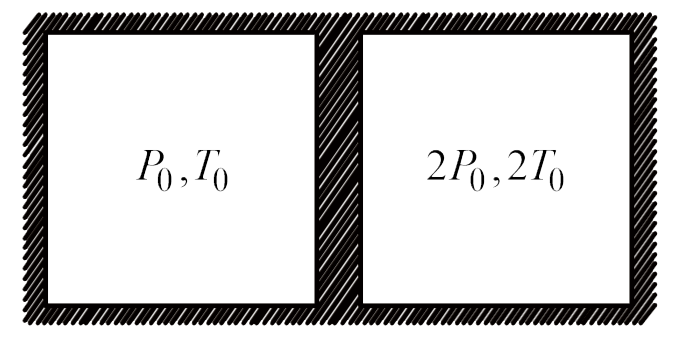
A diathermic piston divides adiabatic cylinder of volume V0 into two equal parts as shown in the figure. Both parts contain ideal monoatomic gases. The initial pressure and temperature of gas in left compartment are P0 and T0 while that in right compartment are 2P0 and 2T0. Initially the piston is kept fixed and the system is allowed to acquire a state of thermal equilibrium.

The pressure in left compartment after thermal equilibrium is achieved is

A

`p_(o)`

B

`(3)/2p_(0)`

C

`(4)/3p_(0)`

D

None of these

Text Solution

Verified by Experts

Promotional Banner

Topper's Solved these Questions

  • HEAT TRANSFER AND NEWTONS LAW OF COOLING

    DISHA|Exercise physics|30 Videos
  • LAWS OF MOTION

    DISHA|Exercise physics|85 Videos

Similar Questions

Explore conceptually related problems

A diathermic piston divides adiabatic cylinder of volume V0 into two equal parts as shown in the figure. Both parts contain ideal monoatomic gases. The initial pressure and temperature of gas in left compartment are P0 and T0 while that in right compartment are 2P0 and 2T0. Initially the piston is kept fixed and the system is allowed to acquire a state of thermal equilibrium. The heat that flown from right compartment to left compartment before thermal equilibrium is achieved is

A diathermic piston divides adiabatic cylinder of volume V0 into two equal parts as shown in the figure. Both parts contain ideal monoatomic gases. The initial pressure and temperature of gas in left compartment are P0 and T0 while that in right compartment are 2P0 and 2T0. Initially the piston is kept fixed and the system is allowed to acquire a state of thermal equilibrium. If the pin which was keeping the piston fixed is removed and the piston is allowed to slide slowly such that a state of mechanical equilibrium is achieved. The volume of left compartment when piston is in equilibrium is

Figure shows an insulated cylinder of volume V containing monatomic gas in both the compartments. The pistone is diathermic. Initially the piston is kept fixed and the system is allowed to acquire a state of thermal equilibrium. The initial pressures and temperatures are as shown in the figure. Calculate Final volume of the left compartment.

Figure shows an insulated cylinder of volume V containing monatomic gas in both the compartments. The pistone is diathermic. Initially the piston is kept fixed and the system is allowed to acquire a state of thermal equilibrium. The initial pressures and temperatures are as shown in the figure. Calculate Final volume of right compartment.

Figure shows an insulated cylinder of volume V containing monatomic gas in both the compartments. The pistone is diathermic. Initially the piston is kept fixed and the system is allowed to acquire a state of thermal equilibrium. The initial pressures and temperatures are as shown in the figure. Calculate The final temperature

Figure shows an insulated cylinder of volume V containing monatomic gas in both the compartments. The pistone is diathermic. Initially the piston is kept fixed and the system is allowed to acquire a state of thermal equilibrium. The initial pressures and temperatures are as shown in the figure. Calculate The final presssures of left and right compartment respectively are

A cylindrical adiabatic container of total volume 2V_(0) divided into two equal parts by a conducting piston which is free to move as shown in figure. Each part containing identical gas at pressure P_(0) . Initially temperature of left and right part is 4T_(0) and T_(0) respectively. An external force is applied on the piston of area 'A' to keep the piston at rest. The value of external force required when thermal equilibrium is reached is.

Consider the adjacent figure. A piston divides a cylindrical container into two equal parts. The lets part contains 1 mole of helium gas and the right part contains two moles or oxygen gas. The initial temperatures and pressures of the gases in the left chamber are T_(0) and p_(0) and the right chamber are (T_(0))/(2) and p_(0) respectively as shown in the figure. The piston as well as the walls of the container are adiabatic. After removal of the piston, gases mix homoganeously and the final pressure becomes p=(4n)/(13)p_(0) . Find the value of n.

Figure shows an insulated cylinder of volume V containing monatomic gas in both the compartments. The pistone is diathermic. Initially the piston is kept fixed and the system is allowed to acquire a state of thermal equilibrium. The initial pressures and temperatures are as shown in the figure. Calculate The heat that flows from RHS to LHS , Given T_(2)gt T_(1) . Now, the pin which was keeping the piston fixed is removed. and the piston is set free to move. The piston is allowed to slide slowly, such that of mechanical equilibrium is also achieved and T_(1)P_(2)gt P_(1)T_(2) . Find.

DISHA-KINETIC THEORY OF GASES-physics
  1. In the two vessels of same volume, atomic hydrogen and helium at press...

    Text Solution

    |

  2. For gas at a temperature T the root-mean-square speed v(rms), the most...

    Text Solution

    |

  3. One mole of gas having gamma = 7//5 is mixed with 1 mole of a gas havi...

    Text Solution

    |

  4. The value of the gas constant (R) calculated from the perfect gas equa...

    Text Solution

    |

  5. Gas at a pressure P(0) in contained as a vessel. If the masses of all ...

    Text Solution

    |

  6. The mean kinetic energy per unit volume of gas (E) is related to avera...

    Text Solution

    |

  7. Mean kinetic energy (or average energy) per gm molecule of a monoatomi...

    Text Solution

    |

  8. At which of the following temperatures would the molecules of a gas ha...

    Text Solution

    |

  9. The kinetic energy of one gram molecule of a gas at normal temperature...

    Text Solution

    |

  10. 70 calories of heat required to raise the temperature of 2 moles of an...

    Text Solution

    |

  11. A vessel contains a mixture of one mole of oxygen and two moles of nit...

    Text Solution

    |

  12. From the following statements, concerning ideal gas at any given tempe...

    Text Solution

    |

  13. Let barv,v(rms) and vp respectively denote the mean speed. Root mean s...

    Text Solution

    |

  14. A gas in container A is in thermal equilibrium with another gas in con...

    Text Solution

    |

  15. A diathermic piston divides adiabatic cylinder of volume V0 into two e...

    Text Solution

    |

  16. A diathermic piston divides adiabatic cylinder of volume V0 into two e...

    Text Solution

    |

  17. A diathermic piston divides adiabatic cylinder of volume V0 into two e...

    Text Solution

    |

  18. Assertion : Internal energy of an ideal gas does not depend upon volum...

    Text Solution

    |

  19. Assetion : Equal masses of helium and oxygen gases are given equal qua...

    Text Solution

    |

  20. Statement-1 : Maxwell speed distribution graph is asymmetric about ...

    Text Solution

    |

