

Home
Class 12
PHYSICS
For spherical symmetrical charge distrib...

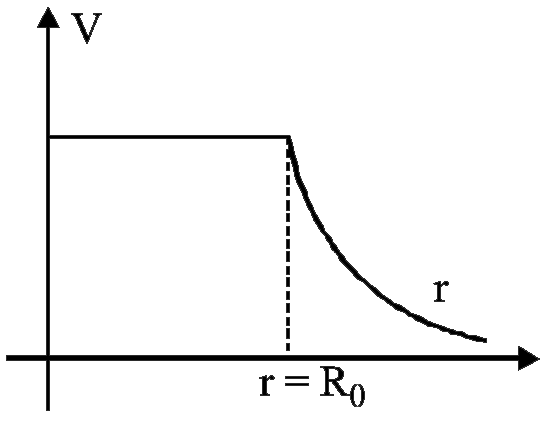
For spherical symmetrical charge distribution, variation of electric potential with distance from centre is given in diagram Given that : `V=(q)/(4pi epsilon_(0)R_(0))` for `r le R_(0) and V=(q)/(4 piepsilon_(0)r)` for `r ge R_(0)`
Then which option (s) are correct :
(1) Total charge within `2R_(0)` is q
(2) Total electrosstatic energy for `r le R_(0)` is non-zero
(3) At `r = R_(0)` electric field is discontinuous
(4) There will be no charge anywhere except at `r lt R_(0)`

A

1,2 and 3 are correct

B

1 and 2 are correct

C

2 and 4 are correct

D

1 and 3 are correct

Text Solution

Verified by Experts

Promotional Banner

Topper's Solved these Questions

Similar Questions

Explore conceptually related problems

A spherical symmetric charge system is centered at origin. Given, Electric potential V=(Q)/(4piepsilon_0R_0)(rleR_0) , V=(Q)/(4piepsilon_0r)(rgtR_0)

Draw a graph of electric field E(r) with distance r from the centre of the shell for 0 le r le 0 .

The electrostatic potential (phi _r) of a spherical symmetric system , kept at origin is shown in the adhacent figure, and given as phi _e = q/( 4 pi varepsilon_0 r) (r le R_o) phi _e = q/( 4 pi varepsilon_0 R_o) (r le R_0) Which of the following option s in //are correct ?

Consider a spherical symmetric charge distribution with charge density varying as rho={[rho_(0)(1-(r)/(R)),r R]} The electric field at r , r le R will be

Potential inside a uniformly charged solid sphere is given by Q (a + b (r/R)^c)/ (4 pi epsilon_0) What are the values of a,b,c?

A sphere of radius 2R has a uniform charge density p. The difference in the electric potential at r = R and r = 0 from the centre is:

A sphere of radius R, is charged uniformly with total charge Q. Then correct statement for electric field is (r = distance from centre): -

Using the concept of energy density , show that the total energy stored by a shell of radius R and charge Q is (Q^(2))/( 8 pi epsilon_(0)R)

DISHA-ELECTROSTATICS-physics
  1. A point Q lies on the perpendicular bisector of an electrical dipole ...

    Text Solution

    |

  2. Consider a system of three charges (q)/(3),(q)/(3) and -(2q)/(3) place...

    Text Solution

    |

  3. For spherical symmetrical charge distribution, variation of electric p...

    Text Solution

    |

  4. An electric dipole (AB) consisting of two particles of equal and oppos...

    Text Solution

    |

  5. An electric dipole (AB) consisting of two particles of equal and oppos...

    Text Solution

    |

  6. Statement -1 : A bird perches on a high power line and nothing happens...

    Text Solution

    |

  7. Statement -1 : Electrons move away from a low potential to high poten...

    Text Solution

    |

  8. Assertion: Surface of asymmetrical conductor can be treated as equipot...

    Text Solution

    |

  9. A total charge Q is broken in two parts Q(1) and Q(2) and they are pla...

    Text Solution

    |

  10. Two small balls having equal positive charge Q(coulomb) on each are su...

    Text Solution

    |

  11. Electric charges of 1mu C, -1 mu C and 2mu C are placed in air at the ...

    Text Solution

    |

  12. An electron is moving round the nucleus of a hydrogen atom in a circul...

    Text Solution

    |

  13. Equal charges q are placed at the four corners A,B,C,Dof a square of l...

    Text Solution

    |

  14. The charges on two spheres are +7muC and –5muC respectively. They expe...

    Text Solution

    |

  15. Electric lines of force about negative point charge are

    Text Solution

    |

  16. Figure shows the electric lines of force emerging from a charged body....

    Text Solution

    |

  17. The magnitude of electric field intensity E is such that, an electron ...

    Text Solution

    |

  18. A charge particle is free to move in an electric field. It will travel

    Text Solution

    |

  19. Two point charges Q and -3Q are placed at some distance apart. If the ...

    Text Solution

    |

  20. Charges q, 2q,3q and 4q are placed at the corners A,B,C and D of a squ...

    Text Solution

    |