Home
Class 12
PHYSICS
A solid sphere S(1) is connected to a ch...

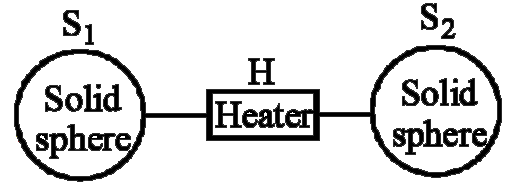
A solid sphere `S_(1)` is connected to a charge reservoir through a heater H as shown in figure.

Flux through a closed spherical surface around `S_(1)` is given by `phi = alpha t^(2)` where `alpha` is a constant and t is time in seconds. If resistance of heater is R then select correct statements
(1) Power consumed by heater will be `4alpha^(2)e_(0)^(2) Rt^(2)`.
(2) Electric flux through a closed spherical surface around `S_(2)` will be `– alpha t_(2)`.
(3) Rate of change of electric flux through a closed spherical surface around `S_(2)` will be `–2alpha t`
(4) All of the above are correct

A

1, 2 and 3 are correct

B

1 and 2 are correct

C

2 and 4 are correct

D

1 and 3 are correct

Text Solution

Verified by Experts

Promotional Banner

Similar Questions

Explore conceptually related problems

Time dependence of a physical quantity P is given by P =P_0 exp(-alpha t^2), where alpha is a constant and t is time. The constant alpha is

The time dependence of a physical quantity P is given by P= P_0 exp (-alpha t^(2)) , where alpha is a constant and t is time. The constant alpha

The time dependence of a physical quantity P is given by P = P_(0)e^(-alpha t^(2)) , where alpha is a constant and t is time . Then constant alpha is//has

Electric flux through a spherical surface shown in the figure is _______

The time dependence of a physical quantity P is given by P=P_(0) exp (-alpha t^(2)) , where alpha is a constant and t is time. The constant alpha

A physical quantity Q is given by Q=Q_(0)e^(-alphat^(2)) where t is the time and alpha is a constant. What is the dimensional formula for alpha ?

The magnetic flux through a loop is varying according to relation phi=6t^(2)+7t+1 where phi is in milliweber and t is in second. What is the e.m.f. induced in the loop at t = 2 second ?

A conducting sphere S_(1) intersects a closed surface S_(2) as shown in the figure.A positive charge q is placed at a point P .What is the value of electric flux through the surface S_(2) ? q P

