Home
Class 12
PHYSICS
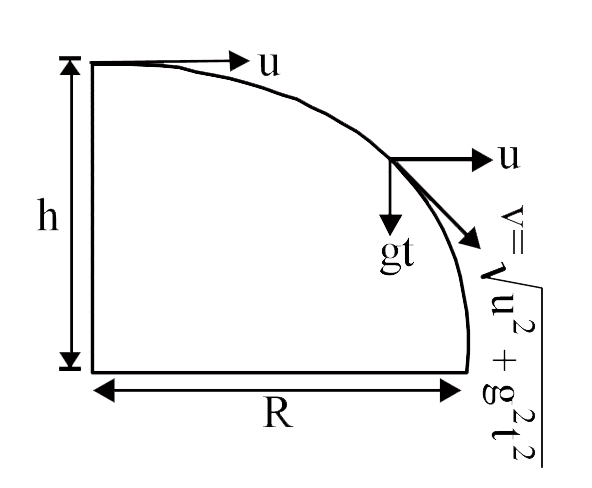
Velocity at a general point P(x, y) for ...

Velocity at a general point P(x, y) for a horizontal projectile motion is given by
`v=sqrt((v_("x")^(2)+v_("y")"^(2))),tan alpha=(v_(y))/(v_(x))`
`alpha`is angle made by v with horizontal in clockwise direction Trajectory equation for a horizontal projectile motion is given by `x=v_(x)t=ut`
y=-`(1//2)"gt"^(2)`
eliminating t, we get `y=-(1//2)(gx^(2))/(u^(2)`
An aeroplane is flying horizontally with a velocity of 720 km/h at an altitude of 490 m. When it is just vertically above the target a bomb is dropped from it. How far horizontally it missed the target?

A

1000m

B

2000m

C

100m

D

200m

Text Solution

Verified by Experts

Promotional Banner

Similar Questions

Explore conceptually related problems

elocity at a general point P(x, y) for a horizontal projectile motion is given by v=sqrt((v_("x")^(2)+v_("y")"^(2))),tan alpha=(v_(y))/(v_(x)) alpha is angle made by v with horizontal in clockwise direction Trajectory equation for a horizontal projectile motion is given by x=v_(x)t=ut y=- (1//2)"gt"^(2) eliminating t, we get y=-(1//2)(gx^(2))/(u^(2) 5An aeroplane is in a level flying at an speed of 144 km//hr at an altitude of 1000 m. How far horizontally from a given target should a bomb be released from it to hit the target ?

Velocity at a general point P(x, y) for a horizontal projectile motion is given by v=sqrt((v_("x")^(2)+v_("y")"^(2))),tan alpha=(v_(y))/(v_(x)) alpha is angle made by v with horizontal in clockwise direction Trajectory equation for a horizontal projectile motion is given by x=v_(x)t=ut y=- (1//2)"gt"^(2) eliminating t, we get y=-(1//2)(gx^(2))/(u^(2) A ball rolls off top of a stair way with a horizontal velocity u m//s. If the steps are h m high and b meters wide, the ball will just hit the edge of nth step if n^(th) equals to

A projectile is fired from the origin with a velocity v_(0) at an angle theta with x-axis. The speed of the projectile at an altitude h is .

A projectile is thrown upward with a velocity v_(0) at an angle alpha to the horizontal. The change in velocity of the projectile when it strikes the same horizontal plane is

The electrostatic potential V at any point (x, y, z) in space is given by V=4x^(2)

In a projectile motion, the height y = sqrt(3)t - 5t^(2) + r^(3) and horizontal distance x = t + 2t^(2) -t^(3) . The angle of projection is given by

For a projectile thrown with a velocity v, the horizontal range is (sqrt(3)v^2)/(2g) . The vertical range is v^2/(8g) . The angle which the projectile makes with the horizontal initially is:

A mass m moving horizontal (along the x-axis) with velocity v collides and stricks to mass of 3m moving vertically upward (along the y-axis) with velocity 2v . The final velocity of the combination is

The equation of projectile is y=16x-(x^(2))/(4) the horizontal range is:-

