

Home
Class 12
PHYSICS
The orbit of Pluto is much more eccentri...

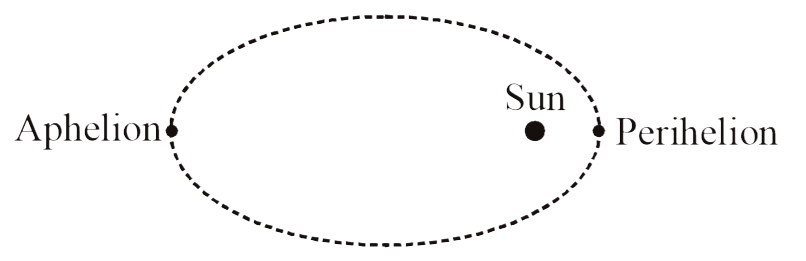
The orbit of Pluto is much more eccentric than the orbits of the other planets. That is, instead of being nearly circular, the orbit is noticeably elliptical. The point in the orbit nearest to the sun is called the perihelion and the point farthest from the sun is called the aphelion.

At perihelion, the mechanical energy of Pluto’s orbit has

A

its maximum value

B

its minimum value

C

the same value as at every other point in the orbit

D

value which depends on sense of rotation

Text Solution

Verified by Experts

Promotional Banner

Topper's Solved these Questions

  • FLUID MECHANICS

    DISHA|Exercise physics|28 Videos
  • HEAT TRANSFER AND NEWTONS LAW OF COOLING

    DISHA|Exercise physics|30 Videos

Similar Questions

Explore conceptually related problems

The orbit of Pluto is much more eccentric than the orbits of the other planets. That is, instead of being nearly circular, the orbit is noticeably elliptical. The point in the orbit nearest to the sun is called the perihelion and the point farthest from the sun is called the aphelion. At perihelion, the gravitational potential energy of Pluto in its orbit has

The orbit of Pluto is much more eccentric than the orbits of the other planets. That is, instead of being nearly circular, the orbit is noticeably elliptical. The point in the orbit nearest to the Sun is called the perihelion and the point farthest from the Sun is called the aphelion. At perihelion, the gravitational potential energy of Pluto in its orbit has

The orbit of Pluto is much more eccentric than the orbits of the other planets. That is, instead of being nearly circular, the orbit is noticeably elliptical. The point in the orbit nearest to the sun is called the perihelion and the point farthest from the sun is called the aphelion. As Pluto moves from the perihelion to the aphelion, the work done by gravitational pull of Sun on Pluto is

The orbit of Pluto is much more eccentric than the orbits of the other planets. That is, instead of being nearly circular, the orbit is noticeably elliptical. The point in the orbit nearest to the Sun is called the perihelion and the point farthest from the Sun is called the aphelion. As Pluto moves from the perihelion to the aphelion, the work done by gravitational pull of Sun on Pluto is

A planet moving in a circular orbit around the sun at a distance, 4times theaverage distance of the earth from the sun will complete one revolution in

A planet is revolving in an elliptical orbit around the sun. Its closest distance from the sun is r and the farthest distance is R. If the velocity of the planet nearest to the sun be v and that farthest away from the sun be V. then v/V is

A comet (assumed to be in an elliptical orbit around the sun) is at a distance of 0.4 AU from the sun at the perihelion. If the time period of the comet is 125 years, what is the aphelion distance ? AU : Astronomical Unit.

All planets move in elliptical orbits with the sun situtated at one of the forci of the ellipse the point at wihich the planet is closest to the sun is

A planet is revolving round the sun in an elliptical orbit, If v is the velocity of the planet when its position vector from the sun is r, then areal velocity of the planet is

DISHA-GRAVITATION-Physics
  1. Spot the correct statements : The acceleration due to gravity 'g' d...

    Text Solution

    |

  2. The orbit of Pluto is much more eccentric than the orbits of the other...

    Text Solution

    |

  3. The orbit of Pluto is much more eccentric than the orbits of the other...

    Text Solution

    |

  4. The orbit of Pluto is much more eccentric than the orbits of the other...

    Text Solution

    |

  5. Statement -1: Gravitational force between two particles is negligibly ...

    Text Solution

    |

  6. Statement-1 :The universal gravitational constant is same as accelerat...

    Text Solution

    |

  7. Assertion: There is no effect of rotation of a earth on acceleration d...

    Text Solution

    |

  8. A body of mass 100kg falls on the earth from infinity. Its kinetic ene...

    Text Solution

    |

  9. An artificial satellite of the earth is to be established in the equat...

    Text Solution

    |

  10. Two satellites S(1) and S(2) revolve round a planet in the same direct...

    Text Solution

    |

  11. In the above example the angular velocity of S(2) as actually observed...

    Text Solution

    |

  12. The moon revolves round the earth 13 times in one year. If the ratio o...

    Text Solution

    |

  13. Two planets of radii in the ratio 2 : 3 are made from the materials of...

    Text Solution

    |

  14. A satellite of mass m is revolving in a circular orbit of radius r. Th...

    Text Solution

    |

  15. A spaceship is launched into a circular orbit close to the earth's sur...

    Text Solution

    |

  16. The ratio of the radius of the earth to that of moon is 10. The ratio ...

    Text Solution

    |

  17. Acceleration due to gravity on a planet is 10 times the value on the e...

    Text Solution

    |

  18. The Jupiter’s period of revolution round the Sun is 12 times that of t...

    Text Solution

    |

  19. The mean distance of Mars from the sun in 1.524 times that of the Eart...

    Text Solution

    |

  20. The semi-major axes of the orbits of mercury and mars are respectively...

    Text Solution

    |