

Home
Class 12
PHYSICS
Two large non conducting plates having s...

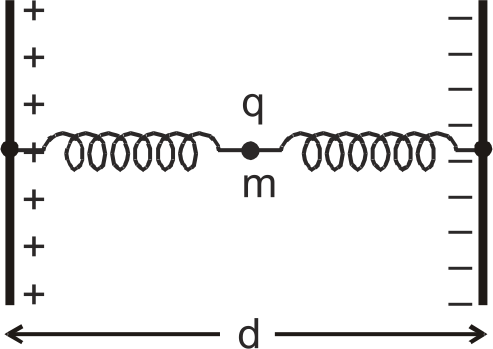
Two large non conducting plates having surface charge densities `+sigma` and `-sigma` respectively, are fixed `d` distnce apart. A small test charge `q` of mass `m` is attached to two non conducting springs each of spring constant `k` as shown in the figure. The sum of lengths of both springs in underformed state is `d`. The charge `q` is released from rest with both the springs nondeformed. then charge `q` will (neglect gravity)

Promotional Banner

Similar Questions

Explore conceptually related problems

Three non-conducting large parallel plates have surface charge densities sigma, -2 sigma and 4 sigma respectively as shown in the figure. The electric field at the point P is

Three non-conducting large parallel plates have surface charge densities sigma, -2 sigma and 4 sigma respectively as shown in the figure. The electric field at the point P is

Two large insulating plates having surface charge densities + sigma and - sigma are fixed some distance apart in a gravity -free region and two ideal insulating springs of force constant k are connected to the plates as shown in the figure. A particle of charge q and mass m which is attached to the junction of the spring is released from rest, then the partice will cross its equilibrium position with a speed

Two large insulating plates having surface charge densities + sigma and - sigma are fixed some distance apart in a gravity -free region and two ideal insulating springs of force constant k are connected to the plates as shown in the figure. A particle of charge q and mass m which is attached to the junction of the spring is released from rest, then the partice will cross its equilibrium position with a speed

Force between two conducting large plates , with charges Q and Q/2 as shown in the figure, is (Area of each face of plate =A)

Force between two conducting large plates , with charges Q and Q/2 as shown in the figure, is (Area of each face of plate =A)

Two masses m and 2m are attached to two ends of an ideal spring as shown in figure. When the spring is in the compressed state, the energy of the spring is 60 J, if the spring is released, then at its natural length

Two masses m and 2m are attached to two ends of an ideal spring as shown in figure. When thye spring is in the compressed state, the energy of the spring is 60 J, if the spring is released, then at its natural length

In the figure shown A & B are two charged particles having charges q and – q respectively are placed on a nonconducting fixed horizontal smooth plane. B is fixed and A is attached to a non conducting massless spring of spring constant k. The other end of the spring is fixed. Mass of A is m, A and B are in equilibrium when the distance between them is r. Choose the correct options