Home
Class 11
PHYSICS
In the figure the variation of potential...

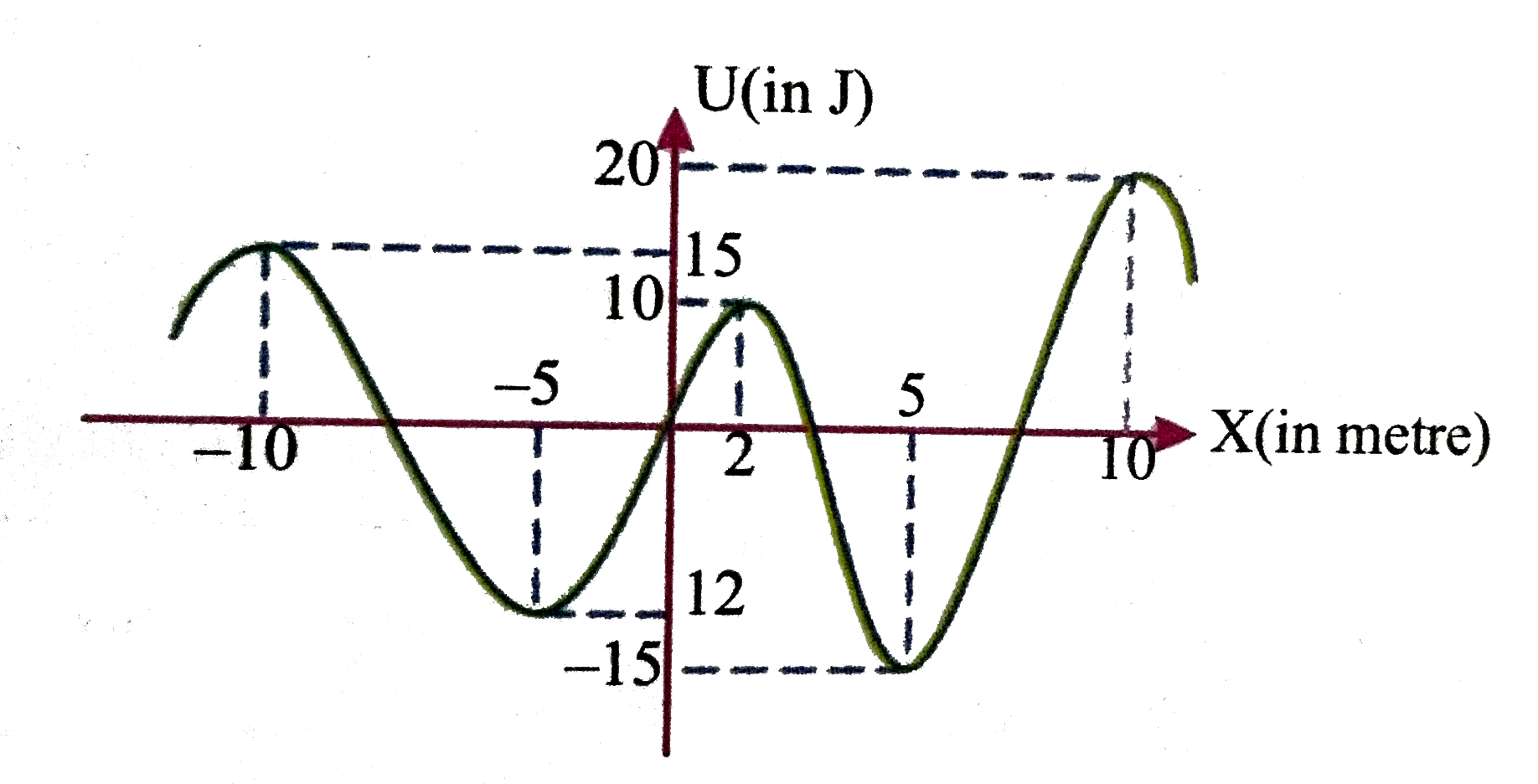
In the figure the variation of potential energy of a particle of mass `m = 2kg` is represented w.r.t. its x-coordinate. The particle moves under the effect of this conservative force along the x-axis.

If the particle is released at the origin then

A

it will move towards positive x-axis

B

it will move towards negative x-axis

C

it will remain stationary at the origin

D

its subsequent motion cannot be decided due to lack of information

Text Solution

Verified by Experts

Promotional Banner

Topper's Solved these Questions

Similar Questions

Explore conceptually related problems

In the figure, the variation of potential energy of a particle of mass m = 2kg is represented with respect to its x-coordinate. The particle moves under the effect of this conservative force along the X-axis. If the particle is released at the origin, then

In the figure, the variation of potential energy of a particle of mass m = 2kg is represented with respect to its x-coordinate. The particle moves under the effect of this conservative force along the X-axis. If the particle is released at x = 2 + Delta where Delta rarr 0 (it is positive), then its maximum speed in subsequent motion will be

In the figure the variation of potential energy of a particle of mass m = 2kg is represented w.r.t. its x-coordinate. The particle moves under the effect of this conservative force along the x-axis. x = - 5m and x = 10 m position of the particle are respectively of

In the figure the variation of potential energy of a particle of mass m=2kg is represented w.r.t. its x-coordinate. The particle moves under the effect of this conservative force along the x-axis. Which of the following statements are correct about the particle:

In figure, the variation of potential energy of a particle of mass m=2kg is represented w.r.t its x-coordinate. The particle moves under the effect of the conservative force along the x-axis. Which of the following statements is incorrect about the particle?

The potential energy of a particle moving along x-axis is given by U = 20 + 5 sin (4 pi x) , where U is in J and x is in metre under the action of conservative force :

In the figure the variations of componets of acceleration of particles of mass 1kg is shown w.r.t. time. The initial velocity of the particle is vec(u)=(-3 hati+4hatj) m/s. the total work done by the resultant force on the particles in time intervals from t=0 to t=4 seconds is :

Force acting on a particle moving in the x-y plane is vecF=(y^2hati+xhatj)N , x and y are in metre. As shown in figure, the particle moves from the origin O to point A (6m, 6m) . The figure shows three paths, OLA, OMA, and OA for the motion of the particle from O to A. Now consider another situation. A force vecF=(4hati+3hatj)N acts on a particle of mass 2kg . The particle under the action of this force moves from the origin to a point A (4m, -8m) . Initial speed of the particle, i.e., its speed at the origin is 2sqrt6ms^-1 . Figure shows three paths for the motion of the particle from O to A. If the potential energy at O is 16J , the potential energy at A will be

DISHA-WORK, ENERGY AND POWER-Physics
  1. A sphere of mass 8m collides elastically (in one dimension) with a blo...

    Text Solution

    |

  2. Two similar springs P and Q have spring constants K(P) and K(Q)(K(P)gt...

    Text Solution

    |

  3. In the figure the variation of potential energy of a particle of mass...

    Text Solution

    |

  4. The potential energy of a certain spring when stretched through a dist...

    Text Solution

    |

  5. A force applied by an engine of a train of mass 2.05xx10^6kg changes i...

    Text Solution

    |

  6. The relationship between the force F and position x of body is as show...

    Text Solution

    |

  7. A body is allowed to fall freely under gravity from a height of 10m. ...

    Text Solution

    |

  8. Block C of mass M is moving with velocity V(0) and collides elasticall...

    Text Solution

    |

  9. Two springs of force constants 300 N/m (Spring A) and 400 N/m (Spring ...

    Text Solution

    |

  10. A body of mass 1 kg begins to move under the action of a time depende...

    Text Solution

    |

  11. A bullet of mass 20 g and moving with 600 m/s collides with a block of...

    Text Solution

    |

  12. A body of mass m kg is ascending on a smooth inclined plane of inclina...

    Text Solution

    |

  13. A glass marble dropped from a certain height above the horizontal surf...

    Text Solution

    |

  14. The potential energy of a 1 kg particle free to move along the x- axis...

    Text Solution

    |

  15. Water falls from a height of 60 m at the rate 15 kg//s to operate a tu...

    Text Solution

    |

  16. A car of mass m starta from rest and accelerates so that the instyanta...

    Text Solution

    |

  17. When a 1.0kg mass hangs attached to a spring of length 50 cm, the spri...

    Text Solution

    |

  18. A block of mass m rests on a rough horizontal surface (Coefficient of ...

    Text Solution

    |

  19. A force act on a 30 gm particle as a friction of the particle as a fun...

    Text Solution

    |

  20. A body of mass M(1) collides elastically with another mass M(2) at res...

    Text Solution

    |

