

Home
Class 11
PHYSICS
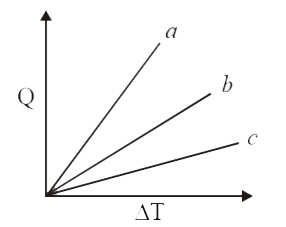
Figure shows the variation in temperatur...

Figure shows the variation in temperature (DT) with the amount of heat supplied (Q) in an isobaric process corresponding to a monoatomic (M), diatomic (D) and a polyatomic (P) gas. The initial state of all the gases are the same and the scales for the two axes coincide. Ignoring vibrational degrees of freedom, the lines a, b and c respectively correspond to

A

P.MandD

B

M,DandP

C

P,D and M

D

D,M and P

Text Solution

Verified by Experts

Promotional Banner

Topper's Solved these Questions

Similar Questions

Explore conceptually related problems

Figure shows an isochore, an isotherm, an adiabatic and two isobars of two gases on a work done versus heat supplied curve. The initial states of both gases are the same and the scales for the two axes are same.

The straight lines in the figure depict the variations in temperature DeltaT as a function of the amount of heat supplied Q is different process involving the change of state of a monoatomic and a diatomic ideal gas . The initial states, ( P,V,T ) of the two gases are the same . Match the processes as described, with the straight lines in the graph as numbered. {:(,"Column-I",,"Column-II"),((A),"Isobaric process of monoatomic gas." ,(p),"1" ),((B),"Isobaric process of diatomic gas" ,(q),"2" ),((C),"Isochoric process of monoatomic gas" ,(r),"Minimum at section B"), ((D),"Isochoric process of diatomic gas" ,(s),"x-axis (i.e.'Q' axis)"):}

The amount of heat supplied to an ideal gas is laid off on the horizontal axis and the amount of work performed by the g-as is laid off on the vertical axis. One of the straight lines in the ligure is an isotherm and the other two are isobars of two gases. The initial states of hoth gases (pressure, temperature, volume) are the same, and the scales on the two axes coincide. Which straight line corresponds to which process? How many degrees of freedom does each gas have? (Vibrational degrees of freedom are not to be taken into account.) The graphs of what processes coincide with the coordinate axes?

Figure shows the variation of internal energy (U) with the pressure (P) of 2.0 mole gas in cyclic process abcda.The temperature of gas at c and d are 300 and 500 K respectively. The heat absorbed by the gas during the process is Xxx 10 R ln 2 . Find the value of x.

Figure, shows the variation of potential energy (U) of 2 mol of Argon gas with its density in a cyclic process ABCA . The gas was initiallly in the state A whose pressure and temperature are P_(A)=2 atm, T_(A)=300K , respectively. It is also stated the path AB is a rectangular hyperbola and the internal energy of the gas at state C is 3000r . Based on the above information answer the following question : The heat supplied to the gas in the process AB is

Figure, shows the variation of potential energy (U) of 2 mol of Argon gas with its density in a cyclic process ABCA . The gas was initiallly in the state A whose pressure and temperature are P_(A)=2 atm, T_(A)=300K , respectively. It is also stated the path AB is a rectangular hyperbola and the internal energy of the gas at state C is 3000r . Based on the above information answer the following question : Heat supplied in the process CA is

A gas takes part in two processes in which it is heated from the same initial state 1 to the same final temperature. The processes are shown on the p-V diagram by the straight lines 1-3 and 1-2. 2 and 3 are the points on the same isothermal curve. Q_1 and Q_2 are the heat transfer along the two processes. Then,

Two moles a monatomic gas in state A having critical pressure P_(0) and temperature 3 T_(0) is taken to a state B having pressure 3 P_(0) and temperature T_(0)//3 by the process of equation P^(2) T = constant. Then state B is taken to state C keeping the volume constant and it comes back to initial state A keeping temperature constant. a. Plot a P and T graph. (P on the y-axis and T on the x-axis). Find the net work done and heat supplied to the gas during the complete cycle.

DISHA-KINETIC THEORY OF GASES-PHYSICS
  1. Calculate the rms speed of smoke particles of mass 5 xx 10^(-17) kg i...

    Text Solution

    |

  2. One mole of an ideal gas requires 207J heat to raise the temperature b...

    Text Solution

    |

  3. Figure shows the variation in temperature (DT) with the amount of heat...

    Text Solution

    |

  4. 1 mole of a monatomic and 2 mole of a diatomic gas are mixed. The resu...

    Text Solution

    |

  5. The density of a gas is 6xx 10^(-2 )kg//m^(3) and the root mean square...

    Text Solution

    |

  6. The absolute temperature of the gas is increased 3 times. What will be...

    Text Solution

    |

  7. Consider an ideal gas confined in an isolated closed chamber. As the g...

    Text Solution

    |

  8. One kg of a diatomic gas is at pressure of 8xx10^4N//m^2. The density ...

    Text Solution

    |

  9. A thermally insulated vessel contains an ideal gas of molecular mass M...

    Text Solution

    |

  10. Figure shows a parabolic graph between T and 1/V for a mixture of a ga...

    Text Solution

    |

  11. The work of 146 kJ is performed in order to compress one kilo mole of ...

    Text Solution

    |

  12. At what temperature is the root mean square velocity of gaseous hydrog...

    Text Solution

    |

  13. The kinetic theory of gases states that the average squared velocity o...

    Text Solution

    |

  14. If 2 mol of an ideal monatomic gas at temperature T(0) are mixed with ...

    Text Solution

    |

  15. From the following statements concerning ideal gas at any given temper...

    Text Solution

    |

  16. Figure shows the pressure P versus volume V graphs for a certains mass...

    Text Solution

    |

  17. The molecules of a given mass of a gas have rms velocity of 200 m//s a...

    Text Solution

    |

  18. A graph is plotted with PV/T on y-axis and mass of the gas along x-axi...

    Text Solution

    |

  19. At identical temperatures, the rms speed of hydrogen molecules is 4 ti...

    Text Solution

    |

  20. Find the expression for the work done by a system undergoing isotherma...

    Text Solution

    |