Home
Class 11
PHYSICS
A mass is suspended separately by two di...

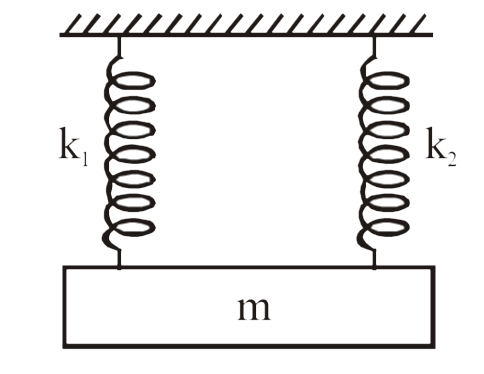
A mass is suspended separately by two different springs in successive order, then time periods is `t_(1) "and" t_(2)` respectively. It is connected by both springs as shown in fig. then time period is `t_(0)`. The correct relation is

A

`t_(0)^(2) = t_(1)^(2) + t_(2)^(2)`

B

`t_(0)^(-2) = t_(1)^(-2) + t_(2)^(-2)`

C

`t_(0)^(-1) = t_(1)^(-1) + t_(2)^(-1)`

D

`t_(0) = t_(1) + t_(2)`

Text Solution

Verified by Experts

Promotional Banner

Similar Questions

Explore conceptually related problems

A mass m is suspended separately by two different springs of spring constant k_(1) and k_(2) given the time period t_(1) and t_(2) respectively. If the same mass m is shown in the figure then time period t is given by the relation

When a block of mass m is suspended separately by two different springs have time period t_(1)" and "t_(2) . If same mass is connected to parallel combination of both springs, then its time period is given by :-

A mass is suspended separately by two springs of spring constants k_(1) and k_(2) in successive order. The time periods of oscillations in the two cases are T_(1) and T_(2) respectively. If the same mass be suspended by connecting the two springs in parallel, (as shown in figure) then the time period of oscillations is T. The correct relations is

The time period of a simple pendulum, in the form of a hollow metallic sphere, is T. When it is filled with sand and mercury, then its time periods are T_(1) and T_(2) respectively. When it is partially filled with sand then its time period is T_(3) . The correct relation between T_(1), T_(2) & T_(3) will be

A mass is suspended separately by two springs and the time periods in the two cases are T_(1) and T_(2) . Now the same mass is connected in parallel (K = K_(1) + K_(2)) with the springs and the time is suppose T_(P) . Similarly time period in series is T_(S) , then find the relation between T_(1),T_(2) and T_(P) in the first case and T_(1),T_(2) and T_(S) in the second case.

A mass m is suspended from the two coupled springs connected in series. The force constant for springs are k_(1) "and" k_(2). The time period of the suspended mass will be

A mass m is suspended from the two coupled springs connected in series. The force constant for spring are k_(1) and k_(2) . The time period of the suspended mass will be:

A mass is suspended at the end of a spring and performs SHM with a time period 3 seconds, while the time period f same mass with other spring is 4 second. If that mass is connected with the combination of the two springs connected in series then time period of oscillator is

A body of mass m is suspended from three springs as shown in figure. If mass m is displaced slightly then time period of oscillation is

