



Home
Class 11
PHYSICS
In a hollow spherical shell, potential (...

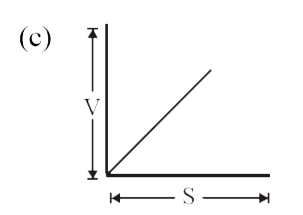
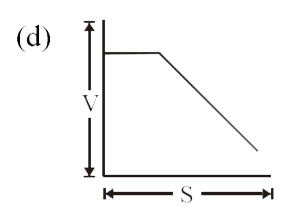
In a hollow spherical shell, potential (V) changes with respect to distance (s) from centre as

A

B

C

D

Text Solution

Verified by Experts

Promotional Banner

Topper's Solved these Questions

Similar Questions

Explore conceptually related problems

In side a hollow spherical shell

In side a hollow isolated spherical shell-

Two concentric speherical shells are as shown in figure. The magnitude of gravitational potential (V) and field strength (E ) vary with distance ( r) from centre as

Inside a hollow charged spherical conductor the potential Is constant Varies directly as the distance from the centre Varies inversely as the distance from the centre Varies inversely as the square of the distance from the centre

The electrostatic potential of a uniformly charged thin spherical shell of charge Q and radius R at a distance r from the centre

Both question (33) and (34) refer to the system of charges as shown in the figure. A spherical shell with an inner radius 'a' and an outer radius 'b' is made of conducting material. A point charge +Q is placed at the centre of the spherical shell and a total charge -q is placed on the shell. Assume that the electrostatic potential is zero at an infinite distance from the spherical shell. The electrostatic potential at a distance R(a lt R lt b) from the centre of the shell is

There are two concentric hollow conducting spherical shells of radii r and R ( R gt r) . The charge on the outer shell is Q. What charge should be given to the inner shell, so that the potential at a point P , at a distance 2R from the common centre is zero ?

If the potential at the centre of a uniformly charged hollow sphere of radus R is V, then electric field at a distance r from the centre of sphere will be (rgtR) .

A solid conducting sphere, having a charge Q, is surrounded by an uncharged conducting hollow spherical shell. Let the potential difference between the surface of the solid sphere and that of the outer surface of the hollow shell be V. If the shell is now given a charge of -4 Q, the new potential difference between the same two surfaces

DISHA-ELECTROSTATIC POTENTIAL AND CAPACITANCE-PHYSICS
  1. A unit charge moves on an equipotential surface from a point A to poin...

    Text Solution

    |

  2. Identify the false statement

    Text Solution

    |

  3. In a hollow spherical shell, potential (V) changes with respect to dis...

    Text Solution

    |

  4. The 1000 small droplets of water each of radius r and charge Q, make a...

    Text Solution

    |

  5. The work done in carrying a charge Q(1) once round a circle of radius ...

    Text Solution

    |

  6. A parallel plate condenser is filled with two dielectrics as shown. Ar...

    Text Solution

    |

  7. Two metal pieces having a potential difference of 800V are 0.02 m apar...

    Text Solution

    |

  8. A one microfarad capacitor of a TV is subjected to 4000 V potential di...

    Text Solution

    |

  9. An uncharge parallel plate capacitor having a dielectric of dielectric...

    Text Solution

    |

  10. In the circuit given below, the charge in muC, on the capacitor having...

    Text Solution

    |

  11. Two concentric, thin metallic spheres of radii R(1) and R(2) (R(1) gt ...

    Text Solution

    |

  12. An alpha-particle is accelerated through a.p.d of 10^(6) volt the K.E....

    Text Solution

    |

  13. Four point charges -Q, -q, 2q and 2Q are placed, one at each corner of...

    Text Solution

    |

  14. A parallel plate capacitor having a separation between the plates d, p...

    Text Solution

    |

  15. Two condensers, one of capacity C and the other of capacity C//2 are c...

    Text Solution

    |

  16. A, B and C are three points in a unifrom electric field. The electric ...

    Text Solution

    |

  17. Three capacitors are connected in the arms of a triangle ABC as shown ...

    Text Solution

    |

  18. Two parallel metal plates having charges +Q and -Q face each other at ...

    Text Solution

    |

  19. An air capacitor C connected to a battery of e.m.f. V acquires a charg...

    Text Solution

    |

  20. Choose the wrong statement about equipotential surfaces.

    Text Solution

    |