Home
Class 11
PHYSICS
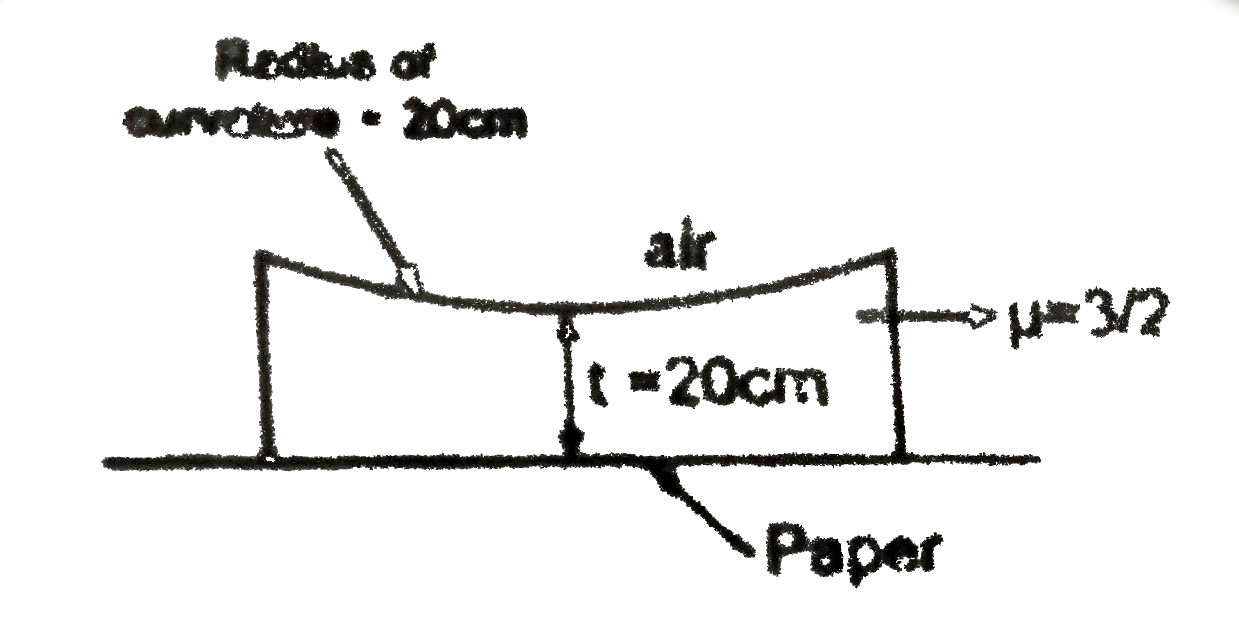
In the given figure a plano-concave lens...

In the given figure a plano-concave lens is placed on a paper on which a flower is drawn. How far above its actual position does the flower appear to be ?

A

10 cm

B

15 cm

C

50 cm

D

None of these

Text Solution

Verified by Experts

Promotional Banner

Topper's Solved these Questions

  • PHYSICAL WORLD, UNITS & MEASUREMENT

    DISHA|Exercise physics|45 Videos
  • SEMICONDUCTOR

    DISHA|Exercise PHYSICS|45 Videos

Similar Questions

Explore conceptually related problems

In Figure, a fish watcher watches a fish through a 3.0 cm thick glass wall of a fish tank. The watcher is in level with the fish, the index of refraction of the glass is 8//5 and that of the water 4//3 . a. To the fish, how far away does the watcher appear to be ? b. To the watcher, how far away does the fish appear to be ?

The word ‘’KVPY’’ is written on a board and viewed through different lense such that board is at a distance beyond the focal length of the lens. lgnorging magnification effects, consider the following statements (I) Image (i) has been viewed from the planar side of a plano-convex lens and image (ii) from the convex side of a plano-convex lens. (II) Image (i) has been viewed from the concave side of a plano-concave lens and image (ii) from the planar side of a plano-convex lens. (iii) Image (i) has been viewed from the cocave side of a plano-concave lens and image (ii) from the planar side of a plano-convex lens. (iv) Image (i) has been viewed from the planar side of a plano-concave lens and image (ii) from the convex side of a plano-convex lens. Which of the above statements are correct ?

The word ‘’KVPY’’ is written on a board and viewed through different lense such that board is at a distance beyond the focal length of the lens. lgnorging magnification effects, consider the following statements (I) Image (i) has been viewed from the planar side of a plano-convex lens and image (ii) from the planar side of a plano-convex lens. (II) Image (i) has been viewed from the concave side of a plano-concave lens and image (ii) from the convex side of a plano-convex lens. (iii) Image (i) has been viewed from the cocave side of a plano-concave lens and image (ii) from the planar side of a plano-convex lens. (iv) Image (i) has been viewed from the planar side of a plano-concave lens and image (ii) from the convex side of a plano-convex lens. Which of the above statements are correct ?

The power of a plano-convex lens is P. If this lens is cut longitudinally along its principal axis into two equal parts and then they are joined as given in the figure. The power of combination will be :

A hemispherieal paper weight contains a small flower on its axis of symmetry at a distance of 4 cm from its flat surface. Where is the flower appears to an observer when he looks at it along the axis of symmetry from the top? (Index of refraction of glass = 1.5)

Where does triple fusion take place in a flowering plant? Why is it so called? Mention its significance.

In which part of the female flower does fertilisation take place?

DISHA-RAY OPTICS AND OPTICAL INSTRUMNTS-PHYSICS
  1. Which of the following is not due to total internal reflection ?

    Text Solution

    |

  2. A body is located on a wall. Its image of equal size is to be obtained...

    Text Solution

    |

  3. A concave mirror forms the image of an object on a screen. If the lowe...

    Text Solution

    |

  4. A ray of light passes through an equilateral prism (refractive index 1...

    Text Solution

    |

  5. The power of a biconvex lens is 10 dioptre and the radius of curvature...

    Text Solution

    |

  6. A microscope is focused on a mark on a piece of paper and then a slab ...

    Text Solution

    |

  7. What causes chromatic aberration?

    Text Solution

    |

  8. The graph between angle of deviation (delta) and angle of incidence (i...

    Text Solution

    |

  9. The ratio of thickness of plates of two transparent medium A and B is ...

    Text Solution

    |

  10. A rectangular block of glass is placed on a mark made on the surface o...

    Text Solution

    |

  11. If a glass prism is dipped in water, its dispersive power

    Text Solution

    |

  12. In the given figure a plano-concave lens is placed on a paper on which...

    Text Solution

    |

  13. To get three images of a single object, one should have two plane mirr...

    Text Solution

    |

  14. Light propagates with speed of 2.2 xx 10^( 8) m//s and m/s 2.4 xx10 ^(...

    Text Solution

    |

  15. A thin convergent glass lens (mug=1.5) has a power of +5.0D. When this...

    Text Solution

    |

  16. A ray of light travelling inside a rectangular glass block of refracti...

    Text Solution

    |

  17. A small coin is resting on the bottom of a beaker filled with a liquid...

    Text Solution

    |

  18. A ray PQ incident on the refracting face BA is refracted in the prism ...

    Text Solution

    |

  19. When a biconvex lens of glass having refractive index 1.47 is dipped i...

    Text Solution

    |

  20. Show that the angle of deviation produced by a thin prism is reduced t...

    Text Solution

    |

