Home
Class 12
PHYSICS
The fig. shows the variation of photon c...

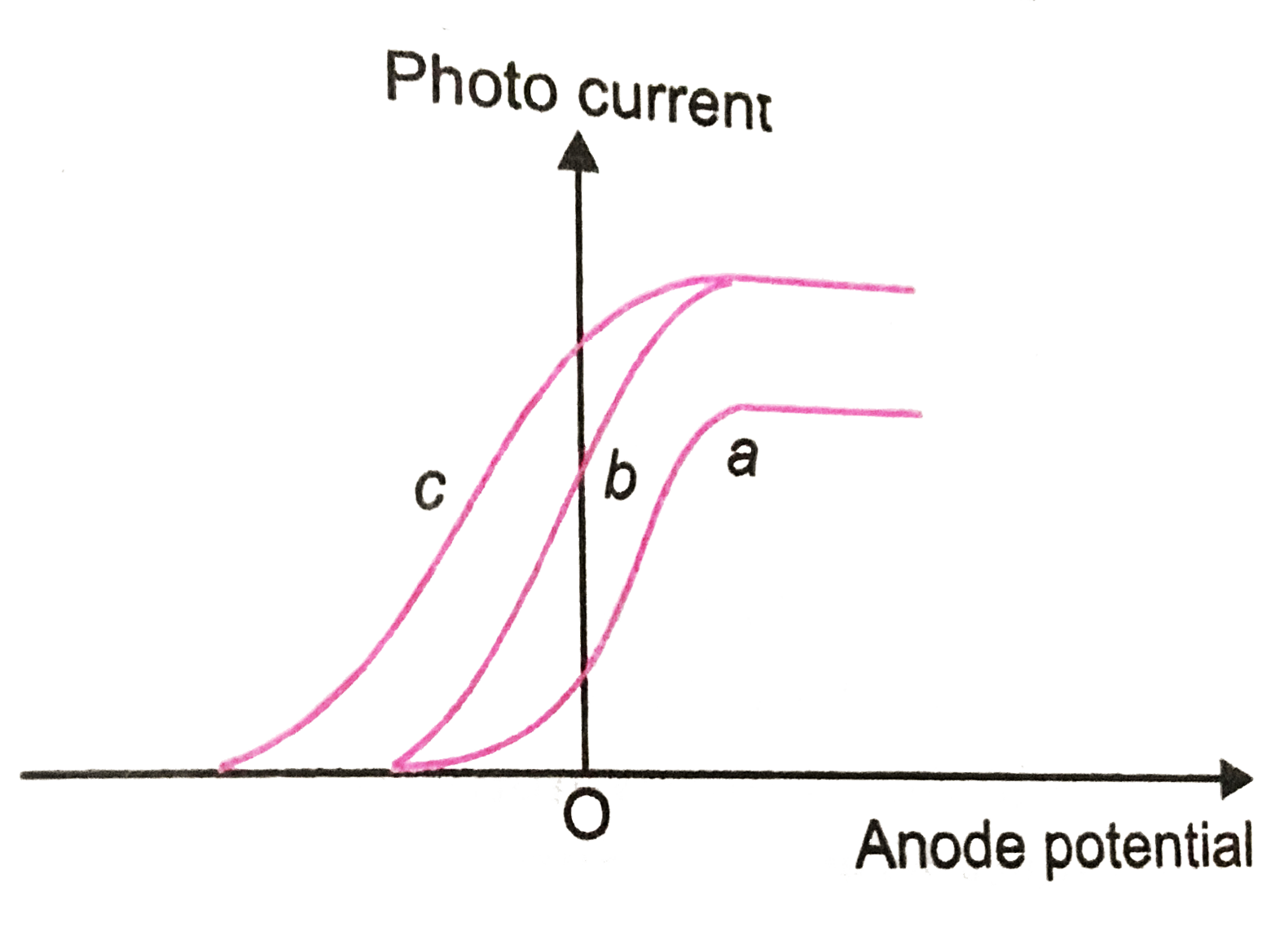
The fig. shows the variation of photon current with anode potential for a photo-sensitive surface for three different radiation. Let `I_(a), I_(b) and I_(c)` be the intensities and `f_(a), f_(b) and f_(c)` be the frequency for the curves a,b and c respectively.

A

`f_(a)=f_(b)` and `f_(a)cancel=I_(b)`

B

`f_(a)=f_(c)` and `I_(a)=I_(c)`

C

`f_(a)=f_(b)` nd `I_(a)=I_(b)`

D

`f_(a)=f_(b)` and `I_(a)=I_(c)`

Text Solution

Verified by Experts

Promotional Banner

Topper's Solved these Questions

  • CURRENT ELECTRICITY

    DISHA|Exercise Physics|50 Videos
  • ELECTROMAGNETIC INDUCTION

    DISHA|Exercise Physics|55 Videos

Similar Questions

Explore conceptually related problems

In the following figure shows the variation of photocurrent with potential of the collector plate for a photosensitive surface for three different radiations. Let I_(a), I_(b) and I_(c) be the intensities and f_(a), f_(b) and f_(c) be the frequencies for the curves a, b, and c, respectively.

The figure shows the variation of photocurrent with anode potential for a photosensitve surface for three different radiations. Let l_a, l_b and l_c be the curves a, b and c, respectively (a) f_a = f_b and l_a != l_b (b) f_a = f_c and l_a = l_c (c ) f_a = f_b and l_a = l_b (d) f_b = f_c and l_b = l_c

The figure shows a plot of photo current versus anode potential for a photosensitive surface for three different radiations. Which one of the following is a correct statement ?

The Fig shows a plot of three curves a, b, c showing the variation of photocurrent versis collector plate potential for the different intensities I_1, I_2 and I_3 having frequencies v_1, v_2 and v_3 respectively, incident on a photosensitive surface. Point out the two curves for which the incident radiation have same frequency but different intensities.

If f is a bijection and g is the inverse of f ,then fog=I_(B and gof=I_(A) where I_(A) and I_(B) are ) the identively. respectively.

In a plot of photoelectric current versus anode potential, how does (i) the saturation current vary with anode potential for incident radiations of different frequencies but same intensity? (ii) the stopping potential vary for incident radiations of different intensities but the same frequency? (iii) Photoelectric current vary of different intensities but same frequency of incident radiation? justify your answer is each case.

DISHA-DUAL NATURE OF MATTER AND RADIATION-Physics
  1. A hydrogen atom moving at a speed v absorbs a photon of wavelength 122...

    Text Solution

    |

  2. The de-Broglie wavelenght of an electron is 0.2 overset(@)A. Calculate...

    Text Solution

    |

  3. A photon and an electron have equal energy E . lambda("photon")//lambd...

    Text Solution

    |

  4. In a photoemissive cell, with exciting wavelength lambda, the faster e...

    Text Solution

    |

  5. Which of the following figure represents the variation of particle mom...

    Text Solution

    |

  6. The work function for the surface of aluminium is 4.2 eV. What will be...

    Text Solution

    |

  7. Slope of V(0)-v curve is- (where V(0)= Stopping potential and v=freq...

    Text Solution

    |

  8. An AIR station is broadcasting the waves of wavelength 300 metres. If ...

    Text Solution

    |

  9. A metal surface of work function 1.07 eV is irradiated with light of w...

    Text Solution

    |

  10. The fig. shows the variation of photon current with anode potential fo...

    Text Solution

    |

  11. An electromagnetic radiation of frequency 3xx10^(15) cycles per second...

    Text Solution

    |

  12. Ultraviolet light of wavelenght 280 nm is used in an experiment on pho...

    Text Solution

    |

  13. The separation between Bragg's planes in a crystal is 10overset(@)A. T...

    Text Solution

    |

  14. Electrons are accelerated in television tubes through potential differ...

    Text Solution

    |

  15. A physicist wishes to eject electrons by shining light on a metal surf...

    Text Solution

    |

  16. A physicist wishes to eject electrons by shining light on a metal surf...

    Text Solution

    |

  17. A physicist wishes to eject electrons by shining light on a metal surf...

    Text Solution

    |

  18. Assertion : Mass of moving photon varies inversely as the wavelength ....

    Text Solution

    |

  19. Assertion : Photosensitivity of a metal is high if its work function i...

    Text Solution

    |

  20. Assertion : The de - Broglie wavelength of a molecule varies inversely...

    Text Solution

    |

